

Executive Action: "A Shabby Fiction about JFK"



Money Quotes:
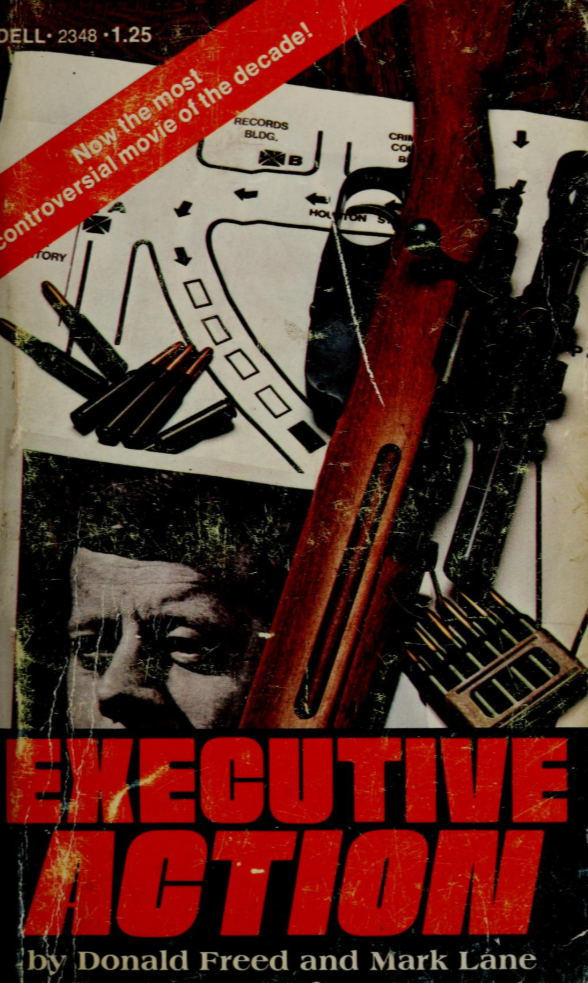
However, even to people who are prepared to accept some sort of conspiracy, including myself, this manner of fiction simply isn't good enough. In spite of the rather pious, unexciting, low-keyed professionalism with which "Executive Action" has been put together, it is fiction of a gross and shabby order. Because it cannot say that this is true, the only point of the film is to raise the question of possibility. Having done that, which is does very quickly, it reduces one of the most turbulent events in American history to the dimensions of routine melodrama. This sort of thing seems very sad, if not reckless.
and
He [Richard Popkin] points out, correctly, I believe, that the Watergate revelations may have made many Americans receptive to the idea that conspiracies can and do exist at high levels of power and influence in the United States. But that is hardly justification for the bogus history offered by "Executive Action," the heavily-footnoted novel as well as the over-simplified film.
JFK assassination researcher Fred Newcomb wrote a critique of the film:




Money Quotes:
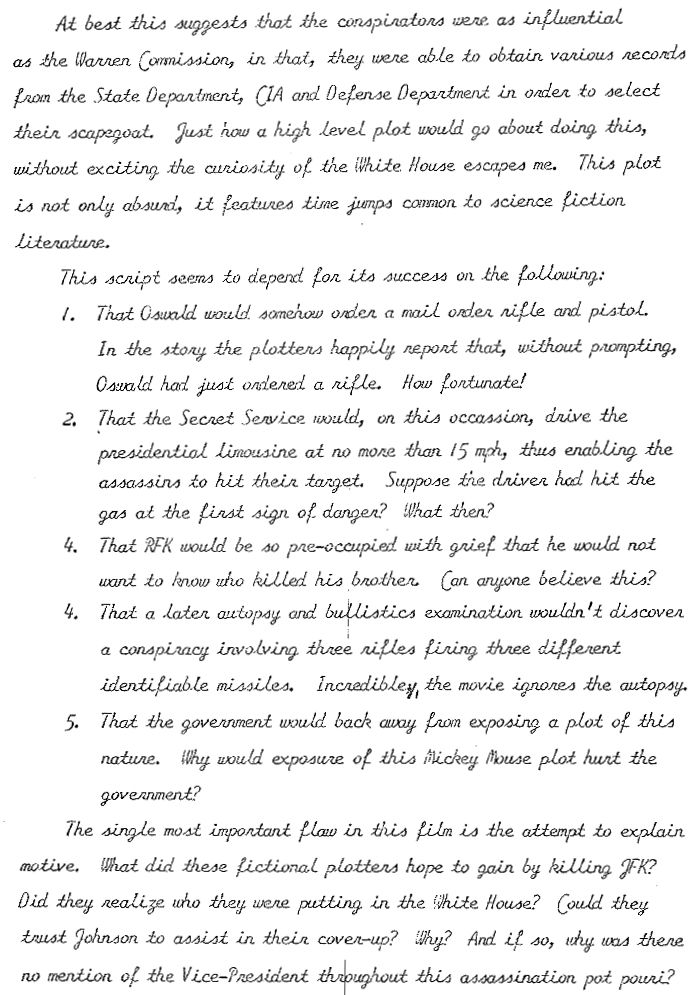
Any plot that hinges, as this one did, on two riflemen gaining access to two buildings, minutes before the motorcade arrives, is a plot that depends for its success upon blind luck. What this plot lacks in sophistication it makes up for in cheap spy thriller dialogue.
and
At another point, the plotters fear that JFK would lead a revolution to gain rights for blacks and cite this as a reason for his removal. One was left to wonder how these same plotters viewed Johnson's subsequent assistance to the cause of civil rights. Would they now start plotting to kill Johnson?
and
The story implies that Oswald was set-up as a scapegoat to take the blame for an assassin firing from his place of employment. Police, apparently, would rush into the building after the shooting to arrest Oswald, while the real assassin slipped away. So far so good. However, in this film there we see a second rifleman (the Records Building) across the way, firing from a building that apparently contained no scapegoat. What if Dallas police had surrounded the second building? Was there a second scapegoat? Was there a third scapegoat on the grassy knoll? The script compounds these problems by missing the point. Or did they conceive a plot involving three Lee Harvey Oswalds hanging around Dealey Plaza that day?
and
The fictional assassination team, for some unexplained reason, was training to accomplish their feat in six or seven seconds. Why not 30 seconds? Is this because an amateur film of the actual assassination taken by Abraham Zapruder showed a six second assassination Had the fictional assassins already seen the Zapruder film?
and
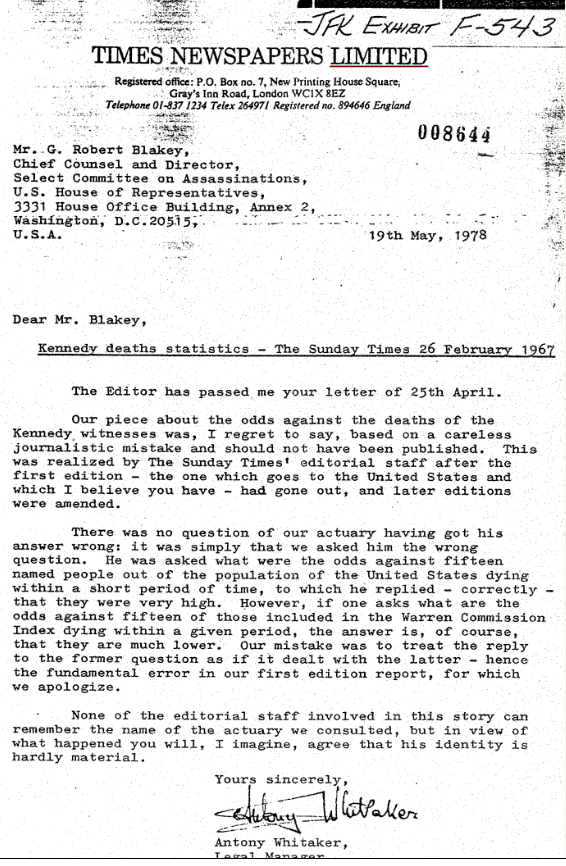
Alas, the movie ended in a pyroxism of paranoia in attempting to show that witnesses to the event have been systematically eliminated (further assassinations) by this same plot. The number of people were were witnesses to the death of JFK, Oswald and Officer Tippit, or who were associated with the investigation of these deaths, numbered in the thousands. Why is is strange that 18 have died "six by gunfire, three in motor accidents, two by suicide, one from a cut throat, one from a karate chop to the neck, three from heart attacks and two from natural causes?" Three from heart attacks and two from natural causes? Since when are heart attacks classified as unnatural deaths? Why not list Lyndon Johnson, Robert Ryan and several others who have passed away in the last ten years as long as you are mentioning natural causes?
The last quote was referring to this excerpt from the book:



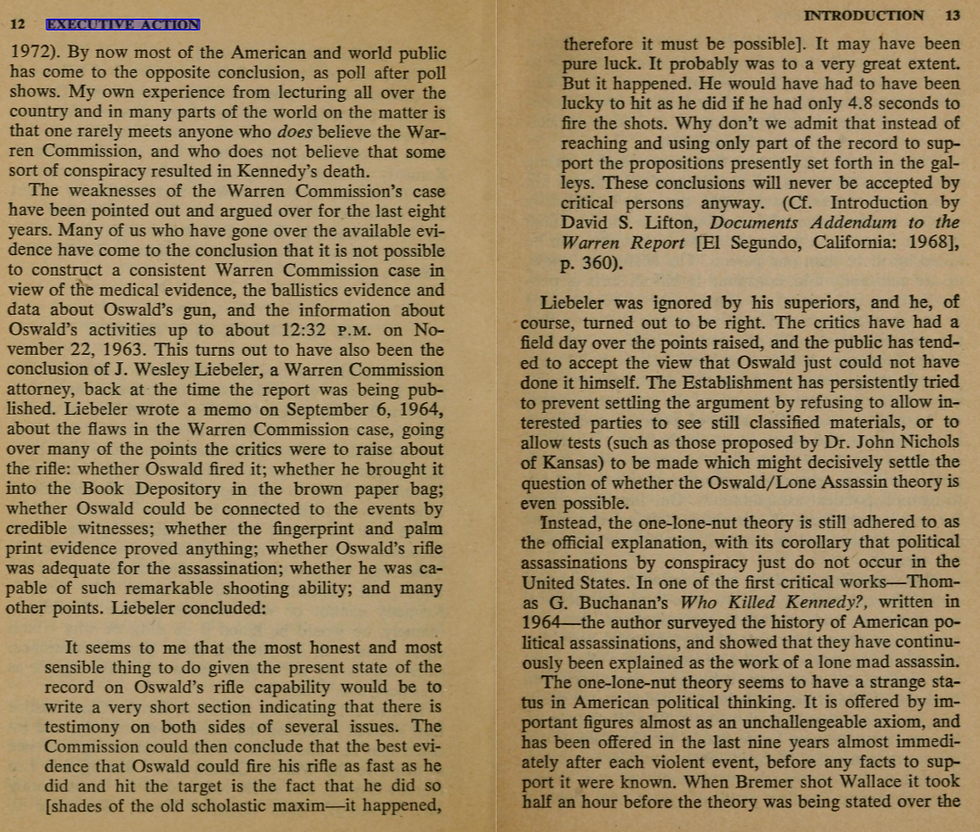


The Onassis story is a hoot (on page 23 of the Popkin excerpt). What happened to his private safe? The opening of his safe might make for a very good Geraldo Rivera show.
Previous Relevant Blog Posts on Mark Lane
Lane cuts out a few of Reynolds' answers.
Sylvia Meagher was incensed at Lane's inclusion of this story in his film.
A good case study in Lane's intellectual dishonesty.
Robert Blakey and the HSCA were very critical of Mark Lane.
Mark Lane and the HSCA.
An interesting anecdote from Mort Sahl's book, Heartland.
Some ads for Lane's film Rush to Judgment.
A Garry Wills opinion piece on Mark Lane.
Navasky tests Lane's book and finds it wanting.
A New York Times profile of Lane and his involvement with Jonestown.
An apt profile.
An opinion piece by Anthony Lewis in the New York Times on Mark Lane and Jonestown.
An opinion piece from the Washington Post
A good opinion piece from the Philadelphia Bulletin.
Meagher tells Labro a story about Mark Lane.
Even a left-wing magazine like The Progressive found Mark Lane hard to take.
Mark Lane's addition to the 1992 edition of Rush to Judgment is eye opening.
Lane tells Dolan about Garrison's amazing evidence.
Lane makes a startling allegation.
A profile from Mother Jones magazine.
Lane and Meagher feuded about a blurb for her book.
A profile from Esquire Magazine.
An article from the Tampa Bay Times.
An Anthony Lewis column on Mark Lane from 1978.
Howard Roffman finds that Mark Lane's scholarship is lacking.
A profile of Mark Lane in Newsweek.
Mark Lane offers to introduce Jim Garrison to a witness that, for $25,000, would tie Jack Ruby with Clay Shaw.
This post has a good case study of how Mark Lane exploited a redaction in a document.
Lane tells the Danish press he knows who killed JFK.
Lane speaks at the Louisiana State Bar Association.

