

Mark Lane and Napoleon Daniels

Updated: Mar 18
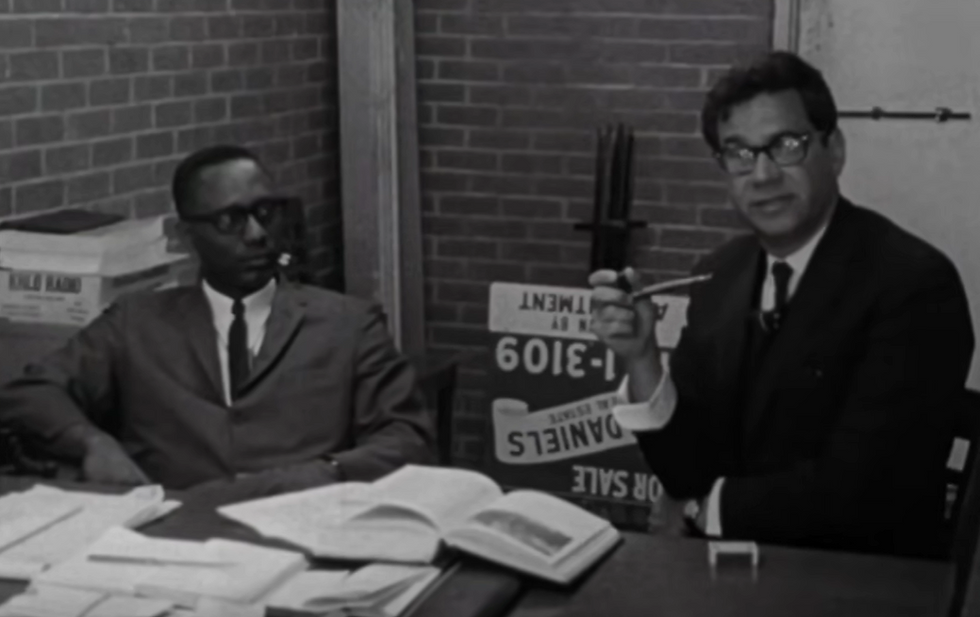
Napoleon Daniels was a Dallas police officer who claimed that he saw officer Roy Vaughn allow Jack Ruby to walk down the Main Street ramp.
Vaughn called Daniels at home on the Monday morning after the assassination:


A couple of things to note. Daniels writes that the person going down the ramp came from the direction of the Western Union office, which is where Ruby would have been coming from, but Daniels said he was not wearing a hat, and, of course, Ruby wore a hat.
He also said that "I did not see Officer Vaughn challenge this person nor did he show any signs of recognizing him, nor even being aware that he was passing, but I know that he saw him. It struck me odd at the time that Officer Vaughn did not say something to this man."


Daniels told the FBI that the photo of Jack Ruby "bore a likeness in his mind to the individual he had previously seen at the police department, as well as the individual who walked by him at the Main Street Ramp."

Now Daniels says that "the impression I got was that Vaughn knew him and maybe he had let him out and still, I wondered too why he let him go down in there ..."
This was quite different from his affidavit.


The Dallas police gave Daniels a polygraph, according to office Roy Vaughn: (page 452 of Larry Sneed's No More Silence: An Oral History of the Assassination of President Kennedy)
Maybe a year after this happened, I ran across N. J. Daniels in a restaurant in South Dallas where I was assigned to work. My partner and I were two white officers eating in a black cafe in a totally black area, which was the only place we had to eat. In any case, N. J. Daniels was there. By this time, he had changed his story. He then claimed that I had allowed Ruby to go down that ramp. My understanding was that he was run on a polygraph, and it showed him to be untrue.
Captain Westbrook said that Daniels was dismissed: (page 321 - 322 of No More Silence)
Polygraphs were also run on Napoleon Daniels, who was a former policeman who had been fired for misconduct on duty. He came forth and volunteered information that Ruby stopped and talked to Vaughn and that Vaughn had let him in. Of course, he had an ax to grind and wanted to get even with somebody. Daniels, who was black, had been managing some real estate for somebody and had tried to collect rent while on duty by chasing a fellow while in full uniform. This account was supported by a fellow officer who was also black. So he was dismissed after he failed a polygraph.
It's unclear if the failed polygraph test was in regards to the ramp or to his real estate dealings. James Hosty, in his book Assignment Oswald, says that Daniels was the victim of racism from the Dallas Police, and that Daniels failed the lie detector test because he was threatened.


Here is a excerpt from a transcript:
Mark Lane: We are in the office of Napoleon J. Daniels, a real estate broker in Dallas, Texas. Mr. Daniels, have you been associated with the Dallas police force?
Napoleon Daniels: I was for seven years.
Mark Lane: In what capacity?
Napoleon Daniels: As a patrolman.
Mark Lane: Where were you on November 24 1963
Napoleon Daniels: Well, I was going down to inspect the assassination site around 11 o'clock, I guess. And, I noticed officer Vaughn standing on the Main Street ramp, the city hall, at the basement, and I stopped to go back to talk to him, and I asked him what his purpose was there, and he told me he was keeping anybody from getting in the basement because they were fixing to transfer Oswald.
Mark Lane: How long did you remain in front of the main street ramp with Officer Vaughn?
Napoleon Daniels: Twenty minutes, I guess.
Mark Lane: Did you remain there until you heard a shot?
Napoleon Daniels: I did.
Mark Lane: From 11 o'clock until 11:20, did anyone enter the basement through the main street ramp?
Napoleon Daniels: There's one man about a couple of minutes before Oswald was shot.
Mark Lane: Could you describe that man?
Napoleon Daniels: Yes, he was a white man, about, weighed about 175, and had on a blue suit, about five-nine.
Mark Lane: What was the color of his hair?
Napoleon Daniels: It's brownish, and he's bald, on the top.
Mark Lane: Was there anything else distinctive about the gentleman?
Napoleon Daniels: He had his right hand, his right coat pocket, and something seemed to be protruding from him.
Mark Lane: What was your impression when you saw him enter the basement with his hand in his pocket?
Napoleon Daniels: My first impression was that he had a gun in his pocket. And then I didn't think too much about it, because officer Vaughn didn't challenge him. He just let him go on down in there.
Mark Lane: Did Vaughn indicate any recognition or knowledge of who the person was, when the man passed by him?
Napoleon Daniels: Well, I just assumed he did, because he didn't try to stop him. I assume he knew who he was.
Mark Lane: Did Vaughn allow anyone else to enter the basement other than that one man?
Napoleon Daniels: No.
Mark Lane: How long after that man entered the basement, did you hear a shot?
Napoleon Daniels: Time enough, I guess, for him to walk down in and get settled.
Mark Lane: And then what did you do after you heard the shot, sir?
Napoleon Daniels: Well, I walked out to the center of the entrance and looked down in the basement. And as I looked down, I saw also scuffling with a man that and I got the impression it was the same man, because I saw his right arm, and you know, same color clothing,
Mark Lane: Same color clothing as the man you saw?
Napoleon Daniels: As the man I saw.
Mark Lane: The Federal Bureau of Investigation showed you pictures of Jack Ruby in December 1963, is that correct?
Napoleon Daniels: It is.
Mark Lane: Did you tell the FBI then, that the man in the picture, Jack Ruby, resembled very closely the man you saw enter the basement ramp?
Napoleon Daniels: Right, that's true.
Mark Lane: The Warren Commission said that Jack Ruby did enter the main street ramp, and they indicated that happened between 11 o'clock and 11:20. If Ruby did enter the Main Street ramp between 11 and 11:20, was Jack Ruby the man who you saw enter?
Napoleon Daniels: He'd almost have to be because that's the only man I saw go there ... that's the only one.
Mark Lane: In your opinion, is the man who you saw walk past Vaughn into the basement Jack Ruby?
Napoleon Daniels: The first impression I got, when Oswald was shot is that the guy I had just seen is the one that did it.
Mark Lane: And now that you've seen pictures of Jack Ruby, does that strengthen your original impression that it was Jack Ruby, who you saw enter or weaken it?
Napoleon Daniels: I'd say it'd have to strengthen.
Mark Lane: It strengthens it.
Video clip
Newsman: Chief Curry. would you comment on the presence of Jack Ruby in the basement of City Hall while Lee Harvey Oswald was being transferred? How did he get there?
Chief Curry: Well, of course, it's been pretty well established by this time that he came in the ramp entrance on the main street entrance, and the officer who was guarding this door had stepped away to permit a vehicle to come out. It wasn't necessary that he do this, but he had stepped across the sidewalk to assist a vehicle coming out of the basement. And that's when Ruby came into the basement. And this was less than two minutes before Oswald was brought down.
Mark Lane: Where was officer Vaughn standing when this man entered past him?
Napoleon Daniels: He's standing right inside the entrance to the basement.
Mark Lane: And what was his responsibility or obligation that day, do you know?
Napoleon Daniels: To not let anyone go down...
Mark Lane: Have you any idea why he allowed this man to enter past him?
Napoleon Daniels: No, I don't know, other than just he knew who he was, or something known as what I thought at the time, he had to know who he was.
Mark Lane: Did officer Vaughan look at the man who walked past him?
Napoleon Daniels: He looked in his direction, yes.
Sylvia Meagher was not impressed with the scene with Daniels. Here is an excerpt from a letter she wrote to Raymond Marcus, dated December 20, 1966

I agree with Meagher that Lane's use of Daniels is dishonest. Lane spent several pages discussing Daniels in his book, but leaves out a lot in his film. Viewers of the film would not know that Daniels changed his story.
Hosty might well have been right, but Lane's dishonesty and the mistreatment of Daniels are not mutually exclusive.
Previous Relevant Blog Posts on Mark Lane
A good case study in Lane's intellectual dishonesty.
Robert Blakey and the HSCA were very critical of Mark Lane.
Mark Lane and the HSCA.
An interesting anecdote from Mort Sahl's book, Heartland.
Some ads for Lane's film Rush to Judgment.
A Garry Wills opinion piece on Mark Lane.
Navasky tests Lane's book and finds it wanting.
A New York Times profile of Lane and his involvement with Jonestown.
An apt profile.
An opinion piece by Anthony Lewis in the New York Times on Mark Lane and Jonestown.
An opinion piece from the Washington Post
A good opinion piece from the Philadelphia Bulletin.
Meagher tells Labro a story about Mark Lane.
Even a left-wing magazine like The Progressive found Mark Lane hard to take.
Mark Lane's addition to the 1992 edition of Rush to Judgment is eye opening.
Lane tells Dolan about Garrison's amazing evidence.
Lane makes a startling allegation.
A profile from Mother Jones magazine.
Lane and Meagher feuded about a blurb for her book.
A profile from Esquire Magazine.
An article from the Tampa Bay Times.
An Anthony Lewis column on Mark Lane from 1978.
Howard Roffman finds that Mark Lane's scholarship is lacking.
A profile of Mark Lane in Newsweek.
Mark Lane offers to introduce Jim Garrison to a witness that, for $25,000, would tie Jack Ruby with Clay Shaw.
This post has a good case study of how Mark Lane exploited a redaction in a document.
Lane tells the Danish press he knows who killed JFK.
Lane speaks at the Louisiana State Bar Association.

