

Mark Lane and Charles Brehm

Updated: Mar 26


Brehm told the FBI that the "shots came from one of two buildings back at the corner of Elm and Houston Streets."
Mark Lane: Mr. Brehm, where were you on November 22 1963?
Charles Brehm: I had taken my five year old son downtown to see the Presidential parade.
Mark Lane: This is a picture taken by Mr. Nix of the limousine at the time the shots were fired. Do you see yourself and your boy in that picture?

Charles Brehm: Yes, sir. This is myself, and this is my son. On this frame here where the first shot hit the President, I would say that the, he was possibly 30 feet away when the first bullet struck, moved a little closer and was possibly 20 to 25 feet away when the second bullet hit.
Mark Lane: Did you see the effect of the bullets upon the President?
Charles Brehm: When the second bullet hit, there was, the hair seemed to go flying. It was very definite then that he was struck in the head with the second bullet. And
yes, sir, I very definitely saw effects of the second bullet.
Mark Lane: Did you see any particles of the President's skull fly when the bullet struck him in the head?
Charles Brehm: I saw a piece fly over, oh, in the area of the curb where I was standing.
Mark Lane: And in which direction did that fly?
Charles Brehm: It seemed to have have come left and back.
Mark Lane: In other words, the skull particle flew to the left and to the rear of the Presidential limousine.
Charles Brehm: Sir, whatever it was that I saw, did fall both in that direction and over into the curb there.
Mark Lane: You were a ranger during the war, correct?
Charles Brehm: Yes, sir, I was a ranger during the war. Took part in the invasion of France and was shot a couple of times. So, as I say, it's possibly like swimming. I hadn't heard that sound for many a year, but you don't forget it once, once you've heard a shot, coming close to you.
Mark Lane: Did you speak with newsmen on November 22 and tell them what you saw?
Charles Brehm: Yes, sir. And told them simply that there, two shots had hit the president and the direction that I had thought the bullets had come from.
Mark Lane: Did you at any time that day make a statement which was televised?
Charles Brehm: Yes, sir.
Brehm video
Charles Brehm: Fortunately, I was probably 15 to 20 feet away from the president when it happened.
Newsman: Tell us exactly what you saw, sir,
Charles Brehm: He was coming down the street, and my five year old boy and myself were by ourselves on the grass there on Palmer street, and I asked Joe to wave to him, and Joe waved, and I waved in the ...man, (crying)
Newsman: That's all right, sir.
Charles Brehm: He was waving back. He was, he was. the shot rang out, and he slumped down in the seat, and his wife reached up toward him. They were slumping down, and the second shot went off, and it just knocked him down from the seat. I'm positive it had hit him. I hope it didn't, but I'm positive that it hit him, and he went all the way down in the car. Then they speeded up, and I didn't know what was going on, so I just grabbed the boy and fell on him, and hopes there wasn't a maniac around. I can't help you more but I won't forget it.
end of Brehm video
Mark Lane: Did you make a statement to the Dallas sheriff's office?
Charles Brehm: Yes, I did.
Mark Lane: How long did you remain in the Dallas sheriff's office that day?
Charles Brehm: I was, say about three hours to four hours.
Mark Lane: Were you among the closest witnesses to the limousine when the shot struck the President?
Charles Brehm: Yes, sir, I would have to say that, if not the closest, one of the closest to the unfortunate incident. I did get a view of something I'll never forget.
Mark Lane: Were you called as a witness by the Warren Commission?
Charles Brehm: No, I was not called by the Warren Commission to testify.
Lane tries to use Brehm as a grassy knoll witness based on the movement of skull fragments after the head shot. But, as we all know, the head material (skull, scalp, blood, brain tissue, brain fluids) flew upward and forward and only seemed to go back and to left because the limousine was moving forward.

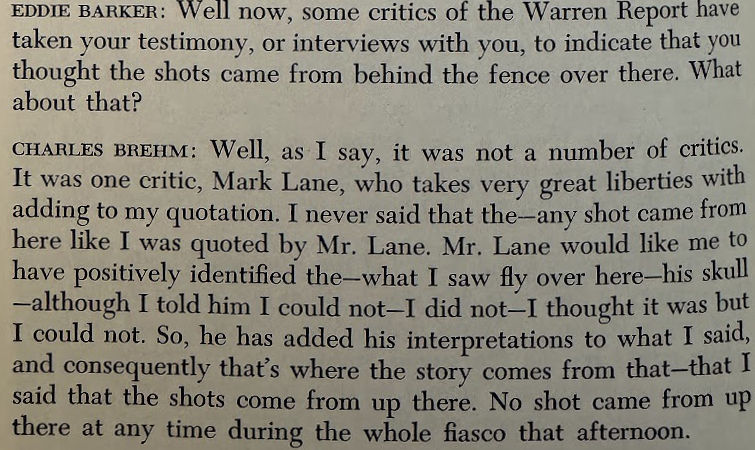
Here is what Brehm thought of Lane's conclusion: (page 61 of The Scavengers and Critics of the Warren Report by Lawrence Schiller and Richard Lewis)

So, why didn't Lane ask Brehm where he thoughts the shots came from?
Well, he DID ask Brehm, but he cut out his answer from the Rush to Judgment film:

Here is what Charles Brehm told CBS News in 1967: (page 284 or Stephen White's book, Should We Now Believe the Warren Report?)
And here is what Charles Brehm told Larry Sneed in his book No More Silence: An Oral History of the Assassination of President Kennedy: (pp. 65-66)
People have mentioned seeing puffs of smoke at the time of the assassination. I saw none whatsoever. The smoke that I created through years of cigar smoking would probably account for a puff of smoke here and a puff of smoke there as I went through life. But I sure didn’t see any puffs of smoke anywhere; nothing other than the three shots from the same area, and that has been identified to me as that particular window as to where they came from. I would agree with it because of the sound factor. But if they told me today that I was all wrong, that they came from the fourth floor, or the seventh floor, I’d have to believe them. But there’s no question in my mind that there were three shots from one source, the Texas School Book Depository, and nothing else from any of the other buildings.
There were no shots from sewers, no shots from the grassy knoll. There were no people hiding around with silencers, which in itself is laughable, because why should this person have a silencer and that person not have a silencer? And if there were nine people, as somebody advocates, why eight people with silencers shooting and only one without one. No, I feel comfortable with myself. I was very uncomfortable until the Warren Report came out because I stood by myself on November 22nd, that night. I came up with the original thought of the single bullet. I said at that time that there were three bullets, and they all came from the same place.
Then all the controversy starts. You don’t know what you’re letting yourself in for in a deal like this. The controversy starts about this or that extra gunman coming from here, coming from there. All of these things go on and you start to doubt yourself. You say, “Hey, am I right on this thing or what?” People are going to show me movies and tapes and things like that of what I said and they’re going to cast doubts. But everything I said was what the Warren Commission said, so I felt that I was clean on it. I felt that they printed the truth of what happened. Conspiracy, before or after, I have no idea. All I know is about those few seconds where I was standing, and that I’m sure of.
I’ve had one experience with Mark Lane where he did the interview by asking the questions off camera. I saw his movie, “Rush To Judgment,” once, and this was less than a year ago. It seems to me that he might have taken poetic justice with some of the questions that he asked or fit my answers to his questions rather than the opposite way of me answering the questions. But that was an unpleasantness because he was the type of person who made you believe that you were helping him when all he was looking for was one piece of junk in that whole new car showroom so he could say, “Ha! Ha! Here’s what! The whole thing is wrong because of this!” And that’s what he was! He was looking for that junk in some shining place so that he could destroy everything that was worthwhile.
Charles Brehm is a good case study of Mark Lane's intellectual dishonesty.
Update:
The Dallas Morning News of November 27, 1966 has a good article on Mark Lane, and they interviewed Charles Brehm:




Previous Relevant Blog Posts on Mark Lane
Robert Blakey and the HSCA were very critical of Mark Lane.
Mark Lane and the HSCA.
An interesting anecdote from Mort Sahl's book, Heartland.
Some ads for Lane's film Rush to Judgment.
A Garry Wills opinion piece on Mark Lane.
Navasky tests Lane's book and finds it wanting.
A New York Times profile of Lane and his involvement with Jonestown.
An apt profile.
An opinion piece by Anthony Lewis in the New York Times on Mark Lane and Jonestown.
An opinion piece from the Washington Post
A good opinion piece from the Philadelphia Bulletin.
Meagher tells Labro a story about Mark Lane.
Even a left-wing magazine like The Progressive found Mark Lane hard to take.
Mark Lane's addition to the 1992 edition of Rush to Judgment is eye opening.
Lane tells Dolan about Garrison's amazing evidence.
Lane makes a startling allegation.
A profile from Mother Jones magazine.
Lane and Meagher feuded about a blurb for her book.
A profile from Esquire Magazine.
An article from the Tampa Bay Times.
An Anthony Lewis column on Mark Lane from 1978.
Howard Roffman finds that Mark Lane's scholarship is lacking.
A profile of Mark Lane in Newsweek.
Mark Lane offers to introduce Jim Garrison to a witness that, for $25,000, would tie Jack Ruby with Clay Shaw.
This post has a good case study of how Mark Lane exploited a redaction in a document.
Lane tells the Danish press he knows who killed JFK.
Lane speaks at the Louisiana State Bar Association.

