

S.M. Holland's "Smoke" on the Grassy Knoll

Updated: Mar 13

There are some serious inconsistencies with S.M. Holland's statements and testimony about his supposed sighting of "smoke" on the grassy knoll.

Holland says that "I heard what I thought for the moment was a fire cracker and he slumped over and I looked over toward the arcade and trees and saw a puff of smoke," and then he heard three more shots. The only puff of smoke he saw came from the first shot.
Which would mean that the fatal head shot would not have come from the grassy knoll, according to Holland.
He also said that "everything is spinning in my head."


The FBI report states that "one of the officers in the front seat of the Presidential car stood up with a machine gun in his hands and was looking back from the car when it immediately speeded up, throwing this officer back across the front seat."
This did not happen. The Secret Service agent who drew his AR-15 was George Hickey in the follow-up car. And he did not fall back on the seat.

Holland located those shots at the southeast corner of the Texas School Book Depository (he wasn't sure how high) and that a later shot came from the knoll and created the smoke. This is not what he said in his initial statement.

Once again, Officer Hargood tried to go up the embankment but he couldn't jump the curb. He left his motorcycle there running and ran up the grassy knoll. Holland clearly saw him and so this was several seconds after the shots.
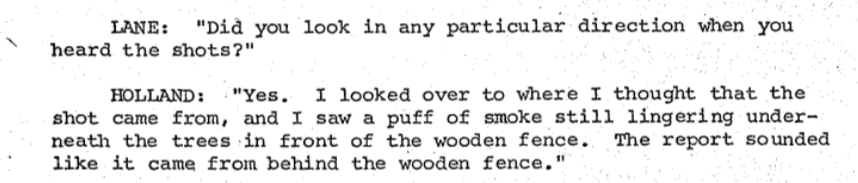
When Holland was interviewed by Mark Lane, his story changed somewhat:

Now Holland is saying the smoke came from the second shot, but not from the third shot which hit JFK in the head. And so the head shot, according to Holland, did not come from the grassy knoll.
But then Holland says something different again:


Now the third shot came from the grassy knoll and the first two shots came from the Texas School Book Depository. It's really hard to understand Holland's sequence of shots.
In 1966, Holland said that the third and fourth shots hit JFK in the head: (pages 85 - 86 in Six Seconds in Dallas)
Thompson: Is it your opinion then ... What is your opinion? That the third and fourth did hit the President?
Holland: My opinion is that the third and the fourth shot did hit the President.
Thompson: In the head?
Holland: In the head.
In any case, the smoke drifted from under the trees:

In fact, the smoke lingered:
Holland was about sixty-five to seventy yards away from where he saw the smoke. The wind was quite strong in Dealey Plaza that afternoon -- so strong that Officer Marrion Baker was blown off his motorcycle.

In addition, the wind might have been even stronger than reports because of the cavernous effect of Dealey Plaza. Vincent Bugliosi talked to Willie Brown, a meteorologist in Asheville, North Carolina:
I've been to Dealey Plaza, and as you know there are many tall buildings in the area. When the wind, like water, is funneled through a smaller channel -- here, between buildings -- the wind will always speed up, sometimes considerably. You're forcing the same volume of air through a smaller area. It's simple physics. In a water example, a wide river may not flow rapidly, but when funneled through a narrow canyon its velocity pics up immediately.
S. M. Holland saw a few things that did not happen -- the Secret Service agent pulling his AR-15 in the Presidential car, and a motorcycle going up the embankment. Perhaps he also got the smoke wrong.
In all likelihood, a lot of what Holland saw melded in his mind. There were several ways he could have seen some smoke -- from cigarettes, from an exhaust pipe, or perhaps steam. Remember the assassination happened quickly and human beings are not video recorders.
Here is what Holland told Josiah Thompson: (page 72 in Last Second in Dallas)
Right under these trees, right at that exact spot, about ten or fifteen feet from this corner, the corner of the fence here, back this way right under this clump of trees, right under this tree ... That's where it was, just like somebody had clump [sic] a firecracker out and leave a little puff of smoke there; it was just laying there. It was white smoke. It wasn't black smoke or like a black powder. It was like a puff of a cigarette.
Yes, it was "like a puff of a cigarette."
Thompson was with Ed Kern of Life Magazine and while Holland denied it was cigarette smoke, here is what he said when they asked him about modern-day guns and ammunition, which shouldn't leave smoke:
The powder still fires. Now I know this much about hunting and guns: the smoke is not near like it was ten years ago. When you shoot you see a black puff of smoke ... just like a steam engine. They have it refined now. But you fire a gun, any gun, from a light underneath this shade you'll see a puff of smoke that'll linger there. It'll be, just like I say, dim, like a cigarette ....
Now Holland says a gun will emit black smoke but he saw white smoke on the knoll, And, once again, he brings up a cigarette. And, of course, he told Thompson that he noticed "three, four, or five cigarette butts" behind the fence.
It is interesting that Thompson was with Ed Kern from Life Magazine but he doesn't mention anything in Last Second in Dallas about the rifle test his reporters had done -- nor does Thompson say anything about Kern's conclusion that Holland's story was a "picturesque invention after the fact."
Todd Vaughan has another possibility. He recently wrote on Facebook:
I just reviewed my very clear digital copy of the Bell film. It appears both the Presidential Limousine and the Secret Service Follow-Up cars are giving off very visible smoke as they accelerate toward and through the Triple Underpass.
Holland was still watching when this happened. Could he have seen smoke from the limousine and just thought it was from the knoll?
I'll conclude once again, with this paragraph from Stephen White's book, Should We Now Believe the Warren Report?: (page 67)

Previous Relevant Blog Posts on Smoke on the Grassy Knoll
Reporters for Life did a test and discounted the possibility that Holland saw rifle smoke on the knoll.
Davis thought the smoke was from a motorcycle.
Holland says he might have seen smoke from a cigarette.
Dodd told the FBI he did not know where the shots came from.
His location of smoke was very close to a steampipe.
Simmons thought the shots came from the TSBD.
He saw smoke but was it from a rifle?
Walter Winborn saw smoke on the grassy knoll, but was it from a rifle?
Previous Relevant Blog Posts on Mark Lane
Mark Lane and the HSCA.
An interesting anecdote from Mort Sahl's book, Heartland.
Some ads for Lane's film Rush to Judgment.
A Garry Wills opinion piece on Mark Lane.
Navasky tests Lane's book and finds it wanting.
A New York Times profile of Lane and his involvement with Jonestown.
An apt profile.
An opinion piece by Anthony Lewis in the New York Times on Mark Lane and Jonestown.
An opinion piece from the Washington Post
A good opinion piece from the Philadelphia Bulletin.
Meagher tells Labro a story about Mark Lane.
Even a left-wing magazine like The Progressive found Mark Lane hard to take.
Mark Lane's addition to the 1992 edition of Rush to Judgment is eye opening.
Lane tells Dolan about Garrison's amazing evidence.
Lane makes a startling allegation.
A profile from Mother Jones magazine.
Lane and Meagher feuded about a blurb for her book.
A profile from Esquire Magazine.
An article from the Tampa Bay Times.
An Anthony Lewis column on Mark Lane from 1978.
Howard Roffman finds that Mark Lane's scholarship is lacking.
A profile of Mark Lane in Newsweek.
Mark Lane offers to introduce Jim Garrison to a witness that, for $25,000, would tie Jack Ruby with Clay Shaw.
This post has a good case study of how Mark Lane exploited a redaction in a document.
Lane tells the Danish press he knows who killed JFK.
Lane speaks at the Louisiana State Bar Association.

