

Life Magazine's Interview with George Davis

Updated: Mar 13
George Davis was another one of the railroad men who watched the motorcade on November 22nd from the triple overpass.

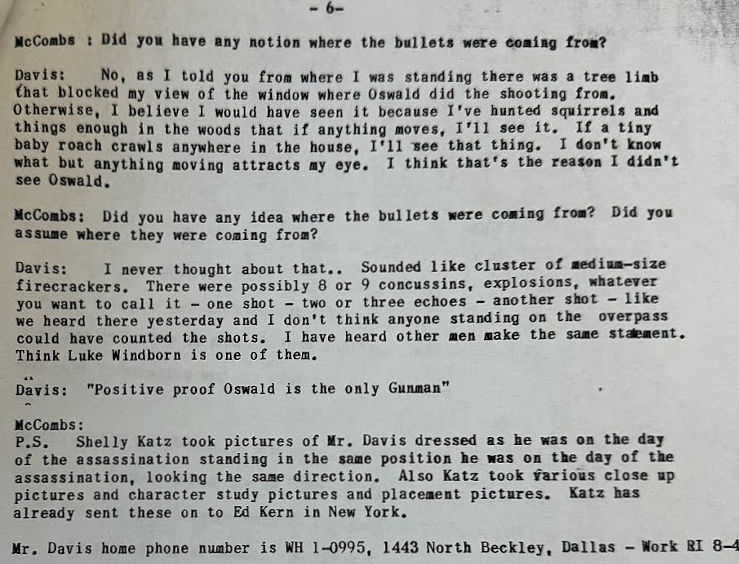
In 1966, Life Magazine briefly started investigating the JFK assassination and they looked into the issue of smoke on the grassy knoll. As part of their investigation, Holland McCombs, one of their reporters, interviewed George Davis:


Davis says that "one of the policemen that was riding in the rear of the President's car on the motorcycle took off up the embankment -- headed north right up the slope and as I remember he went almost to the top of it -- and the motorcycle was putting out blue smoke as it was going us this embankment. He got off of it and kinda laid the motorcycle on its side still puffing, blue smoke still coming up."
Now, this did not happen but Officer Haygood did stop his motorcycle at the edge of the embankment. This must have been what Davis saw -- and I should add that both S. M. Holland and Lee Bowers also say they saw a motorcycle go up the embankment. They were all wrong.
Officer Haygood said he tried to jump the curb, but had trouble -- and this maneuver may have contributed to excessive throttle and might have caused smoke. And blue smoke from a Harley-Davidson motorcycle in 1963 was not uncommon.
In addition, as the motorcade began to accelerate toward the Triple Underpass after the shots were fired, officers gunned their engines to catch up. A sharp twist of the throttle on a 1963 Panhead frequently caused a "burp" of blue-white oil smoke.
On November 22, the wind was quite strong and was blowing generally from the southwest/west. This could carry the exhaust smoke from the motorcycles on Elm Street toward the very trees on the Grassy Knoll where witnesses reported seeing "puffs."
I don't want to make the claim the railroad men saw exhaust smoke, but it's a possibility. Holland, Bowers and Davis all thought they saw Haygood's motorcycle go up the embankment, and so, while they were all wrong, they were still watching what was going on on Elm Street. The exhaust smoke could have melded in Holland's memory about what he had just witnessed.


Davis says that "Mr. Bowers would have seen a man with gun of any kind standing there. He said there was no human being on the north side of the fence. I think that pretty well clears that thing up."

Davis says the smoke lasted a "minute, minute and a half at most." Smoke from a rifle wouldn't linger for that period of time.
The railroad workers came up with a variety of explanations for the smoke -- some thought it was steam; some thought it was motorcycle exhaust; and some thought it might have been from cigarettes.
There is no reason to believe it came from a rifle shot.
One last word about memory, and this comes from Stephen White's book, Should We Now Believe the Warren Report?: (pages 61 - 62)
The fact is that it is never simple to tell where shots have come from. A person directly in line with a shot, or very nearly in line, will usually have a reasonably good notion; a person off to either side will be forced to guess, and only a trained observer is likely to guess accurately. Echoes and reverberations make it especially difficult, and Dealey Plaza, a small bowl surrounded by buildings and by concrete structures, might have been designed to create echoes and reverberations.
It is a further fact that no one in Dealey Plaza was ever able to report what he had heard, at least in a certain sense of the word, but was forced instead to fall back upon what he thought he heard. To some extent, one hears what one wishes to hear, as anyone knows who commonly conducts conversations in crowded rooms. The unexpected noise takes some time to make a conscious impression, particularly upon those whose attention is fixed elsewhere. It is probably that most of those in the Plaza were never conscious of gunshots while the gunshots themselves were reverberating, that only after the gunshots faded away was there any general realization that gunshots had been heard. Recollections, even after a few seconds, is subject to gross error, for it is almost always affected by the whole environment. Those who, upon their realization that they heard gunshots, saw officers rushing up the grassy knoll, would instinctively couple the two events. Completely outside any conscious interference -- indeed, beyond the possibility of conscious interference -- recollection would do the rest by merging the two perceptions: They would honestly and sincerely recall that they had "heard" gunshots from the grassy knoll. It is remarkable how many witnesses who report hearing shots from that direction couple their account with the memory of policemen rushing in that direction. They believe that in that manner they reinforce the validity of their recollection; in point of fact, they cast grave doubt upon it.
Among those in the best position to know -- the occupants of the Presidential car, at whom the shots were directed and who were therefore directly in the trajectory -- the recollection is unambiguous. The Governor, his wife, the driver, and the accompanying Secret Service men recollect clearly that the shots came from the direction of the Texas School Book Depository. So do the occupants of the following car.
Previous Relevant Blog Posts on Smoke on the Grassy Knoll
Holland says he might have seen smoke from a cigarette.
Dodd told the FBI he did not know where the shots came from.
His location of smoke was very close to a steampipe.
Simmons thought the shots came from the TSBD.
He saw smoke but was it from a rifle?
Walter Winborn saw smoke on the grassy knoll, but was it from a rifle?
Previous Relevant Blog Posts on Mark Lane
Mark Lane and the HSCA.
An interesting anecdote from Mort Sahl's book, Heartland.
Some ads for Lane's film Rush to Judgment.
A Garry Wills opinion piece on Mark Lane.
Navasky tests Lane's book and finds it wanting.
A New York Times profile of Lane and his involvement with Jonestown.
An apt profile.
An opinion piece by Anthony Lewis in the New York Times on Mark Lane and Jonestown.
An opinion piece from the Washington Post
A good opinion piece from the Philadelphia Bulletin.
Meagher tells Labro a story about Mark Lane.
Even a left-wing magazine like The Progressive found Mark Lane hard to take.
Mark Lane's addition to the 1992 edition of Rush to Judgment is eye opening.
Lane tells Dolan about Garrison's amazing evidence.
Lane makes a startling allegation.
A profile from Mother Jones magazine.
Lane and Meagher feuded about a blurb for her book.
A profile from Esquire Magazine.
An article from the Tampa Bay Times.
An Anthony Lewis column on Mark Lane from 1978.
Howard Roffman finds that Mark Lane's scholarship is lacking.
A profile of Mark Lane in Newsweek.
Mark Lane offers to introduce Jim Garrison to a witness that, for $25,000, would tie Jack Ruby with Clay Shaw.
This post has a good case study of how Mark Lane exploited a redaction in a document.
Lane tells the Danish press he knows who killed JFK.
Lane speaks at the Louisiana State Bar Association.

