Search Results
Search this site
1274 results found with an empty search
- Saint Lee Harvey was Good with Kids!
A recent article, written by Mark Bujdos, on Jefferson Morley's JFK Facts Substack paints Lee Harvey Oswald as someone who was "kind and thoughtful." Subtracting the weekends that Oswald spent in Irving at the home of Ruth Paine, where his wife Marina was living at the time, leaves 29 days in total that he spent at the house of Gladys and Arthur Johnson. During this time, Hall and her brothers interacted on a daily basis — and not in any small manner — with the man who would be accused of murdering President Kennedy. Oswald helped sixth-grader Pat repeatedly with her reading and math homework at the dining room table. He played with Hal and Mike outside in the yard for hours on end after returning from work each day. Pat remembers one marathon play session of Lee and her brothers lasting three hours. She recalls that on one occasion, Lee stepped into the house and, upon finding the boys camped out in front of the TV set watching Westerns, announced: “Let’s go play.” The three of them went outside and played “Cowboys and Indians.” What a nice guy! Good with children and even helping them with their homework. I don't know how true all of this is. I visited the rooming house in November 2025, and it gave me the creeps. It is dark, dingy and I couldn't wait to leave. I have a hard time that the Johnson family would invite Oswald to their dinner table. Oswald was never known to be sociable and I am sure there was quite a bit of separation between the family and the people who roomed there. But it is totally irrelevant. Lee Harvey Oswald was a violent man who regularly beat his wife and who had taken a knife to his own sister-in-law. Oh, and he killed JFK, JD Tippit, and had recently tried to kill General Walker. Marguerite Oswald saw Marina Oswald with a black eye just six or seven weeks after they had returned home: Her son told her to butt out: Unfortunately, Marina Oswald had sensitive skin: But he was in love with her: M.F. Tobias and his wife managed the residence on Elsbeth Street where the Oswalds lived. Michael Paine was shocked at the relationship of the Oswalds: Mrs. Katrina Ford was a Russian friend of Marina's in Ft. Worth: She talked to Marina about the bruises on her face: George Bouhe was another Russian emigre friend of the Oswalds: Lee Harvey Oswald had shown a propensity for violence when he was living with his mother in New York City. He pulled a knife at his half-brother's wife: Otis Carleton told this story about a seven or eight-year-old Oswald: Oswald told Dr. Hartogs that he occasionally hit his mother when he was 13: Palmer McBride said that Oswald wanted to kill Dwight D. Eisenhower: Priscilla Johnson McMillan described more of the violence that Oswald meted out to his wife in her book, Marina and Lee: (page 317) Marina even attempted suicide: (page 327) Norman Mailer in his book Oswald's Tale: An American Mystery, said that Oswald started beating Marina when they were in Minsk: (page 245) In Russia, women would always tell you, “After your honeymoon, don’t let your husband dominate. What goes on in the beginning is how it will be later.” So, she and Lee both stood their ground. They would argue and slam doors. But there came a day when he hit her. She was so ashamed. She left Lee and went to her aunt. She doesn’t remember what their fight was about, but she thought, “I’m not going to take it.” She left. Lee had slapped her with an open hand on her cheek, and she went and knocked on Valya’s door—it was late at night. Her aunt asked, “Who is it?” and when Marina said, “Can I come in?” Valya said, “Are you alone?” Then Marina heard Uncle Ilya say, “Tell Marina to go back home.” Her aunt stood up then to Ilya. She let Marina in. Her uncle said, “This is the first and last time you are coming here after you have a fight with your husband. Come here together once you patch everything up, but don’t come here alone. If you want a marriage, solve your own problems. Don’t visit this place every time you have something wrong.” At the time, Marina thought he was cold-blooded, but now she would say he was right. Ilya had been cruel but wise. When she went home the next day, Lee said it would never happen again, he was sorry, but she remembered how just before he got violent, he had turned very pale and his eyes had no expression, as if he were looking at her from very far away. In Minsk, he hit her only three or four times. That is not what she found degrading in Russia. It was that KGB was always bugging whatever they did, and then the FBI got into their act in America. Now, she was having to dissect her life for interviewers one more time. So, who was worth it, and what for? Why did she have to explain herself to anybody? She didn’t want to talk about Alik hitting her. Because that put him in a bad light. How could he defend himself from a crime she doesn’t think he committed if people have mental pictures of him beating her? Marina Oswald Porter also testified before the HSCA: There were only a few questions about how Oswald treated Marina: Lee Harvey Oswald killed JFK, killed police officer JD Tippit, tried to kill General Walker, hit his own mother when he was young, pulled a knife on his sister-in-law and physically abused his wife. But he liked children! For some strange reason, tyrants like to show that they are good with children. Here is Saddam Hussein: Stalin: The first example of now ubiquitous “politician with non-related small child”, was an invention of ever-busy Soviet sycophantic propaganda machine. On July 1, 1935, in Pravda was an illustrated story of a girl Nina Zdrogova, who gave a bouquet to Stalin, and was rewarded with a bag of chocolates and cherries. Almost a year later, on June 29, 1936, Pravda printed what was to become a famous and ubiquitous image instantly, the above photo (by one M. Kalashnikov) showing Stalin with a small girl from the Buryat-Mongol Republic, Gelia Markizova. In many respects, Gelia was an archetypical Stalinist icon. Firstly, she was a girl. Stalin told Sergei Eisenstein, “We cannot allow any small boy to behave as though he were Soviet power itself,” for the latter’s heroic depiction of a young Soviet martyr in Bezhin Meadow. Then, as befitting an unthreatening girl, Gelia was non-Russian. Stalin depicted himself not only as a father wedded to Mother Russia, but also as a stern paterfamilias of the Soviet Empire, an ironic sight in a country where newspapers reported trials of children as young as ten for counterrevolutionary behavior. Adolf Hitler: Heinrich Hoffmann's first volume of photos of Adolf Hitler after the Nazi takeover in January 1933 was called Jugend um Hitler – "Young People around Hitler" – and was intended to demonstrate Hitler's special connection with "his" Volk by way of what was said to be his especially strong affection for children. Unusually for Nazi propaganda, which often focused on men and purported manliness, the photo book shows at least as many girls as boys, all of them conforming to the National Socialists' racist ideal. Indicatively, the caption under one two-page spread reads, "Many German tribes … but one race." (Later editions would change this to "Many German tribes … but one young generation.") The numerous photos of Hitler with children were a way of compensating for the fact that Hitler – who was childless, officially had no relationship with a woman, and had supposedly forgone any private life to serve Germany alone – could not be portrayed as a paterfamilias at the head of the state. Hoffmann's media firm also produced a great many postcards showing Hitler with children, including Joseph Goebbels's children congratulating Hitler on his birthday and many similar scenes. Ok, I know a lot of people will get upset with my comparisons. How on earth can you compare Oswald with Hitler. There is no comparison. I could have show a variety of other murderers with kids. It's just that a standard procedure to humanize bad people is to show them with children, or with dogs. Here is an earlier Jefferson Morley article in which he tries to claim that Oswald's personality and psychology were seriously inconsistent with killing JFK. But people change. While George de Mohrenschildt might have thought that Oswald did not kill JFK, he clearly believed, at the time, that Oswald might have shot at General Walker. Ernst Titovets knew Oswald in the Soviet Union, but he was a different man once he returned to the United States. I wrote a whole book about my own political changes. The friends who knew me in Toronto in the early 1980s knew me as a hot-headed leftist. I am not that person any more. Context is everything. Previous Relevant Blog Posts on Jefferson Morley's Substack articles Professor Pearcy's Bad History Lesson Pearcy sounded more like a conspiracy theorist than a historian in his speech in Indiana. Is Thomas Pearcy Just Another Buff? An analysis of Pearcy's interview on Indiana radio. HSCA Contact Reports with DRE Leaders Here are the actual reports from Gaeton Fonzi about his interviews of DRE leaders. Jefferson Morley Gets a New Job It's not clear what he will be doing. Fred Litwin: The pro-CIA Troll I get under Morley's skin. Jefferson Morley's Latest Nothingburger: Evelyn Lincoln JFK's secretary thought the JFK assassination was a conspiracy. Who cares? Jefferson Morley Gets it Wrong, Once Again! Morley misinterprets a Soviet document. The Incurious Dr. Pearcy A supposed CIA whistleblower wasn't very curious. The Reuben Efron Story, Once Again! How many times must Morley repeat this story? Jefferson Morley's William Harvey Nothingburger, Continued It wasn't hard to find evidence that Charles Niles worked for the FAA. Jefferson Morley's Latest William Harvey Nothingburger The truth about FAA credentials. Jefferson Morley Platforms Max Good A rebuttal to Good regarding Ruth Paine. Morley's Substack Goes After Ruth Paine Morley presents several conspiratorial allegations about Ruth Paine. I Am Now a Pro Bono Lawyer for the CIA! I don't even have law degree! Yet Another Morley Nothingburger A new CIA file on Herminio Diaz does not sustain allegations that he was a grassy knoll gunman. Richard Russell and the Warren Report Richard Russell always believed that Oswald was the lone gunman. Was Hoover's Warren Commission Testimony Altered? An article by Chad Nagle, on Morley's Substack, gets it wrong on Hoover's testimony. My Quillette Article on Morley's Nothingburger My latest article for Quillette.com CBS Practices Stenography The recent segment on CBS about Morley and JFK documents was not journalism. Lee Harvey Oswald was not under Surveillance Morley's list of six CIA operations does not prove that Oswald was under surveillance. The CIA's Pro Bono Lawyers Morley claims the SpyTalk authors are working as pro bono lawyers for the CIA. Did the CIA Know Oswald's State of Mind? The CIA was just quoting from a State Department memo. SpyTalk on the Joannides' File, Part Two SpyTalk replies to Jefferson Morley. The Illusion of a Smoking Gun Gerald Posner on the Joannides file. SpyTalk on Morley's Nothingburger Gus Russo and Michael Isikoff on the Joannides personnel file. Jefferson Morley's Unbearable Lightness of Being Now that the entire personnel file of George Joannides has been released, Jefferson Morley has now published his unified theory of nothingness. More Morley Nothingburgers on the way Morley is requesting more documents -- they will reveal nothing about the assassination. Morley's Non-Story Hits the Press Morley got the headlines he wanted to a complete non-story. George Joannides and the HSCA Joannides did not come out of retirement to work with the HSCA. There Was No "Oswald Operation" There is no mention of an "Oswald Operation" in the Joannides' personnel file. The Parkland Doctors, Part Six Morley believes that Dr. Robert McClelland's recollections provides proof of a shot from the front. Here is the truth about McClelland. On the Loss of Occam’s Razor in the JFK Case A reply by Nicholas Nalli to Jefferson Morley. A Case Study in Redaction: The CIA's LIFEAT File Morley suspected a redacted file would reveal major secrets. It didn't. The Schlesinger Memo Unredacted! Several months ago, I posted an article, in association with several researchers, which showed what was contained in the redacted section of Schlesinger's memo. Jefferson Morley's Clairvoyance Morley somehow knows what is in the supposed 2,400 recently discovered FBI files. Was Israel Behind the JFK Assassination? Morley discusses Israel with Tucker Carlson. Morley's Bad History Lesson Morley believes that the United States can never be great unless it solves the JFK assassination. Morley's List of 13 Documents Will Tell Us Little An analysis of the 13 documents Morley wants to see. The Schlesinger Memo, Again! Morley claims I am a CIA apologist and then misquotes me. For The Sake of Our Sanity - Release the Joannides File It would be worthwhile for the CIA to release the Joannides file just to stop the incessant posts from Jefferson Morley. Did Oswald Stay at a Luxury Hotel in Helsinki? Actually, Oswald stayed at two budget-priced hotels in Helsinki. Morley Keeps Asking the Same Questions He keeps asking the same questions, and we keep posting the same answers. The JFK Assassination and Truth Conspiracy authors are playing fast and loose with the facts. Was Herminio Diaz a Grassy Knoll Assassin? There is no evidence that Diaz was involved in the JFK assassination. Morley Misleads on Arthur Schlesinger's Memo on the CIA There are clues as to what is in a redacted section of Schlesinger's memo. Jefferson Morley's Podcast on New Orleans Lays an Egg Chad Nagle and Dan Storper's article on New Orleans gets everything wrong. Chad Nagle and Dan Storper Lay an Egg Believing Michael Kurtz is problematic. Is Jefferson Morley Seeing Double? Morley wrote that there are two redacted memos on CIA reorganization, but there is only one. He wrote about Goodwin's copy as if it was a different memo, rather than a copy of the Schlesinger memo. Jefferson Morley is wrong about "Who Shot John?" The phrase 'who shot John' does not refer to the JFK assassination. Jefferson Morley is Wrong on William Harvey, Again! Only one word is redacted in Harvey's deposition. Jefferson Morley is Wrong about Operation Northwoods, Again! There are no redactions in the Operation Northwoods document. Did Dorothy Kilgallen Have any Special Knowledge about the JFK Assassination? Kilgallen had nothing to tell. Morley's Interview of Marina Oswald Porter Fizzles! An underwhelming interview of Marina Oswald. Jefferson Morley: Able to Leap Intellectual Chasms in a Single Bound Morley often repeats stories and changes their meanings. There was NO Assassination Plot in Chicago Chad Nagle claims there was an assassination plot against JFK in Chicago in November 1963. One problem: There is no evidence of such a plot. Fred Litwin, CIA Apologist? A response to Morley's Substack post alleging that I am a CIA apologist. A Reply to Jefferson Morley on Bill Harvey A rebuttal to Morley's response to my post Was Bill Harvey in Dallas in November of 1963? Was Bill Harvey in Dallas in November of 1963? There is no credible evidence Harvey was in Dallas in November of 1963. Does it Matter Where Allen Dulles was on November 22, 1963? Morley repeats the claim that Dulles was at a CIA training center during the weekend of the JFK assassination. He wasn't. Jefferson Morley's Claims about Reuben Efron Morley's claims about Efron are all wrong. A Reply to Jefferson Morley regarding Operation Northwoods Morley responded to my article "The Truth about Operation Northwoods." Here is my reply. W. Tracy Parnell on Jefferson Morley W. Tracy Parnell is one of the best JFK assassination researchers out there. Here is his look at Jefferson Morley with several important articles. The Truth about Operation Northwoods Operation Northwoods can only be understood as part of the Kennedys' war against Cuba and Operation Mongoose. Jefferson Morley Responds to my Post on MK-Ultra and Jack Ruby And a response from me. Did Dr. Louis Jolyon West Ask to Examine Jack Ruby in November 1963? There is no evidence that Dr. West petitioned the court to examine Jack Ruby before his trial. Did the CIA use a MK-Ultra Psychiatrist to Interfere with Jack Ruby's Case? There is absolutely no evidence that Dr. Louis Jolyon West interfered with Jack Ruby's case. "JFK: Destiny Betrayed" Misleads Viewers on Oswald's "Hands Off Cuba!" Handbills, Part Four Jefferson Morley used a fake Oswald handbill in his press conference for the Mary Ferrell Foundation. Redactions, Redactions, Redactions... An examination of redactions in the JFK collection of documents. Jefferson Morley Doesn't Understand Jim Garrison's Homophobic Prosecution of Clay Shaw Morley doesn't understand Alecia Long's arguments about homophobia and Jim Garrison. Jefferson Morley asks why "what the CIA knew about Herminio Diaz is still off limits." Morley misses that a lot of redactions are actually available. Belief in a JFK Conspiracy Drops! Jefferson Morley's press conference presents evidence that belief in a conspiracy has dropped. Previous Relevant Blogs Posts on Jefferson Morley's Congressional Testimony Jefferson Morley's Congressional NothingBurger An analysis of Congresswoman Luna's Congressional Hearings In Search of the Oswald Operation, Part One An FBI memo that quoted James Angleton is used by Morley to reach an unwarranted conclusion. In Search of the Oswald Operation, Part Two Morley misreads Angleton's testimony before the HSCA. In Search of an Oswald Operation, Part Three Morley believes a document proves the CIA did not believe that a lone gunman killed JFK. Update on the Heath Memo Additional documents relevant to Part Three. In Search of an Oswald Operation, Part Four Morley claims that there is some connection between the suicides of Gary Underhill, Charles Thomas, George de Mohrenschildt, and the overdose death of Dorothy Kilgallen. In Search of an Oswald Operation, Part Five Morley believes that Agustin Guitart was spying on pro-Castro forces in New Orleans.
- Steve Roe's Second Oral History Interview with the Sixth Floor Museum
Here is a link to Steve Roe's oral history interview with Stephen Fagin. Steve donated a copy of True Adventures Magazine to the Museum which contained the ad that Oswald used to order his Smith & Wesson revolver. Here is a link to Steve Roe's first oral history interview. Steve Roe is a terrific researcher on the JFK assassination and he is an expert on the attempted murder of General Edwin Walker: Steve Roe Posts on the Walker Shooting On the Trail of Delusion, Episode 5, Steve Roe on General Edwin Walker Steve Roe conducts a master class on the life of General Walker and on Oswald's attempt to assassinate him. The General Walker Shooting The chain of custody of the Walker bullet. Understanding the Walker Letter An analysis of the letter Oswald left for his wife. Irony of all Ironies - Oswald tried to kill a Conspiracy Theorist Oswald continued to stalk Walker after his murder attempt. Another General Walker Shooting Story A rebuttal to an article on James DiEugenio's website. Did General Edwin Walker plot to kill President Kennedy? An analysis of a film shot by John T. Martin. The General Walker Bullet - Real or Fake? An analysis of supposed issues with CE 573. And Steve Roe was instrumental in examining the chain of custody of CE 399, including a ground-breaking article on Max Holland's website. You can read Steve's article on CE 399 here. Here is an article that Steve wrote about the chain of custody on his blog. And I interviewed Steve about CE 399 on my podcast. And Steve has a chapter in Gayle Nix Jackson's book on the assassination. I am quite proud to count Steve Roe as one of my friends.
- Am I the Face of Evil?
My friend Nick Nalli was kind to post my oral history project on X. But here is Chad Nagle's response. Chad is a major contributor to Jefferson Morley's Substack and has never taken kindly to my debunking efforts. Have a look at my analysis of a Chad Nagle article. Nagle has also argued there was an assassination plot against JFK in Chicago in early November 1963: There was NO Assassination Plot in Chicago Chad Nagle claims there was an assassination plot against JFK in Chicago in November 1963. One problem: There is no evidence of such a plot. But he actually admitted on X that there is no evidence of such a plot: I guess I am I evil because I am a CIA apologist. Update Here are the subsequent tweets on X after Nagle's "face of evil" comment: And then my reply:
- My Second Oral History Interview for the Sixth Floor Museum
Here is a link to my second oral history interview for the Sixth Floor Museum in Dallas. Here is a transcript: Video Record2025.001.0102 - full.mp4 Curatorial Commentary Prior to this 2025 interview, Fred Litwin recorded an oral history with the Museum in March 2020. In that recording, he discusses his first book, I Was a Teenage JFK Conspiracy Freak (2018). The interview may be watched in the Museum's online collections database: Fred Litwin Oral History – Works – The Sixth Floor Museum at Dealey Plaza. - Riley Harris, Collections Cataloger Curatorial Commentary Fred Litwin's book, I was a Teenage JFK Conspiracy Freak (2018), may be found here in the Museum's Library Collection: Bibliovation | Details for I was a teenage JFK conspiracy freak / Fred Litwin. Since his initial book on the Kennedy assassination, Mr. Litwin has published additional titles largely focused on New Orleans District Attorney Jim Garrison's discredited investigation: On the Trail of Delusion: Jim Garrison: The Great Accuser (2020); Oliver Stone's Film-Flam: The Demagogue of Dealey Plaza (2023); and A Heritage of Nonsense: Jim Garrison's Tales of Mystery and Imagination. - Stephen Fagin, Curator Curatorial Commentary More information about researcher Fred Litwin and his books may be found on his website: Discover JFK Assassination Theories | On The Trail of Delu - Read Now!. - Stephen Fagin, Curator Don't miss my first oral history interview with the Sixth Floor Museum.
- On the Trail of Delusion, Episode 43, Bugliosi vs. Meagher
I am joined by Dr. Robert Vitt to discuss how Sylvia Meagher treats the evidence against Oswald. Vincent Bugliosi lists 53 pieces of evidence in his 2007 book, Reclaiming History, against Lee Harvey Oswald. I wrote a document which lists them and shows how Meagher discussed this evidence in her 1967 book, Accessories After the Fact. In some cases, Bugliosi listed evidence that was not included in the twenty-six volumes, and I have noted that since Meagher's book is largely limited to those books. If anybody has suggestions for improving this document, please let me know. Here is a transcript of our discussion: It is not a perfect transcript by any means -- it was generated by Notebook LM. What is her legacy? (46:20) Dr. Robert Vitt: What is Sylvia Meagher's legacy in the JFK assassination? What is she leaving for us? Fred Litwin: She's leaving, I think a very sad legacy because she devoted so many years of her life to this and she was so bought into this and in the end, it it all came to naught. She was wrong. she was wrong on everything and she just wasn't an investigator and and I think that, you know, I mean, she just wasted many many years of her life. And I that's why I tell young people today, don't waste your time trying to find a conspiracy or another assassin because you'll waste too many years of your life. Go play guitar, go learn a language or whatever. I think it's a sad legacy. Dr. Robert Vitt: No, I agree. I think it's sad. I'm sure a conspiracist would just steams coming out of their ears. You know. I mean, I I think she can I think she can take credit in, that of the books that I've read criticizing the Warren Report or books concerning the assassination. This is one of the books that I think even now, people don't put it high enough on their list. And in that way, I think she could be proud of this book. Towards the end (57:13) Dr. Robert Vitt: My final parting is, it's a good book. And if you had to read just one criticism of the Warren Report, I would probably pick this one. But I would read it right alongside the Warren Report. Previous Relevant Blog Posts on Sylvia Meagher Jim Garrison Complains About Sylvia Meagher Garrison replies to Meagher's critique of his book. Sylvia Meagher's Critique of Jim Garrison's Book Meagher's critique, Prentice-Hall's rejection letter, and Garrison's response. On the Trail of Delusion, Episode 40, Accessories After the Fact My review of Meagher's book. The Housewives Underground My review of Kaitlyn Tiffany's new book. Previous Episodes of On the Trail of Delusion: Episode 1 My first guest was Robert Reynolds who is an expert on the JFK assassination files. Episode 2 Robert A. Wagner discusses his new book, JFK Assassinated. Episode 3 Gerald Posner discusses the JFK assassination and conspiracy theories. Episode 4 Dr. Martin J. Kelly, Jr. discusses conspiracy theories and the medical evidence in the JFK assassination. Episode 5 Steve Roe discusses the life of General Edwin Walker and Oswald's attempt to kill him. Episode 6 Gus Russo discusses his participation in the PBS Frontline documentary on Lee Harvey Oswald. Episode 7 Dave Perry tells some great stories about debunking JFK conspiracy nonsense. Episode 8 Nick Nalli explains some of the science behind the assassination. Episode 9 Alecia Long discusses Jim Garrison and his non-existent case against Clay Shaw. Episode 10 Don Carpenter discusses the life of Clay Shaw. Episode 11 Bill Brown discusses the murder of Officer J. D. Tippit. Episode 12 Eric Dezenhall discusses the relationship between the mob and JFK. Episode 13 Nick Nalli discusses the acoustics evidence and the Zapruder Film. Episode 14 Scott Maudsley discusses Lee Harvey Oswald's antisocial personality disorder. Episode 15 Document expert Robert Reynolds discusses what to expect in the upcoming JFK assassination file releases. Episode 16 A panel discussion on the document releases with Fred Litwin, Gus Russo, Robert Reynolds, Larry Haapanen, Mark Allen, and Steve Roe. Episode 17 An interview with author Michel Gagné about conspiracy theories. Episode 18 An interview with Phil Tinline about his book, Ghosts of Iron Mountain. Episode 19 An interview with Janet Banister, grand-niece of Guy Banister. Episode 20 The Marina Oswald Tapes. Episode 21 Dr. Chad Zimmerman discusses JFK's autopsy X-rays and photographs. Episode 22 Tour guide Daniel Evans talks about his years of researching the JFK assassination. Episode 23 Adam Gorightly discusses Fred Crisman, Thomas Beckham, Raymond Broshears and Kerry Thornley. Episode 24 A fun interview with Larry Haapanen who discusses the Garrison investigation, and his involvement with Project Blue Book. Episode 25 Dale Myers discusses the Tippit shooting and shows us some nifty animation. Episode 26 Brian Roselle discusses the timing of the first shot. Episode 27 Dr. Martin J. Kelly, Jr. talks about the psychology of Lee Harvey Oswald and Jack Ruby. Episode 28 Gus Russo talks about what happened to Lee Harvey Oswald in Mexico City. Episode 29 John-Paul Pagano discusses conspiracy theories, conspiracism and antisemitism. Episode 30 Dr. Robert Vitt talks about conspiracy theories, the early JFK researchers, and how to evaluate evidence. Episode 31 Josh Sundloff discusses conspiracy theories and his TikTok channel. Episode 32 A panel discussion of the single-bullet theory with Dr. Martin Kelly, Dr. Nick Nalli, Fred James and Scott Maudsley. Episode 33 Ernest Kearney discusses conspiracy theories and how to evaluate evidence. Episode 34 Steve Barber discusses the acoustics evidence and his visits with Robert Groden. Episode 35 Assassination researcher John Corbett stops in to talk about the case. Episode 36 Fred Litwin teaches Professor Robert Vitt's class at Long Beach City College. Episode 37 Steve Roe goes over the chain of custody of CE399. Episode 38 Todd Kwait discusses his documentary on the Warren Commission. Episode 39 Bill Brown gives us a tour of the Tippit murder scene. Episode 40 Fred Litwin reviews Sylvia Meagher's book Accessories After the Fact. Episode 41 Judge Burt Griffin talks about the Warren Commission and Jack Ruby. Episode 42 Journalist Terry Glavin drops in to talk about current events.
- A Response to My Post on Professor Pearcy
National security attorney Mark Zaid tweeted out my post on Professor Pearcy's Bad History Lesson yesterday. Gerald Posner then commented on Mark's post: And then Chad Nagle, one of the senior contributors to Jefferson Morley's JFK Facts Substack chimed in. Once again, I am accused of being "paid to pump out tired articles." And I guess it's a bad thing that my blog is free, as opposed to JFK Facts. Over the past couple of years, Jefferson Morley has accused me of being the CIA's pro bono lawyer, a CIA apologist, and a troll. Fred Litwin: The pro-CIA Troll I just pointed out the obvious about Evelyn Lincoln. I Am Now a Pro Bono Lawyer for the CIA! I don't even have law degree! The CIA's Pro Bono Lawyers I am not part of a group of esteemed pro bono lawyers for the CIA. Fred Litwin, CIA Apologist? I guess Morley didn't like my post on Paul Landis. And it's not just Morley and Nagle who think I work for the CIA. And Lisa Pease is another one who thinks I am CIA. Here is a view of me in my office: And don't miss our CIA dinner in Dallas. Update Chad Nagle responded to my article: I wonder which federal agencies I run interference for. Of course, Nagle has previously tweeted that I am a CIA apologist: He was completely wrong about my article. The title of my piece did not state that the entire file given to Luna was a KGB operation.
- Jim Garrison Complains About Sylvia Meagher
Jim Garrison was clearly not happy with Sylvia Meagher's extensive critique of his book. I found this Garrison letter that he wrote to his literary agent in the files of Richard Sprague, the Warren Commission critic who specialized in the photographs of the case, at the National Archives. This is the first time, to my knowledge, that it has been published on the internet. Garrison really goes after Meagher and says she was mistaken "on virtually every major point which she made." Garrison included some enclosures with this letter. Here is Meagher said in regard to point one on his list: In response, Garrison included the title page from Richard Helms' testimony: But here is what Helms actually said, and Garrison knew this because this document was in his files: Helms said was that Shaw was a domestic contact of the CIA. Like thousands of other businessmen. Regarding point two, here is what Meagher wrote in her analysis: Garrison included this to support his allegation: Surely, Garrison must have known that the Justice Department had made a mistake. I covered this in two blog posts: Did Clay Shaw Get the Help He Deserved?, Part Two Shaw's attorneys go to Washington to clear up the mess made by Ramsey Clark and the Justice Department. Did Clay Shaw Get the Help He Deserved?, Part Three The DOJ clarified the situation with a statement in June, 1967. Point three in Garrison's letter is about Oswald's height. Here is what Meagher wrote about that: Here is Garrison's text which concerns his belief that Kerry Thornley was impersonating Lee Harvey Oswald. Of course, the reality is that Oswald was shorter than Thornley. Exclusive: Jim Garrison Tells the HSCA that Kerry Thornley Impersonated Lee Harvey Oswald... Garrison tells the HSCA all sorts of stories about Kerry Thornley Exclusive: Jim Garrison Interviewed by the HSCA Garrison tells the HSCA that Kerry Thornley might be the body in the backyard photographs. Was Kerry Thornley the Second Oswald? Garrison wrote a crazy memo to the HSCA about Thornley. Did Kerry Thornley Lie About Oswald's Height? Garrison writes to Gaeton Fonzi about Thornley. Another Wacky Garrison Investigative Memo - Was Oswald Impersonated? Lou Ivon writes an entire memo about Oswald's height. Garrison then brings up the Clinton witnesses. Here is what Meagher had to say about them: I have covered the Clinton witnesses in detail. Had their been discovery in the Louisiana courts in 1967, Shaw's attorneys would have had access to Garrison's case file. The Clinton witness reports were full of inconsistencies and would have provided ample fodder for cross-examination. In fact, the notes of Anne Dischler, Garrison's initial investigator in Clinton, casts serious doubt on the credibility of these witnesses. But even the HSCA did not have her notes, nor did the HSCA figure out that she was Garrison's first investigator in Clinton. You have to love Garrison's accusation that Meagher might have been "government property": Garrison writes that "I could hardly have had a more severe mugging from Anthony Summers." Garrison had taken exception to having Summers serve as a referee because he had written that Garrison had met Johnny Roselli in Las Vegas. The CIA IG report on plots against Castro had this paragraph: The report then says this: In a December 1985, letter to Louis Sproesser, Garrison referred to Summers as a CIA prostitute: Back to Garrison's letter: Garrison suggests that other reviewers would have been more objective than Meagher -- "there were many from which to choose -- ranging from Mark Lane to Fletcher Prouty ..." Previous Relevant Blog Posts on Sylvia Meagher and Jim Garrison Sylvia Meagher's Critique of Jim Garrison's Book Meagher's critique, Prentice-Hall's rejection letter, and Garrison's response. On the Trail of Delusion, Episode 40, Accessories After the Fact My review of Meagher's book. The Housewives Underground My review of Kaitlyn Tiffany's new book. Jim Garrison's No-Show Meagher comments on Garrison's failure to appear on a radio show. Sylvia Meagher on the Sewer Shot and Jim Garrison An excerpt from a letter Meagher sent to Thomas Stamm. A Vincent Salandria - Sylvia Meagher Exchange on Jim Garrison Salandria tries to make up with Meagher. Sylvia Meagher Corresponds with Philippe Labro Philippe Labro was a French journalist who covered the JFK assassination for France-Soir. Sylvia Meagher writes Bud Fensterwald Fensterwald invites Meagher to join his organization. She refuses because of Jim Garrison. Sylvia Meagher's Review of "The Kennedy Conspiracy" by Paris Flammonde A scathing review of Flammonde's book about the Garrison investigation. Mary Ferrell and Sylvia Meagher Discuss Jim Garrison An exchange of letters about Jim Garrison. Jim Garrison's Code and Sylvia Meagher Garrison comes up with a crazy code and Sylvia Meagher calls him out. Sylvia Meagher's Ode to the District Attorney of New Orleans Meagher also wrote poetry. Sylvia Meagher Writes Clay Shaw with an Idea Meagher's very good idea shows that Garrison didn't care to learn the truth. Kerry Thornley Writes Sylvia Meagher in 1970 Thornley tells Meagher about an article illustrating Garrison's pre-occupation with the JFK assassination. Tom Bethell Writes Sylvia Meagher about the Shaw Trial Bethell wrote Meagher about Charles Spiesel and his ridiculous testimony at the Clay Shaw trial. Sylvia Meagher's Letter to Look Magazine Sylvia Meagher's terrific letter to Look Magazine in response to their article "The Persecution of Clay Shaw." Sylvia Meagher Congratulates Clay Shaw On His Acquittal She was very pleased with his acquittal. Sylvia Meagher and Jim Garrison, Part One Meagher writes Clay Shaw a letter and his response is just terrific. Sylvia Meagher and Dr. Cyril Wecht Discuss Jim Garrison Dr. Wecht didn't think too much of Garrison, either. Mike Farrell, of M*A*S*H fame, and Sylvia Meagher Meagher educates Farrell on Jim Garrison. When will Oliver Stone Admit he was Wrong about Clay Shaw? A plea to Oliver Stone with a compilation of Meagher's writings about Jim Garrison. Sylvia Meagher on the Clay Shaw Case Howard Roffman writes a letter to Harold Weisberg about Sylvia Meagher. Penn Jones' Phone Call with Sylvia Meagher This phone call broke their relationship. Sylvia Meagher and Jim Garrison, Part Two An unpublished Meagher memo on the trial of Clay Shaw. Sylvia Meagher and Jim Garrison, Part Three - a never before published article by Meagher Another unpublished Meagher memo on the Garrison investigation and Warren Report critics. Garrison's Playboy Interview - What Couldn't Be Printed Sylvia Meagher's letter to the Editor regarding Garrison's interview in Playboy Magazine. Sylvia Meagher's Reaction to the Verdict in the Shaw Trial Meagher writes Harold Weisberg with her comments on the verdict. Two Letters to Jim Garrison about "A Heritage of Stone" James Phelan and Sylvia Meagher write Garrison letters about his book. Kerry Thornley writes Sylvia Meagher An exchange of letters between Thornley and Meagher. Did RFK Tell Garrison that there were guns between him and the White House? Meagher writes Thornley about Lane's comment on RFK. Was Jim Garrison Napoleon or Rasputin? Meagher writes Thornley with an opinion. M. S. Arnoni and Sylvia Meagher Take On Jim Garrison... Exchange of letters between Meagher, Arnoni and Garrison. Jim Garrison Blows His Top Meagher writes Weisberg about the damage Garrison is doing to critics of the Warren Report. James Phelan Writes to Richard Popkin Meagher replies to the New York Review of Books regarding Popkin's article on Garrison. Sylvia Meagher Replies to Richard Popkin An exchange of letters between Popkin and Meagher.
- Professor Pearcy's Bad History Lesson
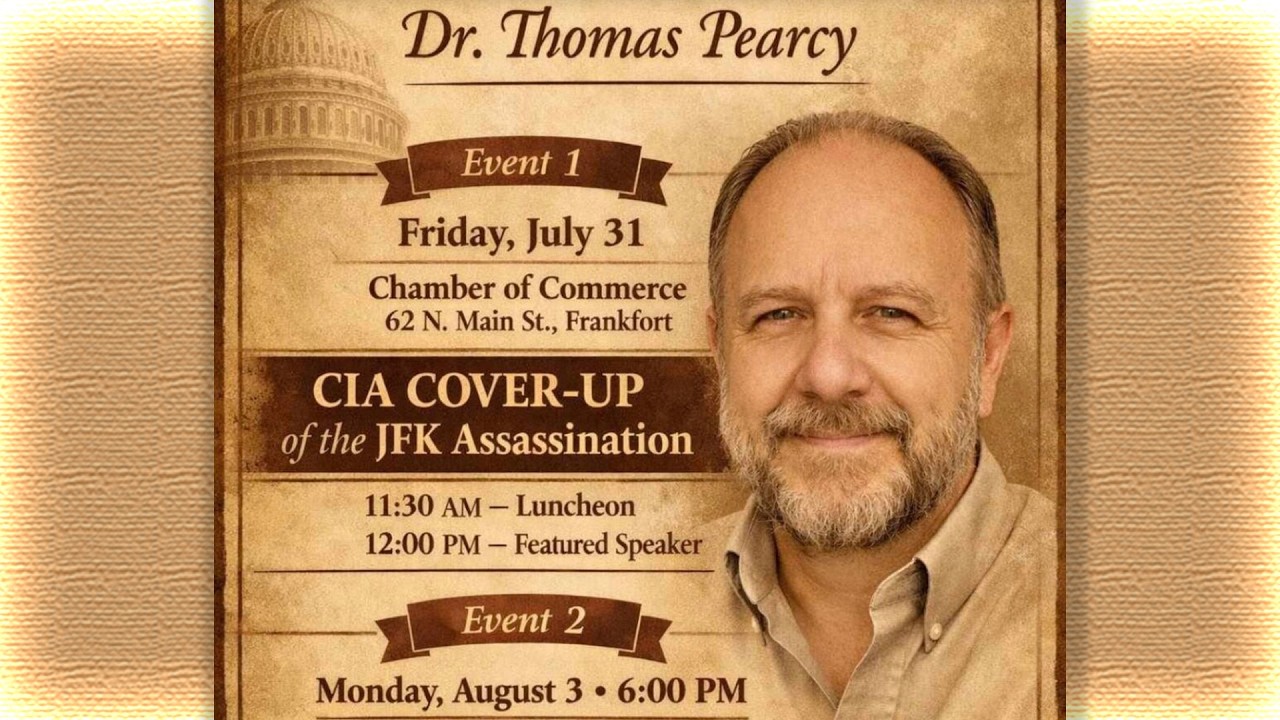
Dr. Thomas Pearcy gave a speech on Monday night in Indiana on "Plausible Deniability." The people who came to hear an esteemed historian lecture on a fairly important topic instead heard a conspiracy theorist spouting a bunch of recycled speculations and factoids. He doesn't get around to discussing his supposed important document finds for over an hour, until my point ten below. And thus, the conspiracist part of his lecture helps us assess the credibility and reliability of his personal account of what happened in the SCIF. Pearcy's performance should be embarrassing to Jefferson Morley who hoisted his implausible claims through his JFK Facts Substack. Should Anna Paulina Luna decide to have Professor Pearcy testify before her Committee, I hope that some of the members will investigate and cross-examine him properly. I suspect that Pearcy is not quite ready for prime time. There were a number of memorable moments during his speech, and since this a very long post, I have divided them into categories: His claims of seeing a nonexistent Inspector General's report and an unredacted Hawkins report (points 10 -13) Dealey Plaza buff arguments (points 5 - 9) The dismissive Pearcy (point 1) Deep State nonsense (all other points) Here is a complete transcript of Pearcy's lecture. Here are the highlights in chronological order. Pearcy mentions my blog post (21:14) Pearcy shows a screen shot of my blog post. Pearcy: First, one of the great things about this experience has been, I had never been trolled before, and I love being trolled. Some nut writes this story about the incurious Dr. Pearcy, and I showed this to my class. I was like, "This guy lit into me. 'He's making these things up. We just, oh my God, that document's already been in the public realm for 30 years, and he doesn't know what he's talking about.'" And he insulted me, not with that picture, but included my buddy Mac. I mean, that's like a declaration of war, you know. He's getting my dog involved, my son's dog. But I start there because, it was for me, I actually reached out to Morley. I said, "Jeff," he's like, "don't worry about it. They're they're, people talk about things that they don't know anything about, and the end." I am glad he noticed my blog post, but I would have preferred a substantive response rather than a complete dismissal. Paul Hoch, Robert Reynolds and I put a lot of work into that post and we were not trying to troll Pearcy -- we were trying to clarify some of the issues, and share some of his documented record as a conspiratorial JFK buff. And how did I insult him? Pearcy claims it's "like a declaration of war." Just by including a photo of Pearcy with his dog? Is being flippant the only response he can make? It's too bad that Pearcy doesn't take his own advice: “I encourage my students not to believe me,” Pearcy explained. “I want them to go find the documents. I want them to think critically and not just to accept someone else’s opinion.” The Sixth Floor Museum is a False Flag Operation (28:05) Pearcy: Now, my course on disinformation has evolved over time because more information has become available, and I'm going to walk way along the edge of ice here. If you, if anyone sees a black Suburban, let me know, okay. One really good example of a false flag operation is the Sixth Floor Depository in Dallas, Texas. If you've ever been there, it is completely a false flag operation, and I know the people that run the false flag operation. I will not say it here because I still enjoy family life, but we'll probably get that in the Congressional Record at some point. Is Stephen Fagin part of the CIA? I'll have to ring my colleagues at Langley and find out more. James Angleton Determined that JFK Needed to Die (29:55) Pearcy: I was asked by a friend, before we started tonight, about the oath that I took to protect our nation, and I would never ever violate an oath to protect our nation. I know where our nuclear weapon systems are located, the warheads, the propulsion, the guidance. I'm aware of these things. I would, would be killed before I would betray my country. I believe that people who do awful things in our names, things that, and you can run up with the Epstein files, whatever example somebody wants to pull up with -- avoiding accountability, just because you can, is not national security. And, the Director of Counterintelligence deciding in October and September of 1962, that John Kennedy needed to die, that's not in our national security. That's because he had just issued a National Security Action Memorandum 263 which ordered all troops withdrawn from Vietnam by December of 1965. That's when the decision was taken that he needed to die. So, James Angleton decided that Kennedy "needed to die" in September and October of 1962. And all because of NSAM 263? But NSAM 263 was issued in October of 1963. Did Pearcy just get the date wrong of when Angleton issued the order to kill JFK. If Angleton only decided in October 1963, he would have had to work pretty fast, no? NSAM 263 said "The objectives of the United States with respect to the withdrawal of U.S. military personnel remain as stated in the White House statement of October 2, 1963." That statement indicated a belief that the troops could be withdrawn sometime in 1965 predicated upon the success of South Vietnamese troops to stop the insurgency. And Pearcy doesn't mention clause 1: It remains the central object of the United States in South Vietnam to assist the people and Government of that country to win their contest against the externally directed and supported Communist conspiracy. The test of all decisions and U.S. actions in this area should be the effectiveness of their contributions to this purpose. CIA Talking Head Claims the Agency Killed Six Million People (42:15) Pearcy played a video of CIA whistleblower John Stockwell from 1989. John Stockwell: We've set out to overthrow functioning constitutional democracies in over 20 countries. We manipulated elections in dozens of countries. We created standing armies and directed them to fight. We went after to organize ethnic minorities to encourage them to revolt. The first thing we did in Nicaragua was to go to the Mosquito Indians, who had never gotten along with the other people in Nicaragua very well, and give them more money than they had seen in the entirety of history, and arms and training and rationales and sanctuaries in Honduras and sent them into Nicaragua to attack, kill, fight, rape, burn, pillage, and this has been a technique the CIA has used in Nicaragua, in Thailand, in Vietnam, in Laos, in the Congo, in Iran, Iraq, with the Kurds in different parts of the world. We created, trained, and funded death squads like the Treasury Police in El Salvador, and we've assassinated world leaders, including the United States president in 1963. And I'll get to that in more detail in just a moment. You can never be sure how many people are killed in the jungles of Laos or the hills of Nicaragua, but adding them up as best we can, we come up with a figure of six million people killed. Minimum figure, it has to be more than that. These things are all done in countries of the third world, where the governments don't have the power to force the United States to stop destabilizing the country and brutalizing their people. John Stockwell lost a lot of his credibility when he also became a JFK assassination conspiracist. Here is a blog post that has a document he wrote after meeting with fabulist Tosh Plumlee. Stockwell claims that the CIA assassinated JFK, and promises to get into more detail later in his speech. Here is what he later said about the JFK assassination: (50:00) Stockwell: John Kennedy, the president, and his brother Bobby, the Attorney General, had for years been waging a war against the Mafia, trying to put the leaders in jail, throwing Carlos Marcello, the Don from New Orleans, out of the country, going after them in a serious, systematic way, and it turned out that there were numerous threats and indications of the Mafia's plans to kill the Kennedy brothers, the war as they saw it between themselves and the Kennedy brothers. So what happened was a team of what they call CIA renegades, because it wasn't the coat and tie people inside the building like myself and David McMichael. I think is sitting in the back, CIA officers who were of the establishment inside. It was the renegades down in Florida who were working this destabilization activity against Cuba, working with Cuban exiles, overlapping greatly with the Mafia, which was involved in this flow of drugs from Cuba into the United States. These people plotted a military-style ambush in Dallas, and they set up a team of shooters on the top of buildings. They had the cooperation of someone in the Secret Service. They had the cooperation of the Dallas police. They got the parade route redirected. They got Kennedy into this, the cars into this place where we would have to make 120-degree turn. The Secret Service driver stopped when the bullets began flying, and anyone who's been through that kind of training -- and I've been through their bang and burn courses --- they drill it into you that when the bullets start flying in a situation like you have a president or yourself or something, you mash down on the gas and you get the hell out of there. You don't stop and look around as a seasoned Secret Service driver did, in fact, and Kennedy was shot down short distances from shooting stations, probably four of them, firing probably seven shots. He was hit twice: once in the back, once in the front of the neck, and twice in the head. Connally was hit once or twice. Two bullets were fired on each side of the thing, the convoy then blasted away and got out of there. Immediately, the FBI launched the cover-up. The announced purpose by the people in the establishment being to prove, to reassure, as they put it, the nation that it was the work of the lone assassin Lee Harvey Oswald. The evidence was tampered with massively. The president's body was altered. The photographs of the autopsy were altered, and forty-nine witnesses were killed. So they could not blow the whistle and testify and blow this thing open. Until this day, despite the fact that the House Committee in 1979 concluded that it was a conspiracy, there has been no formal investigation by the Justice Department of the conspiracy to kill our president. This was nothing less than a coup d'état. Forty-nine witnesses were killed? The conspirators had the cooperation of the Dallas police and the Secret Service? The motorcade route was changed? JFK's body was altered? The autopsy photographs were altered? Perhaps Professor Pearcy could have found a better expert. Katzenbach and Hoover (50:44) Pearcy repeats his claim that Deputy Attorney General Nicholas Katzenbach was not interested in the truth about the assassination. Pearcy: President Trump issued this executive order, in the three previous investigations into the assassination, and by the way, Jefferson Morley even, let alone Representative Luna, did not know what I'm about to tell you. When the Warren Commission investigated the assassination, by the way, the decision was made what the conclusion was within 24 hours. There's something called the Katzenbach memo, who was the acting, the Deputy Attorney General under Bobby Kennedy. The day that John Kennedy was buried. Katzenbach wrote a memo and said, "We've got to convince the American people that this is what happened." But J. Edgar Hoover let it be known, the night of the assassination that, as Mark Lane said, "Case closed. We've got our man." I covered this in my blog post on Pearcy's radio appearance. Katzenbach said nothing of the kind. As for Hoover, like many people, he was convinced early on that Oswald was the assassin (how could they not, the evidence was overwhelming), but at no time did his agents stop investigating, and leads were coming in all over the place. Pearcy probably would not want to quote this memo sent out by Hoover at 11:19 PM on November 22nd: Pearcy on the Medical Evidence (55:45) Pearcy: Groden became the forensic photographer for the House Select Committee on Assassinations. A couple of important things happened in the 70s. Now the story is the same. The House Select Committee was supposed to rubber stamp the Warren Commission report, and they were going to do this. Two things happened. First, Robert Groden. So, Groden goes in there after he's on Geraldo Rivera, and the first thing he does, In those days, you didn't have Photoshop or AI, and it was very expensive to amend or alter photography, and there were very few organizations that did it well. None better than the U.S. intelligence community. They used a technique called matting, M-A-T-T-I-N-G. And Groden pointed out that if you look at a matted photograph under a 3D viewer, you can see the actual photograph. And he told me about this. He literally did what any good curious historian would do. Once he realized what was going on, he looked at the actual photographs, and if you've ever seen an actual photograph, the photograph that was released is that there's a very nice, neat entry hole here and a skull flap. The actual photographs aren't so pleasant. I know the radiologist who conducted radiology on the president's remains that night. Gerald Custer. Now, why he did this, I don't know. He alarmed me when he said it, but he was like, he said that whole, there was no brain. Of course, there wasn't. It had already been removed. But he said I stuck my fist inside the president's head. I'm like, dude, you are not well. You know why? Why would you honkin' do that? But the point is, Groden discovers, looking at the actual photographs, the truth that the entire back of the head is gone. And oh, by the way, the wound that was supposed to have gone through the president and out his neck and blew off the right nipple of Governor Connally, so now we have a one-nipple governor. That that bullet wound in the lower spine had no trajectory; it went in about an inch and it fell out on the floor. And Dr. Humes picked it up in the autopsy room and handed it to agents Sibert and O'Neill, but that story didn't break until 1980. And my paranoid friend David Lifton broke that story. Where do I have even start with this? Robert Groden couldn't convince any of his colleagues at the HSCA that any of the autopsy photographs had been altered. Groden "discovers" that the whole back of the head is gone? Pearcy believes that the first bullet hit JFK in the back, went in an inch, and fell out during the autopsy, and that Dr. Humes picked it up. These are not the words of an historian. Even Pearcy's friend David Lifton was never that careless with details. The Acoustics Evidence (58:42) Pearcy buys into the acoustics evidence and doesn't say one word about the NAS conclusion that the Dictabelt did not record the shots. Pearcy: But, the other thing that happened, along with the autopsy pictures, is they were literally preparing to wind it up, and a little old lady, a little person, a sweet old person, a sweet person, younger than me, calls up the House Select Committee and says, "Hey, why don't you come out to Dallas, and in the Dal-Tex Building there are records, and there are dictabelts. She said there was a police officer in the motorcade that day who had his microphone stuck on. You might want to hear that recording. Yeah, that might be a good idea. So Blakey goes out there, they listen to it, and the official conclusion of the House Select Committee on Assassinations was that there was a 90 percent probability of a conspiracy. And literally, the Warren Comm -- we have two standing decisions: One is that Oswald did it alone. One is that conspiracy, meaning more than one person. But the cool thing about the dictabelt is the acoustics in Dealey Plaza are pretty straightforward. So they did acoustic fingerprints. So enterprising Groden, more recently, superimposed the actual shots that were picked up on the microphone onto the video, and that's what I'd like to show you now. Pearcy then plays the Zapruder film with the sounds of four shots superimposed on the video. But he does not mention that the HSCA agreed with the Warren Commission that Oswald fired three shots and killed JFK. The Harper Fragment (1:02:10) Pearcy claims that the Harper fragment was found 75 feet to the rear of the limousine. Pearcy: There was something called the Harper fragment, a piece of the skull that was found 75 feet to the left rear of the limousine, by a law student. That is just not true. The Harper fragment was found to the left front of the limousine, completely in line with a shot from the rear. The limousine is positioned at the location of the head shot. The Harper fragment was found at the bullseye. Gordon Arnold on the Grassy Knoll (1:02:22) Pearcy then recounts the story of Gordon Arnold, who was a star figure in the series "The Men Who Killed Kennedy." Pearcy: In the aftermath of all this, of course, there were a lot of people, there's an active-duty soldier, on the grassy knoll, filming. And he hears a bullet come over his head. He's seen live action. And a guy trembling approaches him and says, "Were you filming that, I need your camera." And he's like "dude, on my life, this is my mother's camera." Smart guy. But the guy grabbed his camera and ripped the film out of it. And this happened over and over all over Dealey Plaza. There were no Secret Service agents on the ground in Dallas that day. Not one. Zero. No FBI agents. Nothing. That's all part of the way he was assassinated and if you are interested, I can explain that later. Gordon Arnold didn't come forward with his story until 1978, and there is no evidence to support any part of his story. You can read more about Gordon Arnold here. 10. The Discovery of the "Document" (1:10:00) Here is Pearcy's description of how he came across the document that is central to his account of being a whistleblower. Pearcy: Anyway, I happened upon—I ordered a folder that was so sensitive that everybody in the Compartmented Information Facility had to vacate. Even the CIA historian. Nobody had clearance except me to be there when this box arrived. Those things have to be couriered ... by people who have the clearance equal to the contents of the box. And a courier is always accompanied by an M4-toting person that helps make sure that they get there. And if the tape—if the packaging has been messed with, a federal law has occurred. There—it's serious. So, this thing shows up. I'm going through this, and here's this folder in the middle. I didn't—my search terms did not include JFK, or the assassination, or Lee Harvey Oswald. None of those things. And that's what makes the story kind of funny. But I pulled this folder out. I had the legal authority and right to do so. And it was literally a 50-page Inspector General's report after the House Select Committee had—G. Robert Blakey had visited Langley. They had completely forged—now when I say forged, when you say sanitize and redact, you draw lines through it. That's not what I'm talking about. They had their own bindery, and they do a beautiful job of it. And—and the Mexico City records, the people that call me incurious are sure that I don't know what I'm talking about, because there was a sanitized version of this released, and so I don't, you know—and none of them have ever been in the box where I was. I know what I worked with. I remember the search terms, the Boolean logic combination that I used perfectly. I have a photographic memory when it comes to this stuff. But literally, they did an internal review, a secret internal review to see if they had fooled Congress and the American people. And it was very disrespectful of G. Robert Blakey. I won't go into detail here, but this is why I finally reached out to Morley in 2018. These, the senior CIA brass that accompanied—the one person that accompanied Morley [sic] and took him these falsified records, they are praying literally to God. I mean, they were nervous, because if he asks any questions, "Well, what about this?", they're in trouble. But the Agency knows that unless you've been in the Agency, you have no way of having any clue what they do or don't have. So Blakey sits down, goes through these things, stands up, says, "I have no questions." And the after-action report said G. Robert Blakey is the most uncurious human being I have ever interacted with. And that is CIA after-action report speak for "What a dipshit." I mean, I—pardon the language, but they're making fun of him. You know, they got away with it. So, Pearcy enters some Boolean-logic search terms seemingly related to the 1980 Romero assassination, and is given a box of documents. The Inspector General's report is inside this box -- clearly this report has been filed erroneously in this box. And so if the filing of this report is in error, then the only way the CIA could possibly retrieve that document is to use Pearcy's search criteria to get the same documents. The SCIF (1:15:20) A SCIF is a Sensitive Compartmented Information Facility. It's a specially built room so that people can discuss and look at classified national security information. Pearcy: So I see this IG report, and I'm like, "Well, this rocks. We did it, and we covered it up." The important thing is, is that IG report—that Inspector General's report—details methodically and painstakingly exactly how the Central Intelligence Agency did this. Sometime later, I'm downstairs—and I'll show you something kind of funny in a moment—but I was in an area called the Declassification Center. And these sites are not places where there's water fountain chit-chat. No, you don't speak to the people who work in the SCIF next to you. You have no idea what they do, they have no idea what you do. The SCIF right next to where I worked in this building was labeled the "Terrorist Media Center." So when we went into Abbottabad and we got Bin Laden, and we got his hard discs and we got his floppies and his jump drives, they were in that SCIF within 24 hours where intelligence analysts work with them. But it's a weird and interesting kind of a place to work. So I go downstairs to this area where the CIA historians have never been. You do not enter unless you have a reason to, and I did. I was actually looking at the assassination of Archbishop Romero. So I'm down there, and oddly enough, there's a SCIF within a SCIF, so kind of a vault within a vault. And over here's this vault within a vault, the door's open, and then there's this woman named Mary speaking very loudly in a Northport, New York accent, and I'm cracking up. But it's hard to read about Archbishop Romero's assassination and, and you know ... and that's an environment where you cannot act surprised at anything. And my assistant person who was helping me with redactions said, "Oh, don't, don't bother, don't worry about her. That's just Mary. She takes care of making sure certain Kennedy artifacts will never see the light of day." Now, of course, Tom Pearcy wants to say, "WTF?" Right? "What... what..." you know. But I had to act like I didn't hear it. But afterward, as I stand up to leave, she said, "Would you like to meet Mary?" And I was like, "Ah, sure, you know, why not?" And, I go into this room where they have a list of every human being that's ever entered. There were 50 names on it. I did not sign it because I introduced myself to her as the nation's Joint Historian, and we had a nice chat. But as we're chatting, I'm just looking around, and there was a video, a movie, of Lee Harvey Oswald meeting with the CIA station chief in Mexico City in September of 1963. That's very significant for reasons I, I won't address here, but if anyone has questions afterward, I absolutely will. A video of Oswald meeting with the CIA Station chief in Mexico City? And a woman who makes "sure certain Kennedy artifacts will never see the light of day." Pearcy talks about "my assistant person who was helping me with redactions." Who is this person, and is this person a witness who can confirm Pearcy's story about such a SCIF? Pearcy then shows the floor plan of the building and then talks further about this SCIF: (1:19:39) Pearcy: And inside the Declassification Center is the... what I dubbed, and, and trolls immediately pounced on, and the CIA denounced its existence, of course... but I told Morley, I said, "That's the Kennedy SCIF. That's where they keep things that literally nobody knows exist—artifacts as well as documents." The Kennedy SCIF? For artifacts and documents? The Search Terms (1:20: 58) Pearcy was recently in a meeting with Jefferson Morley, Anna Paulina Luna and representatives from the CIA. Pearcy: Okay, we have told them ... I have told them ... I will not tell you the terms that I used to conduct this search, and, and I won't ever. Representative Luna has pressed this and said, "We need to get Dr. Pearcy access to a discrete server in the intelligence community where he can locate these materials." And I've coached them: We, we need to arrange to have them couriered, because the CIA will, from the moment they know where this is, the documents become in play. Well, I got a call late that night. They said, "Never mind. CIA is not going to let us do it. They're demanding that Representative Luna go in by herself." I am not sure what the problem is. Luna can go in with Pearcy's search terms and retrieve the box. Has she done this? 13. Pearcy's Annotation (1:25:25) Pearcy says he annotates every document he has seen and has assigned his own alphanumeric values as well. Pearcy: I remember... I literally, every document that I've ever brought out of an archive for any reason anywhere in the world, I assign an alphanumerical value to it and I write an annotation to it, so that at a moment's notice, thousands of documents, I can pinpoint exactly what it is that I need. I just donated all that to the government of Panama, by the way. But they can't find this document. And they pled with me—until Representative Luna lit into them and said, "Stop it. It isn't going to happen your way. It's going to happen our way." They plead with me, honest to goodness, to tell them how to find this document. And that ain't going to happen. Those poor CIA people -- pleading with Pearcy and he just won't help. Was there not some identifying number on the document in question? How about the actual title? Lyndon Johnson and NSAM 273 (1:42:59) Pearcy misleads the audience about NSAM 273: Pearcy: And the two culprits there that Americans ought to know about are: One, Lyndon Johnson comes in and says... the day that Kennedy is buried, he issued National Security Action Memorandum 274 [sic] which reversed everything. NSAM 273 did not reverse everything: 2. The objectives of the United States with respect to the withdrawal of U.S. military personnel remain as stated in the White House statement of October 2, 1963. Lady Bird Johnson and Bell Helicopter (1:43:30) Pearcy makes an erroneous claim about Lady Bird Johnson: Pearcy: Lady Bird was the principal shareholder in Bell Helicopter, you know. She... I have a problem with that. There is no evidence that Lady Bird owned stock in Bell Helicopter. Pearcy Makes Precautions in Case He Disappears (1:46:41) Pearcy is asked by a member of the audience if he is concerned about his safety. Pearcy: I'm not, but my family is concerned. My wife made me give her the names of the attorneys in Pittsburgh and Washington that would help her find me if I disappeared. And by the way, the biggest law firm in, in Pittsburgh and a very famous attorney in, in Washington will work for... will help me pro-bono if I, you know, disappear or get in trouble. Who Killed Kennedy (1:49:46) Pearcy: Nobody asked me who killed Kennedy. Why did I do what? Oh, James Angleton was the director of counterintelligence at the Central Intelligence Agency. This is documented; Jefferson Morley has established this. Uh, the day ... we know that Oswald was CIA. That's not a question. A man by the name of Joannides was in charge of counterintelligence in Miami, and he ran Oswald. Joannides answered to James Angleton, who was chief of counterterrorism [sic], and Oswald was sheep-dipped. He was very much made to look like a communist. In those days, to have a, a television camera show up when somebody's picketing was not as common as it is today, but cameras showed up and they showed him. I will say, regarding Oswald ... the CIA right after the assassination said, "Well, we have one photograph of Oswald and here it is," and they showed some dude that was heavier than I am and about four foot, and everybody's like, "This is not Oswald." In the Inspector General's report that I referenced, they reported that they have 2,300 high-quality photographs of Lee Harvey Oswald in Mexico at the Soviet and Cuban embassies. The reason for those was if Oswald ... Oswald, by the way, was exactly what he said he was: a patsy. He did not know his role in this. But if, in the... the misfortune that Oswald had lived, the Agency needed evidence that he was a communist to pitch this to the American people. And so we have a lot of high-quality Hasselblad cameras focused on him and his movements in Latin America and in the Soviet Union. But yeah, the agency did that. You really want to know... Well, I'm gonna go out on a limb here, and if you see a Suburban circling, you rescue my ass. Okay, here's how it happened. You've heard of Carlos Marcello, right? The godfather in New Orleans, who also was responsible for Texas. The best evidence suggests right now that Angleton made the decision. Joannides would have been involved with it. Oswald would not have been involved with it. Hoover would not have known about it. Hoover had instructions to act in case of this or that. But the CIA had worked with Marcello for years, with the Mafia. We arranged for Marcello to go to Marseilles and hire a "wet" team. We paid them—and those of you who are old enough to have been around then, or your parents, you'll love this—with our tax dollars. We paid them in heroin, because heroin is an easy way to launder money. Right now... we did the same thing, by the way... What's that? Right. We did the same thing, by the way, in, in Panama and South America in the '90s when all of that cocaine was flooding into the Americas, into East Los Angeles specifically. But we... yeah, the French Connection. We, we, we paid this team, and the Marseilles wet team's technique is to get uniforms and badges—police and military, Secret Service, anything that they need—and they would come onto the scene and, and do their thing. The most... I... there were three shooters, I think there were five shots. I only hear four on the dictabelt, but I think there's a fifth. Pearcy can't even get the Joannides story straight. Joannides was not the head of counterintelligence in Miami and he did not report directly to James Angleton. And Joannides did not run Oswald. Of course, no one would have ever believed that Lee Harvey Oswald was a Marxist unless there were 2,300 photographs of him visiting the Soviet and Cuban embassies in Mexico City. Pearcy's lecture was incredibly unpersuasive. The audience did not hear an esteemed historian, they heard the rantings of a raging conspiracy theorist. No matter how good and reliable his work on Latin America may be, when it comes to the JFK assassination, he is not credible. Previous Relevant Blog Posts on Thomas Pearcy Is Thomas Pearcy Just Another Buff? An analysis of Pearcy's interview on Indiana radio. The Incurious Dr. Pearcy A supposed CIA whistleblower wasn't very curious.
- Is Thomas Pearcy Just Another Buff?
I want to thank Robert Reynolds for his research in finding all the relevant documents below. I strongly urge people to have a look at his excellent website on the JFK documents. Professor Thomas Pearcy was on Indiana radio on July 28th to help promote a major event on August 3rd. If you remember, Pearcy is the person who claimed to have seen a secret CIA document in which they bragged about keeping G. Robert Blakey in the dark. I wrote a blog post about this in December of 2025. Here is an excerpt from a transcript: (38:30) Pearcy: Just like the Oliver Stone movie triggers the Assassination Records Review Board. Now, I saw this document in in early 2009. I did not copy it. I would not remove it. I would never, ever do something like that because I had taken an oath to not do those things. Host: And this is the 50-page document you're talking about that. Pearcy: The Inspector General's report, where they lay it all out. I didn't approach Morley until 2018. I sat on it, in part because I enjoy living. I didn't want to go to prison and would like to spend some time with my family, you know. But it wasn't the right time. And then in 2018, the CIA wrote something publicly that bothered me to the point that I reached out to Morley, who was I think at the New York Times at that point, and I said, "Man, give it to this person. I mean, what he's saying is not right." Morley was intrigued that I knew these people. He flew to Pittsburgh to meet me, and thus we began this this working relationship. Here's where my contribution differs. I mentioned the joint historian position for you, that it was created in the 1990s. Host: Yes. Pearcy: My job was not to declassify -- anything. My job was to look at anything in the world, at any level of classification, and determine as a professional historian whether or not a thorough and accurate record of our government's relations with other countries required this document. Host: Yeah. Pearcy: That was my determination. Host: I'm gonna simplify. I'm gonna try, because I'm very simple-minded. Pearcy: Okay, Host: I'm a Louisiana guy, so I didn't get much education. Pearcy: I hear you. Host: You're kind of the keeper of the minutes. You're the keeper of the historical, not the keeper, but maybe the checker of that. Because you know, I take minutes in a variety of different boards and things. Okay, there are things that are said that are not included in minutes sometimes just because they don't mean anything. Somebody, you know, coughed or sneezed or maybe grunted. You're not going to include that in the minutes. Then there's things that maybe that you include, but it's not maybe with the same vigor or passion that it was shared or set in, or maybe even the intent of. I just want to clarify that as you're looking and you're extracting history; you're trying to make sure that you get also the intention .. Pearcy: Yes. Host: ... of all that is said and that and all that is shared. Pearcy: Context, absolutely, I am, and my role, this sounds prideful, and I don't mean to sound prideful. I don't. I hope I'm. Host: Hey, you're an accomplished person. You're. We appreciate you. Pearcy: Thank you. But my role as a professional historian with decades of deep archival experience was to go into these places, the most secret place in all of the world for our government is not far from Mount Vernon, and there is only one signature in the world that can get you on that property, and that is the signature at 1600 Pennsylvania Avenue. So I had George Bush's signature, then Barack Obama's signature on my clearance. If you're only the Secretary of State or the Secretary of Defense, and you begin to enter this facility, they will use terminal force to protect it. So my job is to go into everything, and with my knowledge of, or I think that's the way they review it. Knowing history the way I do, I can go in and say this has got to be part of it. Host: Yeah, I want to take this a little more on the personal level with you. You know, let's go back to that night in 1975 when you saw the Zapruder film for the first time. Pearcy: Yes. Host: What was what was going through? How old were you then? Pearcy: I was I was 14. Host: Okay, so you're not you're not about the same age ... because it was horrific for me. Pearcy: It was horrific for me also, and my mother had a tough life and worked two jobs, and I would spend all of my time down with my Aunt Minnie, my dearly beloved Aunt Minnie. I don't think we're any blood relations, but you know, Host: we got a lot of [garbled] like that. Pearcy: You got a lot of folks like that in Frankfort, and she would sit and would read to me about the Kennedy assassination. I mean, when I was 7, 8, 9 years old, and she would weep. She would just cry. Host: Oh, it was so impacting. Pearcy: And it touched my soul. I have no idea of her politics and I, I never really cared, but I would see her good heart just breaking over this event. So I'm laying on the floor in her house watching ... Host: The Zapruder film. Pearcy: ... Good Night America, and it was it was stunning to me. It was. I literally ... Host: Was that the moment that things kind of stirred you to say, you know, I want to be. I know you said you were not very much interested in history. Pearcy: Yeah. Well, I would say that's the time period. The first book that I ever read when I was in first grade in Tiger School [high school?] was Jim Bishop's The Day Kennedy was shot, Host: Wow! Pearcy: And that's not a small book, but my beloved Aunt Minnie's love of this ... Host: That influenced you. Pearcy: Yeah, and so yeah, the Zapruder film showed me that, as Mark Lane said, there's something wrong here. You know that doesn't make sense. Well, it was, Host: And what was so funny, Tom? Not funny. It's I. I mean that, you know, metaphorically. I think that what was so unreal about all of this is that government, and there were there were still people spinning the narrative, Pearcy: Right. Host: Even after you see the video ... Pearcy: Correct. Host: And you go, "How in the world could there not be some other?" I mean. Pearcy: Right, right. Host: Because it's like, how can one guy shoot in that, and have that, and they and they're still saying that. There's still the narrative out there by the government. Pearcy: Actually, the government is responsible for two or three of the most widely dispersed assassination conspiracy theories -- that's false flagging or whatever phrase we want to use. I won't, for legal reasons, go into a lot of detail. But the entire Schoolbook Depository Museum is a false flag. Host: Yeah, been there. Yeah. Pearcy: And that's all under intelligence community control, shall we say? Anyway, the long and short of it is this: you know, students say the government that we all we all think about this. I'm the first person. This is why I don't call myself a whistleblower in the same way. I waited years to do it, and I came forward only when I thought, because I'm in a classroom with young people and their lives are discouraging. Who do you believe, you know? Host: Right. Pearcy: And I tell them. I try to teach them, to inspire them, to stand up for truth, be kind, and do the right thing. You know, and sometimes doing the right thing requires some guts and attorneys, But the difference between all of the other whistleblowers and mine, my testimony, which is now on the Congressional Record and is a part of our nation's history, when FBI whistleblowers have come out before, they come out and they say, "Well, we killed these heads of state, we did this and we did that." Well, that's all interesting, but the American people already believe that. You know, they know something sinister is going on. But my question to my students is, how do you fix sinister? You know, if I, the example I use in class is, if I ask you to help me out by picking up my friend who's flying to California tomorrow, you say okay, and you get in the car and you go right. Probably a little information would be helpful, like which airport, what part of the state? Host: Yeah, he's coming in. Yeah, Pearcy: And that's where my testimony comes in because in this document that I read from cover to cover and then return where it belonged. And by the way, the funny part of all this, to me, as a side note, is that the agency cannot figure out the search terms, the Boolean logic that I use to locate it. So I'll bring that up to speed when, or up to date when, when you want me to do that. But effectively, what I saw was -- in 1977-78, the House Select Committee. You know, after Groden went on Geraldo Rivera, the House Select Committee does this investigation. Two important things happened during that investigation. It was intended by the government to simply rubber stamp what the Warren Commission had already said. and the government knew very well the night of the assassination what had happened. The Assistant Attorney General Nick Katzenbach wrote a memo on the night that Jack Kennedy was buried. There had been no evidence brought forward. They had nothing in Washington, and he wrote a memo that said we have to convince the American people that this is our guy, that he was a communist. Anyway, in this document that I found, what had happened is G. Robert Blakey, the head of the House Select Committee on Assassinations had notified the CIA, with the Congress's permission, I want to see your records on the assassination. Host: Is this part of the executive order that was given by President Trump? Pearcy: No, that's coming. This is in the 70s. Host: Okay. 70s. Okay, okay, okay. I'm sorry. Yeah, I'm sorry. I got ... Pearcy: But the same thing happened. They've done it. They've done it three times before Blakey went in. They wouldn't allow him to bring anyone else in with him. No one. And Blakey is an attorney. He doesn't know this stuff. You know. I mean, I don't mean any disrespect, but he's not an archivist. Host: Right. Pearcy: And they also insisted that he would not have access to their indexing and filing systems, but he could tell them what he wanted, and they would bring it to them. You know, now imagine this: you know, go to a library and you want a book on the Civil War. Somebody stops you at the door and says, "I'll go find a book. There, you got it. Well, Blakey had requested, the House Select Committee on Assassinations had requested the CIA station histories from Mexico City in the early '60s. The CIA knew exactly why Blakey wanted to see those because Lee Harvey Oswald absolutely worked for the CIA, Host: and he was in Mexico. Pearcy: Well he wasn't. Host: Oh he wasn't, okay. Pearcy: We sheep dipped him though to make him look communist. You know, his going into the embassy in Moscow and renouncing his citi ... All of that stuff was part of a plan, and so the House Select Committee requested these documents, and literally the report that I found is this. This is what they detailed. First, you know there was a famous instance where the Agency released one photograph of somebody who was a little chubby and a little shorter, and they said, "Well, this may be him. It's all we know, right? Host: Yes. Pearcy: In this inspector's general report, which I'm the only person in that part of the building who can even be looking at, and this is the most secret black site in the United States, it's just terribly sensitive document for obvious reasons. The Inspector General started out by saying we have two thousand, three hundred very high-quality photographs of the subject. Host: Being Lee Harvey Oswald. Pearcy: Yes, and he described the four Hasselblad cameras, two of each positioned at the Soviet and Cuban embassies, where they could, they were, they had lots of pictures of him going into communist places -- in case he accidentally survived Dallas. Now he didn't know that, of course, but the part that stirred my patriotic American soul or geriatric soul, I don't know how I would describe it -- was they described bringing Blakey into the CIA. Now I'm going to stop here. Say that G. Robert Blakey did all of us a huge disservice when, after the events I'm about to describe to you, he went out publicly and said, "Oh yeah, I saw everything the CIA had. They don't have anything." I mean, he honest to god said that. Host: Yeah, I remember hearing that. Pearcy: Yeah. well, what actually happened, and this is the document I'm pushing for to be. Host: And I believe a Clinton County guy over anybody else. I'm believing you, Tom. Pearcy: Thank you. So, the description of this stunned me because there, there, there were three senior CIA brass in a room. These are the same people who'd been involved with the decision to assassinate the president in in 1963. Host: At Langley? Pearcy: That is correct. Anyway, and that's another story, and I won't deviate from it unless you bring me back. Host: No, and we're going to run out of time here shortly, and so this has again been a teaser for Friday. It's going to be -- today is a little bit of a teaser. Friday's the appetizer, but then next Monday night you're going to be able to just have a full-blown presentation and share at the library, but let's finish the Blakey part because I think that, that has a lot of meat on the bone there because because he lie, he lies. Pearcy: He didn't lie, actually, well he was ignorant. Host: Yeah okay he was ignorant and maybe the truth was certainly suppressed. Pearcy: Oh, oh! In fact, and this is where my testimony really is the first actionable intelligence ever made public about the CIA and the intelligence community and keeping secrets, Whether it's files today or whenever. They describe Blakey coming over to Langley. They had located three volumes. The CIA has its own press, so it presses, and it and it and it binds beautiful brown leather binding, and and the attorney describing this, who was with Blakey, went into great detail. He said, "We simply went in and removed from the originals anything that would in any any way be problematic" and then they made a perfect duplicate of all of this stuff that they had decided Blakey could see, and they bound it. And when he came into the room, they say he hung his hat up on a hat tree and his coat, and he sat down. And they very specifically said, we set all three volumes, we stacked them to to his left. He brought the first one over, and he opened, and he looked, and he looked, and he looked, and he set it aside. And he did that same thing three times. And then he stands up, and the agency people are freaking out because if for some reason he would say, "Hold that I have a question," it could be problematic. But the agency also knows that unless you've worked at the CIA, you have no idea what they do or don't have. It's plausibly deniable. Yeah, you know, can you prove it exists? Anyway, the after-action report on that event. When Blakey visited, he stood up, and the attorney said, "Mr. Blakey, is there anything else that I can do for you?" He said, "If you like, I can explain some of the redacted materials you know that you've seen, but you've got everything." And he said, "No, nope, I'm good." And he left. He goes back to Capitol Hill, back to the Cannon Building. So the CIA convenes upstairs, and they're like, "Oh my God, we got away with it. He didn't ask any questions." I mean, he didn't say it in that language. But the thing that that gotten my feathers up was the person who was with Blakey said, and I can quote this verbatim: "G. Robert Blakey is the most intellectually uncurious human being I've ever dealt with." Host: Yeah. Pearcy: End of quote, and in their language, that's an insult. Host: Yeah. And as we wrap up, you know, go back to your analogy of the library. I mean, that's exactly what just happened. Blakey is standing at the door of the library... Pearcy: Correct. Host: ... asking for information on a on the book of John F. Kennedy assassination, and the librarian, the CIA, comes back and hands him a tightly bound book of what they want him to see. Pearcy: That is correct, and absolutely correct. Host: And then he's like, "Oh, I don't need to know about the redacted. I don't need to." But they were ready to answer even the redacted. Pearcy: They well, Host: Was that purposely done? The redacted ... Pearcy: Yes, the things that were redacted were nominal. There was -- anything that involved sheep=dipping or the Kennedy assassination was entirely removed, and I would add also that the meeting where the phrase, the most intellectually uncurious human being I've ever heard, that was redacted from the sterilized copy. Host: Okay. Yeah. Well, it's amazing, Tom. You are a fascinating individual with just all of the information that you have, the history that you have, and we're very proud of you as a Clinton County. And thank you very much for all of the things that you've done. You're going to be at the Clinton County Chamber of Commerce this Friday. We're going to have a membership luncheon. Going to start. You're going to start speaking about noon. We're going to start the pork burgers and hot dogs about 11:30, and then you're going to give us another little appetizer for what's going to happen on Monday. Is it 6 o'clock at the library? Pearcy: 6 o'clock at the library. Host: 6 o'clock at Skanta Theater next Monday. I think that's the third, August 3. So, you want to make sure that you're there for that because you're going to hear the you're going to hear the whole scope of this, folks. It really is interesting, not just interesting. It really should, like you said, get your feathers up because it is frustrating. Pearcy: It is, and if you can't fix something that you don't know is broken, and on Monday night I'm going to speak about things that are going to make people uncomfortable, but we should know these things. Host: Yeah, and and have been involved with the Laura Luma [sic]. Pearcy: That's right. Host: The investigate. I mean, she now, and that you're going to talk about that because you've been in Washington recently and dealing with Congressman Luma [sic]. Pearcy: That is correct. Representative Luna was appointed. By President Trump to head a House Committee investigating these declassifications to make sure that the CIA and others are cooperating. And Morley testified in April of last year and said she asked him point blank, "You have someone from the inside," and Morley said yes. She was referring to me. Host: Yeah, Pearcy: And I never did get the, what, of course, loved ones would hope for the promised. You know, I could still be fired and lose everything if I'm charged with a felony. But it's this important to me and my wife and my family are concerned, but I think the dangerous period has passed. I was in Representative Luna's office with Jefferson Morley in the Cannon Building on Capitol Hill ten days ago, and we were in a meeting with the CIA top brass, and they were trying to, you know, well, they they want me to give them the search parameters because they can't find the document, and I said no way. And they were pushing me a bit. And Representative Luna stepped in, and you know, honestly, when I left that meeting, I was blown away by her. She will take no nonsense from anyone, and she literally picked up her phone, called the Director of the Central Intelligence, did not answer, called the White House, spoke with the President, and said during this meeting, Host: Yeah, Pearcy: "Mr. President, we're not getting any cooperation" Host: We're getting stonewalled. Pearcy: Yeah, and so here we are at this critical juncture in history. We may actually, you know, Host: 60 what? 64 years later? 66 years? It's just crazy. Pearcy: It is crazy. Host: 64 years later. Pearcy: And the way that they've kept that secret is the way that they've kept a lot of other secrets. Host: Sure. There's a trail of death in all of this too. I mean, I mean, there's been a lot of people that have been killed. Pearcy: There is. There is. ******************************************************************************************************************************** Here are the highlights of the above transcript. In Green above: Pearcy: Actually, the government is responsible for two or three of the most widely dispersed assassination conspiracy theories -- that's false flagging or whatever phrase we want to use. I won't, for legal reasons, go into a lot of detail. But the entire Schoolbook Depository Museum is a false flag. Host: Yeah, been there. Yeah. Pearcy: And that's all under intelligence community control, shall we say? The Sixth Floor Museum is a false flag operation and is "under intelligence community control." I've got to send a note to Stephen Fagin. I have to find out if he is witting or unwitting. In purple above: Pearcy: And that's where my testimony comes in because in this document that I read from cover to cover, and then return where it belonged. And by the way, the funny part of all this, to me, as a side note, is that the agency cannot figure out the search terms, the Boolean logic that I used to locate it. So, Pearcy is stating that he used some sort of search terms, or Boolean logic, to locate the document in question. He says the CIA cannot figure it out. The report in Axios says he just happened to come across the document: So, did he use "search terms" to find it, or was it accidental. He also told Marc Caputo of Axios that the “document in question should be easily findable by the CIA because they have an alpha-numeric record locator from the "sanitized" memo.” Why on earth would he not share that locator with the very people who are trying to find it? But later, he says that he refused to help the CIA when meeting with Representative Luna (in purple above right at the end) Pearcy: I was in Representative Luna's office with Jefferson Morley in the Cannon Building on Capitol Hill ten days ago, and we were in a meeting with the CIA top brass, and they were trying to, you know, well, they want me to give them the search parameters because they can't find the document, and I said no way. And they were pushing me a bit. Pearcy wouldn't help them? Does this make it any sense? And the host should have asked Pearcy if he had the details. In blue above: Pearcy: Two important things happened during that investigation [the HSCA]. It was intended by the government to simply rubber stamp what the Warren Commission had already said. and the government knew very well the night of the assassination what had happened. The Assistant Attorney General Nick Katzenbach wrote a memo on the night that Jack Kennedy was buried. There had been no evidence brought forward. They had nothing in Washington, and he wrote a memo that said we have to convince the American people that this is our guy, that he was a communist. How does Pearcy know that the American government intended to have the HSCA rubber-stamp the conclusions of the Warren Commission. And, of course, they didn't. His reading of the Katzenbach memo is wrong. I don't anywhere in the memo where Katzenbach wrote that Oswald "is our guy," and "that he was a communist." For instance, take a look at this paragraph: And, of course, he didn't mention the first paragraph of the memo: In blue above Pearcy: We sheep dipped him though to make him look communist. You know, his going into the embassy in Moscow and renouncing his citi ... All of that stuff was part of a plan, Pearcy sounds like Fletcher Prouty here. So, Oswald wasn't communist? In orange above: Pearcy: The CIA knew exactly why Blakey wanted to see those because Lee Harvey Oswald absolutely worked for the CIA, Is Pearcy an historian or is he a buff? Then, in red above: Pearcy: The Inspector General started out by saying we have two thousand, three hundred very high quality photographs of the subject. Host: Being Lee Harvey Oswald. Pearcy: Yes, and he described the four Hasselblad cameras, two of each positioned at the Soviet and Cuban embassies, where they could, they were, they had lots of pictures of him going into communist places -- in case he accidentally survived Dallas. Did Pearcy mean two thousand, three hundred very high quality photographs of the Embassies or Oswald? The host jumped to a conclusion and Pearcy agreed, but it only really makes sense if he was referring to the embassies. But then his next sentence is just plain silly, "they had lots of pictures of him going into communist places -- in case he accidentally survived Dallas." So, Oswald's murder was planned, and how would those photos have helped if he "accidentally survived Dallas." Because they couldn't figure out that he was a Marxist? And, in blue-green: Pearcy: Thank you. So, the description of this stunned me because there, there, there were three senior CIA brass in a room. These are the same people who'd been involved with the decision to assassinate the president in in 1963. So, the CIA assassinated JFK? Right at the end of the interview, the host brings up the old Penn Jones concept of mysterious deaths: Pearcy: And the way that they've kept that secret is the way that they've kept a lot of other secrets. Host: Sure. There's a trail of death in all of this too. I mean, I mean, there's been a lot of people that have been killed. Pearcy: There is. There is. Why did Pearcy go along with the host? Does he really believe that people were killed to keep secrets? Robert Reynolds has done a tremendous amount of work detailing the efforts of the HSCA to get the complete history of the Mexico City Station. This document from August 23, 1978 describes the meeting that took place the evening before Blakey came back to read the station history: You can see that Blakey threatened to charge DCI Turner with contempt of Congress if he didn't get the documents. This document gives Breckinridge's account of the meeting on August 23, 1978. s Blakey read the read the station history excerpts prepared for Cornwell. This memo provides the results of the meeting between Deputy Director of the CIA Frank Carlucci, and Louis Stokes and G. Robert Blakey. It was agreed that the CIA would provide the unsanitized history of the Mexico City station to the HSCA. Note point d. above where Carlucci said that "Mr. Blakey and Mr. Cornwell could review it [the Mexico City station history] in unsanitized form. That was accepted." This shows that Blakey did not stop with just seeing excerpts of the Mexico City station. The excerpts that Blakey read on the evening of August 23rd totaled about 120 pages. In the document below, Blakey describes 240+ pages, so Blakey had indeed examined the entire history. Here is the reply from Breckinridge: Did the supposed Inspector General's report that Pearcy read not include mentions of the meeting which resolved the dispute between the HSCA and the CIA? It does appear that Pearcy is an assassination buff who has now made a name for himself. But as Clara Peller used to say, "Where's the beef?" Previous Relevant Blog Posts on Anna Paulina Luna Anna Paulina Luna Doubles Down on Mind Control Luna will have conspiracy theorist Lisa Pease testify in September. MK-Ultra -- Once Again Some tedious testimony about MK-Ultra. Jefferson Morley Gets a New Job Morley will now work for Luna's Committee, but it's not clear what he will be doing. Soviet File Given to Luna Proves a KGB Operation Something really interesting from Luna's work but no one wants to talk about it. Historian Alexis Coe on Luna's JFK Hearings A first-hand account of Luna's hearings. Luna Talks to Rogan about Interdimensional Beings and the Ark of the Covenant Some highlights of Luna's visit with Joe Rogan. Luna Comes up with a Bombshell! Luna says the Russians will be giving us their JFK files in the fall. The MAGA Crowd Gets The JFK Assassination Conspiracy They Need Luna, Bannon, and Tucker believe some crazy things about the assassination. Luna's Ridiculous Hearing Luna's second hearing -- I don't know what was worse - the silly testimony of the witnesses or the brainless questions of the committee members. Jefferson Morley's Congressional NothingBurger An analysis of Congresswoman Luna's Congressional Hearings Is Congresswoman Luna a Luna-tic? Congresswoman Luna doesn't really know much about the JFK assassination. Is Congresswoman Luna a Luna-tic? Part Two Have a look at the book on Luna's desk Anna Luna's JFK Conspiracy Circus A link to an excellent article by Michael Isikoff. Congresswoman Luna Finds a New Witness Here is the conspiracy witness who knows the truth.
- Death by Org Chart
Paul Bleau's two-part series on "Assassination Inc." sets a new low standard for JFK assassination research. Oliver Stone, Vincent Salandria, and Jim Garrison thought that by ascertaining the motives of the people who wanted JFK dead, that you could deduce the conspiracy. And thus was born the CIA/Military Industrial Complex conspiracy theory. "The Way It Wasn't" -- George Lardner on Oliver Stone's "JFK" Monika Wiesak's Dreadful History Paul Bleau has now gone one step further. He asks the question -- who had the skills to pull off the conspiracy -- and the answer allows him to pinpoint the guilty parties. In this essay, the author argues that one can deduce the most important facts about the conspiracy to assassinate JFK by answering the following questions: 1) What skills were required to pull it off? 2) Who possessed the skill, authority and connections required to accomplish it? And how to do this? Key to the research is: 1) Similar case analysis about both suspicious activity during the year before the assassination and its aftermath, as well as other covert regime changes and assassinations carried out by persons related to the JMWAVE network. 2) An analysis of 1963 CIA org-charts. Suspicious activity? Sounds overly broad to me -- just about anything is suspicious to conspiracy theorists, no? And why the focus on 1963 CIA org-charts? What kind of an analysis does one do on organization charts? I can tell you from my experience at Intel Corporation that org charts do not tell the whole story. I remember that there were two heads of the networking division within which I worked, both at the top of the org chart. But one was really in charge, and he was the person who had the ear of upper management. The org chart may not tell you much about the various dotted lines (informal reporting arrangements) that may exist, nor does it tell you about budgets and priorities. I had many direct reports at Intel, but not everybody had the same grades, and I relied upon some more than others. And those two paragraphs lead Bleau to the following conclusions: Based on this we can conclude: that the power brokers of the Cold War era saw JFK as a threat to the U.S.; that by no later than the Missile Crisis they wanted him removed from power; that the focal point for carrying out the assassination was a regime change specialist linked to the JMWAVE station in Miami who recruited propaganda, assault and assassination experts from his established network; and, that they honed regime change tactics that were part of their covert activities playbook of the day. Does any of the evidence sustain such conclusions? Bleau lists what the "perpetrators" had to do: (these bullet points are taken directly from Bleau's article) Have Oswald impersonated at least a dozen times to make him appear to be unhinged and pro-Castro; Connect Oswald with intel-linked personalities such as Ruth Paine, David Ferrie, George de Mohrenschildt, Carlos Bringuier, Ed Butler, Guy Banister, Carlos Quiroga and many others; Create a misinformation scheme in Mexico City where Oswald was being set up as a fall guy who supposedly exchanged with Russian and Cuban agents; Get Oswald to start a Fair Play for Cuba Committee chapter in New Orleans at the peak of the Cold War; Concoct incriminatory Black Letters from Cuba on multiple occasions to link patsies with Cuban agents; Recruit Cuban Exiles and Mafia-linked assets; Eliminate JFK in a military-style ambush; Ensure weak security during the deadly motorcade; Block Oswald from being on the security watch list; Harness other Oswald-like useful idiots used in prior, similar incidents; See that Jack Ruby was recruited to eliminate Oswald, the most important witness; Control the narrative on day one of the assassination; Manipulate the media and writers of history books; Rig the President’s autopsy; Stage corrupt inquiries; Obstruct justice for decades. That's quite a list, no? Was it really necessary to have Oswald "impersonated a dozen times" to appear to be pro-Castro. Well, of course, because in the conspiracy world, Oswald was a man of the right, not the left. Not only did they have Oswald impersonated, they "harness[ed] other Oswald-like useful idiots used in prior, similar incidents." What is the difference between an Oswald-impersonator and an "Oswald-like useful idiot"? And then the plotting team would have to "connect Oswald with intel-linked personalities such as Ruth Paine, David Ferrie, George de Mohrenschildt ..." You see, not only did Oswald have NO agency, just about everybody he knew was connected with intelligence. Bleau just slides in idiocies like Ruth Paine being CIA and casually slips in the factoid that Oswald knew Guy Banister and David Ferrie. Did Oswald even go to Mexico City? Bleau refers to the "highly suspicious, alleged Oswald visit to Mexico City." And that was all part of a "misinformation scheme." And somehow the plotters got "Oswald to start a Fair Play for Cuba Committee." Oswald was putty in their hands. Why the need to do all of the above? Couldn't the plotters have just released the news to the public during the 1964 campaign that JFK was having an affair with Sam Giancana's girlfriend? That would have sunk the JFK candidacy and catapulted Goldwater into the presidency, who I assume would have been preferable to the hawks rather than Lyndon Johnson. How many people would be needed to plan and actually do the above steps? Bleau has constructed a conspiracy theory of hundreds -- and guess what, this is the logical outgrowth of rabid conspiracy thinking. And to Bleau, the conspiracy is still ongoing -- "obstruct justice for decades." And the elephant in the room -- just one line, really: Eliminate JFK in a military-style ambush. One could almost envisage the plotters picking from a menu. What type of ambush do you want? Military-style? Mafia-style? And how on earth could a "military-style ambush" be blamed on a sole gunman? I guess that's where the cover-up comes in. To Bleau, these tasks call for "regime-change specialists," and only those "who mastered "Executive Action." And thus there are only a few people capable of such an assignment, and who better than Paul Bleau to figure out just who those people are. And Bleau points the finger at the one man capable of organizing the coup: The analysis of org-charts is a good first step to identify a universe of regime change specialists who had the skill set and the contacts to assassinate JFK. The list of candidates who could have taken coordination roles consists of: William Harvey, head of Task Force W; Ted Shackley, Head of JMWAVE; Robert Moore, the Deputy Chief of Station; David Morales, Head of the Operations Branch at JMWAVE; George Joannides and Phil Toomey, who headed the Covert Action Department… David Atlee Phillips, who was part of Western Hemisphere 4, also figured prominently in this group. Out of this set of officers, there is only William Harvey who could have qualified to be the focal point; Harvey’s subordinates were simply too low in the hierarchy to be considered persons of trust for the policy makers above Harvey. Bill Harvey. And all this from looking at an organizational chart! Bleau then examines the org chart of the CIA personnel in Mexico City. And he makes this ridiculous assertion: This author believes that, as head of Cuban Affairs there, he [David Phillips] certainly was aware of DRE, FPCC and AMSANTA activities taking place during 1963 and that Oswald should have been an easily known quantity to him during his alleged visit at a minimum. A more realistic conclusion was that he was part of the puppeteering of Oswald throughout the summer of 63. This would link Phillips to George Joannides, who ran the DRE (at one time supervised by Phillips). The puppeteering of Oswald? Again, Oswald has no agency, or should I say he has too much Agency. Bleau then links Phillips to Joannides, who did not run the DRE -- he was just the CIA contact for a while. This blog post shows that the DRE was not very good at following CIA direction. Bleau then just casually throws out another assertion without evidence: Also noteworthy on the org chart is Anne Goodpasture, who was judged to be lying during her HSCA testimony and part of a cover-up on the impersonation of Oswald Who judged her to be lying? I guess Paul Bleau. Bleau then instructs people to read some additional files: Legal Attaché Clark Anderson, along with Ambassador Mann, was instrumental in pushing the Oswald Castro partnership in the assassination scenario. To know more, read the entire file available at Mary Ferrell. The "Oswald Castro partnership in the assassination scenario." What does that mean? And it's up to me to go the Mary Ferrell Foundation to find out more, gee, a link would have been helpful. Bleau then presents a spreadsheet showing which operations CIA "regime change/assassination specialists" worked on. Bleau seems amazed that World War II veterans played a major role in the founding of the CIA -- particularly since it evolved from the OSS. As with the members of the Joint Chiefs of Staff JFK inherited, U.S. intelligence was highly like-minded, anti-communist and hawkish. U.S. intelligence was like-minded? It seem like Bleau is upset that U.S. intelligence was just like JFK-- anti-communist and hawkish. And was the CIA totally hawkish? Arthur Schlesinger, in his book, A Thousand Days: John F. Kennedy in the White House, was measured in his evaluation of the leadership of the CIA: (page 492) None of this is to suggest that the CIA constituted, in the title of a popular exposé, an “invisible government” or that its influence was always, or often, reactionary and sinister. In my experience its leadership was politically enlightened and sophisticated. Not seldom CIA representatives took a more liberal line in White House meetings than their counterparts from State. But nuance is not something to expect from Bleau. What's really missing from all this talk of Executive Action are the Kennedys: Bleau casually throws in that "Some believe that the [Watergate] plumbers were also involved in the JFK assassination." Some people? Who exactly, and why should we take this seriously? Bleau sees things that no one else can see: This represents a partial list of the coups, assassinations, and other covert activities that saw the handful of CIA officers discussed in the previous section reappear in some of the most violent periods of the Cold War. One can plainly see that the JFK assassination was not committed in a vacuum and that only a handful of regime specialists had the skills required to complete the mission. Their names keep coming back. It was argued that Oswald’s alleged attempt to murder General Walker proved that he had a propensity for violence. Need we say more? "Need we say any more?" Well, yes. Bleau claims that "only a handful of regime specialists had the skills required to complete the mission." The very people who utterly failed in their attempts to kill Fidel Castro had the skills to pull off and cover up a political coup in the United States? And yes, Oswald's attempt to kill General Walker does say something about his propensity for violence. Bleau then turns to his "key characters," Bill Harvey and John Roselli. Harvey had been the head of Task Force W up until the aftermath of the Missile Crisis. He authored Executive Action plans code-named ZRRIFLE. He was tasked with planning the assassinations of Sukarno, Lumumba and Castro. Harvey played an integral role in the CIA- Mafia plots to kill Castro. He developed a friendship with mafioso John Roselli that lasted many years. His team was directly linked to the use of Black Letters to frame Castro for the murder of JFK in November 1963 and November 1962. His hatred for the Kennedys was well-known. In May 1963, when he was supposed to be exiled in Rome, he had meetings with Johnny Roselli in the Keys where he billed expenses under a QJWIN-ZRRIFLE heading. In July 1963, he asked for a six-month security clearance for Claire Booth Luce. According to one of his colleagues, he was present in a Dallas airport just a few weeks before the assassination. He attended many SGA meetings as the CIA expert on anti-Castro operations. He had direct relations with a number of the officers at JMWAVE, including David Morales. Harvey failed in the attempts to kill Sukarno (he died of natural causes), Lumumba (it's unclear the CIA had anything to do with Lumumba's assassination) and Castro. The CIA-Mafia plots also failed. Harvey did have a friendship with Johnny Roselli, but so what? I see no evidence that Harvey "was directly linked to the use of Black Letters to frame Castro for the murder of JFK in November 1963 and November 1962." November 1962? What's that all about? I've written extensively about Bill Harvey and the continued obsession to paint him as a JFK conspirator. Jefferson Morley's William Harvey Nothingburger, Continued JFK Facts' research is hardly exhaustive. Jefferson Morley's Latest William Harvey Nothingburger There really is no mystery about Harvey's FAA Credentials. Jefferson Morley is Wrong on William Harvey, Again! Removing redactions in Harvey's Church Committee testimony do not shed light on the Fair Play for Cuba Committee. A Reply to Jefferson Morley on Bill Harvey A rebuttal to Morley's response to my post Was Bill Harvey in Dallas in November of 1963? Was Bill Harvey in Dallas in November of 1963? There is no credible evidence Harvey was in Dallas in November of 1963. And Bleau even falls for the supposed death bed confession of E. Howard Hunt: E.H. Hunt confessed to his son that it was Harvey who oversaw the murder, which was called the Big Event. Hunt's widow and two of his children dispute the so-called confession: Hunt's widow and her two children, 27-year-old Austin and 23-year-old Hollis, dismiss the brothers' story, saying it is the result of coaching an old man whose lucidity waxed and waned in his final months. Kevan bitterly accuses her brothers of "elder abuse," saying they pressured their father for dramatic scenarios for their own financial gain. Hunt's longtime lawyer, Bill Snyder, says: "Howard was just speculating. He had no hard evidence." Bleau's other main conspirator is David Atlee Phillips: Phillips had nearly twenty touch points with Oswald during the six months leading up to the assassination. He confessed to his brother that he was in Dallas when JFK was assassinated. Twenty touch points? And what is the evidence that he confessed to his brother that he was in Dallas when JFK was assassinated? The allegation is on page 363 in James DiEugenio's Destiny Betrayed. Before he died on July 7, 1988, he called his estranged brother James Phillips. James knew how much his brother disliked Kennedy. And he always suspected he had played a role in his assassination. Phillips/Bishop knew he was dying. So the brothers understood this was probably the last time they would ever speak. At the end of the call, James asked David if he had been in Dallas the day Kennedy was killed. The longtime Cold Warrior started to weep. He then said yes, he had been. This confirmed what James had long suspected. James then hung up. DiEugenio's source is page 272 in Dick Russell's book, The Man Who Knew Too Much. His source was the singer-songwriter Shawn Phillips, who was David Phillips' nephew. His father supposedly told him about the phone call with David Phillips. Yet another death-bed confession! Tracy Parnell discussed this supposed incident on his excellent online book about the Veciana allegations. The estrangement between David and James Phillips and the reasons behind it undoubtedly had an impact on the story James allegedly related to his son Shawn. The passage of time could also have impacted Shawn’s memory regarding the anecdote. James Phillips’ “knowledge” that David was “seriously involved” in the assassination was only an assumption on his part and likely originated from his own prejudices regarding the CIA. For instance, James told author Francis Nevins that the CIA was a “hidden and secret government” which “determines foreign policy.” Similarly, in 1975, the same year that saw heightened media disclosures regarding alleged CIA misdeeds, James told columnist Jack Curtin, “I am indeed the brother of David Atlee Phillips, lately CIA spymaster and apologist for that organization. I do not join him in that effort.” As for his actual whereabouts on November 22, 1963, Phillips claimed, in his book The Night Watch, that he was in Mexico City, where he worked, when Kennedy was killed. This document supports his story: Hat tip: Tracy Parnell. In this document, Phillips was "Choaden," and he was either at home in Mexico City or at the Mexico City station on November 22nd. Bleau then trots out another factoid: He [David Phillips] admitted to Mark Lane that Oswald probably never even went to Mexico City. Tracy Parnell discusses this supposed incident here: Lane debated Phillips at the University of Southern California in 1977. Lane’s account of the event was first published in his book Plausible Denial and is the source for the information here unless otherwise indicated. Lane maintains that the “confession” by Phillips was in response to a question from the audience regarding Mexico City. Phillips allegedly said, “there is no evidence to show that Lee Harvey Oswald visited the Soviet Embassy." I say allegedly because I don’t believe Lane would be above changing a word or two in the transcript and I have no way to verify it. “I sat there stunned” Lane wrote. “Phillips had confessed. His statement to the Warren Commission given in Mexico City was, he now admitted, false, as was his recent testimony before the congressional committee and as were his words in his newly published book.” For confirmation of his instantaneous conviction that Phillips had confessed, Lane looked to that bastion of truth Donald Freed—the same Donald Freed who would later write a fabricated tome that accused Phillips of murdering Orlando Letelier. Freed supposedly nodded his acknowledgement that he had also heard the “confession.” To get to the bottom of this allegation by Lane, it is necessary to look at the larger picture. In his book, Lane makes much of the fact that he was somehow privy to Phillips’ testimony before the HSCA the previous year. I’ll give Lane the benefit of the doubt and assume that he was working from an account of Phillips’ testimony provided by an unknown individual and not a transcript. That might explain why some of what he says is simply false. For example, Lane writes: Phillips testified that tape recordings were made when Lee Harvey Oswald called the Soviet Embassy in Mexico City. He explained that the CIA could not give the recordings to the Warren Commission because “they had been destroyed before the assassination, as a routine matter.” An internal regulation required the destruction of tapes within one week after they had been created, he said. When asked to produce that regulation, he said it too had been destroyed. But Phillips said no such thing. He told Richard Sprague that there was a set of “Station Regulations” that dictated proper procedure regarding things such as drinking and the possession of handguns. But regarding the amount of time a tape should be held before it was erased Phillips, “never saw such a regulation nor heard of it in Mexico City Station.” Indeed, Phillips described the amount of time a tape was held as a “local matter.” Nor did Phillips utter a word about the destruction of any regulation regarding tapes or anything else. Now on to Phillips’ “confession.” Phillips, according to Lane, said, “… but I will tell you this, that when the record comes out, we will find that there was never a photograph taken of Lee Harvey Oswald in Mexico City. We will find out that Lee Harvey Oswald never visited, let me put it, that is a categorical statement, there, there, we will find out there is no evidence, first of all there was no proof of that. Second, there is no evidence to show that Lee Harvey Oswald visited the Soviet Embassy." Rather than being any sort of “confession” or reversal of his HSCA testimony, this statement by Phillips represents a mid-seventies clarification of his views regarding Oswald and his Soviet sojourn. Obviously, Phillips had no personal knowledge of Oswald’s physical presence in the embassy and never said that he did. He did testify about what he thought was on the Soviet transcript, later admitting in his 1978 testimony that he had been cajoled by the techniques of Ron Kessler into “remembering” things that had not happened such as Oswald asking for free transport to Russia via Cuba. But a 1975 interview with Dan Rather again shows Phillips making the distinction between the physical presence of Oswald in the Soviet embassy and the possibility that he had only phoned them: Rather: You believe he was at the Soviet embassy? Phillips: I’m not sure about that. I’m … I’m positive that he made contact with them. This is exactly the point that Phillips was trying to make to Lane in the debate. He couldn’t say with certainty from his personal knowledge that Oswald had visited the embassy—only that he had contacted them. Perhaps Phillips emphasized this distinction because he had his own theory about Oswald’s visit to the embassy. Another possibility is that this was a way for Phillips to make it known that he was open to all interpretations of the evidence. In any case, it certainly was not any type of “confession” that reversed his 1976 testimony. And we now know from the totality of the evidence (most notably the 1993 book Passport to Assassination) that Oswald was physically at the Soviet embassy. Therefore, Phillips’ mid-seventies opinion is incorrect in this instance. Bleau then provides another Phillips story: He denied his participation in the conspiracy to investigator Kevin Walsh but admitted that there was one “likely involving intelligence agents”. And, once again, Tracy Parnell has looked at that allegation: Assuming Walsh’s recollection of the Phillips statement is accurate, there is an explanation that doesn’t require guilty knowledge on his part. Phillips, like most people, had his own personal opinions on the assassination and could have expressed those to Walsh. Indeed, in 1977, Phillips appeared on the David Susskind show. On that occasion he said in response to another guest, “Sir, I’m not trying to defend the [Warren] commission. I’m not saying even that there wasn’t a conspiracy involved, because I don’t know.” But there is no evidence that Phillips’ beliefs regarding a possible conspiracy were the result of any special knowledge he possessed. And, of course, according to Bleau: He [David Phillips] was also outed by E.H. Hunt. I guess we are back to the death-bed confession. And, of course, Bleau accepts the Veciana story without reservation: Veciana claimed that Phillips met Oswald shortly before the assassination. Once again, Tracy Parnell has totally debunked that story. Here is his conclusion: Probably the most consequential conclusion in this book is one that was first provided by Fonzi himself in his HSCA writeup. He wrote, “No corroboration was found for Veciana's alleged meeting with Lee Harvey Oswald.” Absent such confirmation, the Veciana story goes nowhere. Bleau continues in this manner examining the following suspects: My comments on Bleau's quotes are in italics) David Morales ("Hunt told his son that Morales was part of the team Harvey put together to eliminate JFK," and this important tidbit, "HSCA and CHURCH Committee investigator Gaeton Fonzi considered Morales a prime suspect.") E. Howard Hunt ("He eventually told his son that William Harvey, David Morales, Cord Meyer and David Atlee Phillips were responsible for the assassination, sanctioned by LBJ, and that Corsicans were recruited as the hitmen.") Ted Shackley ("He joined Phillips in Chile when Operation Condor was in full swing and ended his career of intrigue by joining the Iran-Contra gang, which included many of the Laos clan.") The Laos clan? George Joannides ("During the HSCA investigation, he was strategically and illegally brought in as the liaison between the CIA and HSCA investigators.") Illegally? Tony Sforza ("Both had been among the last CIA agents exfiltrated from the island. Records show that Sforza intended to contact Phillips by phone in Mexico City or at his home on November 23, 1963.") Bleau provides a RIF number to the CIA document above that shows that Phillips was in Mexico City on November 22, 1963. Emilio Rodriguez ("Emilio Rodriguez was the oldest son of Arnesto Rodriguez and brother of Arnesto Junior, whom Oswald had visited in New Orleans in an attempt to learn how he might involve himself in training camps for sabotage against Castro." Actually, Oswald just visited Rodriguez to inquire about the possibility of taking a Spanish language course. William Rip Robertson ("He was a frequent visitor to John Martino’s home. Martino confided to his close ones an involvement in the assassination.") Yet another confession! Carl Jenkins ("Gene Wheaton tried unsuccessfully to get Jenkins and two of his proteges, Rafael Quintero and Nestor Izquierdo, to reveal what they knew about the assassination of JFK to the Assassination Records Review Board pending an immunity deal.") Really? Rafael (Chi Chi) Quintero ("However, Quintero was once quoted as saying: “If I were ever granted immunity, and compelled to testify about past actions, about Dallas and the Bay of Pigs, it would be the biggest scandal ever to rock the United States.”) Really, and Bleau believes this. Luis Posada ("He, along with Orlando Bosch, was responsible for the bombing of Cuban Flight 455, causing the death of 73 passengers, for which they were arrested.") Ok, but has this got to do with the JFK assassination? Orlando Bosch ("Bosch, after the failed Bay of Pigs, produced literature that blamed JFK.") But wait, there's more! Bleau has other "Certain persons of interest who were not profiled in this section but deserve more scrutiny." William Pawley ("a wealthy businessman who networked with many of the subjects discussed in this section." Allen Dulles ("...whose behaviour during the lead-up to the assassination and on the fatal weekend it occurred was very suspicious.) Suspicious only to conspiracy theorists. Edwin Wilson ("a shady CIA operative involved in murders, criminal activity and covert scandals galore.") Ed Lansdale ("whose role on the SGA [Special Group Augmented], expertise in regime change operations and incriminating behavior about JFK’s Texas travels render him worthy of further investigation.") What "incriminating behavior? Captain Westbrook of the Dallas Police Force ("who some claim was part of Operation Phoenix with Morales.") Who makes this claim? But the ultimate boss was Bill Harvey, and he knew who to call: The ultimate boss of this gang was the assassination Tzar himself: William Harvey. For anything that needed to be done that was beyond his capabilities, such as a rigged autopsy, the stifling of the Dallas Police Force, the weakening of security, the control of media and the ensuing cover-up, etc., he could count on his powerful bosses. And Harvey got his task to kill JFK at the end of 1962: It is before William Harvey was exiled to Rome at the end of 1962 that he was likely tasked with an Executive Action mission to eliminate Kennedy. The Pepe Letters have his fingerprints all over them. The likely go-ahead was passed on by members of the Joint Chiefs of Staff who sat on the SGA team that advised RFK. They must have been emboldened by attitudes expressed by powerful influencers, including LBJ, who was in all probability about to be dropped as VP by Kennedy. While they knew Harvey, they likely used a conduit to communicate with him. Either Lansdale or Dulles could have had the standing to reassure Harvey. Harvey recruited David Morales, Johnny Roselli and David Atlee Phillips to help carry out the mission. After his exile to Rome, they were needed. Their likely functions were Phillips in the key role in propaganda, Roselli for Mafia-related tasks and Morales in planning the hit. The on-the-ground operatives could have come from the network of revolutionaries already trained in assassinations and regime change, soldiers of fortune linked to this network, such as Frank Sturgis and Roy Hargraves, mafiosi hitmen linked to the Roselli network or those connected to the QJWIN universe. Is Bleau writing fiction? And Lee Harvey Oswald was the perfect patsy: Oswald became the perfect patsy to lay the blame on Castro. His puppeteering during the summer of 1963 likely began with Phillips and probably involved George Joannides. His starting an FPCC chapter in New Orleans, impersonation in Mexico City, and relations with the Cuban Exile community and right-wingers were all part of sheep-dipping tactics going on to make him look unhinged and pro-Castro. Sheep-dipping tactics? Somebody has been spending too much time reading Fletcher Prouty. Thank God for the Mafia: It is through the Mafia contingent that Jack Ruby was brought in to eliminate Oswald, the most important witness who would have blown the lid off the whole enterprise. Oswald knew everything? But there was a hitch: The one thing that did not go to plan was LBJ’s decision to push through a lone-nut narrative. This is why today we can be certain there was a conspiracy, and we can figure out much of the full portrait. So, LBJ "pushed through a lone-nut narrative." His one mistake blew the operation and that is why we now know there was a conspiracy. But wait, there's more -- but help is needed: The spreadsheet and org-charts are possibly incomplete and may contain some errors; they are a work in progress… They need your input. Names will be added, removed or moved around. We need those for the FBI, Dallas Police Force, Military Intelligence, and the Secret Service… With this, we will be able to perform cluster analysis and create entity link diagrams and flowcharts for efficient data visualization. I can't wait for the cluster analysis. But just who coerced David Phillips? It is important to note that some esteemed members of the research community believe that Phillips was coerced into contributing to propaganda on the day of the assassination itself. While this author disagrees with this point of view, he encourages a healthy debate around this subject. A healthy debate? I'm ready! Update Here is an excerpt from an October 1976 Washington Post article on Bill Harvey: This is the man who organized the "military-style ambush" on the President of the United States while he was in Rome. Previous Relevant Blog Posts on Paul Bleau Hale Boggs and the Warren Report Hale Boggs always supported the Warren Report. Did the Second Oswald Fly to Roswell? A rather insane story. Chokeholds Uses a Fake Story The book treats a Mort Sahl quote as if it was correct. Paul Bleau Chokes, Part 18 Chokeholds leaves out a lot of information about Aloysius Habighorst. Paul Bleau Chokes, Part 17 Bleau doesn't tell his readers about Roger Craig's credibility problems. Paul Bleau Chokes, Part 16 Bleau believes the Rose Cherami story. Paul Bleau Chokes, Part 15 Bleau claims the Shaw jury believed there was a conspiracy in the JFK assassination. This is just not true. Paul Bleau Chokes, Part 14 Bleau doesn't tell you everything about Lyndon Johnson's feelings towards the Warren Report. Paul Bleau Chokes, Part 13 Bleau leaves out some important details about the beliefs of Burt Griffin. Paul Bleau Chokes, Part 12 Bleau leaves out an important paragraph from Alfredda Scobey's article on the Warren Commission. Paul Bleau Chokes, Part 11 Bleau misleads readers on the testimony of John Moss Whitten. Paul Bleau Chokes, Part 10 Bleau gets it all wrong on Dr. George Burkley. Paul Bleau Chokes, Part 9 Bleau doesn't tell the whole story about John Sherman Cooper. Paul Bleau Chokes, Part 8 Bleau claims that J. Lee Rankin questioned the findings of the Warren Report. This is just not true. Paul Bleau Chokes, Part 7 Bleau tries to make it appear that Dallas policeman James Leavelle had doubts that Oswald could be found guilty at a trial. Paul Bleau Chokes, Part 6 Bleau gets it all wrong on the FBI Summary Report. Paul Bleau Chokes, Part 5 Bleau discusses the conclusions of the HSCA but leaves out it most important finding. Paul Bleau Chokes, Part 4 Bleau leaves out some important details about a Warren Commission staffer. Paul Bleau Chokes, Part 3 Was Oswald a loner? Bleau says no, and then says yes. Paul Bleau Chokes, Part 2 Bleau leaves out some important details about Malcolm Kilduff. Paul Bleau Chokes An introduction to Paul Bleau's new book, Chokeholds.
- Aaron Kohn's Memo on Jack Martin
Jack Martin Aaron Kohn was the head of the Metropolitan Crime Commission of New Orleans which was a private organization studying crime in the city. Here is a link to Merriman Smith's article on Garrison's cast of characters which included Jack Martin. Here is what Carlos Quiroga told Aaron Kohn about the threat from Jack Martin: Previous Relevant Blog Posts on Jack Martin Steve Roe's Portrait of Jack Martin Steve Roe wrote an in-depth look at Jack Martin. Exclusive: Jim Garrison Talks to Jack Martin Links to a audio recording, and a transcript, of a Jim Garrison interview with Jack Martin from December, 1966. Did John Dean Frame Jim Garrison? Jack Martin told the HSCA that John Dean, of Watergate fame, framed Jim Garrison. Jack Martin and David Lewis Talk to the Press An early interview with Martin and Lewis. Why did Guy Banister Pistol-Whip Jack Martin? Here's the real reason why Banister pistol-whipped Jack Martin Did David Ferrie Introduce Jack Martin to Lee Harvey Oswald in Banister's Office? A transcript of a Pershing Gervais interview with Jack Martin from December, 1966. Did Lee Harvey Oswald Have David Ferrie's Library Card? Jack Martin helped spread the rumor that Oswald had David Ferrie's library card. Did David Ferrie Speak to Clay Shaw on the Telephone from Guy Banister's Office? This never happened. This post includes Jack Martin's interview with the HSCA.
- Fletcher Prouty's Interview with the ARRB, Part Eight
Was General Edward Lansdale in one of the pictures of the three tramps? Allegation #9: General Edward Lansdale was in Dealey Plaza on the afternoon of the assassination, and can be seen in one of the "tramp" photos. (Prouty has made this statement at several public conventions, and repeats it during the interview.) Here is the "tramp" photograph in question: The man with his back to us is supposedly General Edward Lansdale. Here is are some excerpts from Prouty's interview with the ARRB: (Lansdale stuff starts at page 31) Wray: Let me ask you a couple of other questions about the assassination. I didn't read this in your book; I've sort of heard this indirectly from other researchers, that you are quoted -- or alleged by other researchers -- that you have ... they cite you as having said that Lansdale was in Dealey Plaza. Prouty: Yeah, the picture ... it's in Garrison's book. Wray: This is the photograph ... which photograph are you referring to? -- Prouty: Tramps picture, chronologically, number one. You know; have you seen -- you've seen the series. The first one, he's going by the garage -- the iron door of the garage there, at the corner of the building, and right after the shooting, with police in front, and policemen in back; and they don't have handcuffs on. He says [sic], "I don't understand that." We were looking at the pictures, and I said, "Geez -- the police uniforms aren't the same thing." We were just critiquing the photographs. And these were big press photographs, 8 x 10's, clear ... [it was] the first time I had seen him. And I didn't tell Dick, because I wasn't sure ... but the guy walking past the tramps -- the tramps are going this way, (indicating a direction to his right), with the police and everything else -- and walking past them, by himself, is one man. And he's not looking at them ... he's just walking right along. And I thought, "That's strange. One of the greatest events in the world, and the guy isn't even looking at the police." And then I looked at him more carefully, and [it was a man] I'd known for years. It was Lansdale. So, I got a copy of that set from Sprague [researcher Richard E. Sprague]. And I took that photo, without the others, and I sent it to a few selected people. And I got answers back -- like, one of them, it was most interesting -- said in the first sentence, 'What the he -- and I didn't say who was in it; I just said, 'Look at this tramps thing. Have you ever seen the police take these guys in [with] no handcuffs on, and different uniforms. Doesn't that indicate some kind of role-playing, instead of the real situation? Something's wrong down there in Dallas." His first sentence was "By God, what's Lansdale doing there?" Just like that. He saw like I ... we knew the guy very well ... you sit in the same goddamn office with a guy, you know him. When the ARRB asked who this person might be, Prouty demurred: Wray: Do you recall who that person was that made that statement? Prouty: No. That's a personal mater. A personal letter. Lansdale was a neighbor of Prouty's. Perhaps they discussed this: Barger: Did you have the opportunity ever -- you had mentioned that Lansdale had been a neighbor of yours until his death -- did you ever have that opportunity, or decide to take the opportunity, to discuss this with Lansdale, or ask him about it at all? Prouty: No, I figured it's his business. Because my idea -- now this is nothing more than personal -- he was very good at the 'C and D' role. He was very good at the scenario role. So I figured, if he's there, he's on duty. And if he's on duty, [then] he's doing a scenario. Well, the scenario were the tramps. [sic] See? I mean, any other guy ... the tramps were never picked up by anybody. I mean, what a silly thing to run in the middle of the show. But that's what they were doing. You see, it's to distract ... and Howard Hunt has had to admit he was there ... it's the same kind of -- and I'm quite sure others were there. Well, that's a paid business. But: who puts them in the business on that day at that place? Now, that's beyond any ... I just don't know. But there's no question about the guy. What about other people? Wray: Do you know of anyone we could talk to, to confirm this independently? Prouty: Well, people that knew him. Wray: But you're talking there about looking at the photograph again. Prouty: Yeah. Wray: Do you know anyone who was an associate of Lansdale around that time ... I would guess what I'm talking -- what I'm asking here is someone who could confirm that he was away from office, or might have been aware of his activities, who might be able to describe them to us? Prouty: Well, you have ... you have Oliver Stone's book that came out right after the movie -- Wray/Barger: Yes. Prouty: -- called, "The Book of the Film"? It's in there. All the details. Lansdale was in Ft. Worth in the same hotel that Kennedy was in a week later; he was there a week before Kennedy was there. That's on the record ... See, he had retired his role as [an] Air Force officer in October of '63. But he was still working -- when I was a banker in Arlington, I'd see him going in and out the CIA building across the street ... later in the sixties. So he must have stayed on duty with the CIA. And I used to see him at social ... we never talked business, but ... our wives knew each other ... but we didn't talk business. Perhaps there are some documents about Lansdale's role? Wray: Are you aware of any documents that might exist that would somehow describe Lansdale's role in this? Or speculate of such documents? Where we might find them, or ... Prouty: You would never find them. They would not ... whenever you get into that kind of thing -- like, when I would be told .... I'd be called into see General Cabell, and General Cabell and I would go and see Mr. Dulles, and Mr. Dulles would tell me what he wanted done, and I'd go back. End. No notes, nothing. We didn't do it with that kind of work. No documents all over the place. In fact, I worry about it ... I'll be frank with you fellows, because this is a business you're in. I worry about the validity of documents you find, because I don't think they ever existed, frankly. I mean, I did too much of this stuff myself ... I had secretaries that I trained carefully on exactly what to do with the documents as soon as I got done with them. They never even saw the files. Wray: Would there even be records like travel orders, or anything like that, or would those have been melted routinely? Prouty: Well, they seemed to ... this material that Stone put together -- which I was surprised to see, because I didn't know he was that interested in it -- there must have been records, he picked them ... of course, he was on a -- supposedly, anyway, a personal vacation. He was going out to see his son, or something like that. Or a friend in Arizona, and he never got there. But he got as far as Texas, that kind of stuff. I mean, you've seen it; you've read the book, I'm sure. Well ... I was surprised when I saw that except [that] I'd seen him in the picture, so I figured he must have stayed in the same hotel. Result or conclusion by ARRB: Prouty relies on an unofficial source (Oliver Stone's book) to "prove" Lansdale's presence in Dallas the week before the assassination, and has no corroboration whatsoever of Lansdale's presence in Dallas that day. While a search of travel records from Lansdale's office or his personnel file might verify or disprove this allegation, the small likelihood of successfully finding such records, as well as the relative unimportance of these records, the fact that finding them might not clarify much of anything, and the limited amount of time and resources that ARRB has remaining would indicate that these records are not worth checking out. No action is recommended. As you can see, Prouty did not convince the ARRB. Prouty did convince Oliver Stone. In JFK, Mr. X [Prouty] talks about his boss General Y, and you briefly see his desk nameplate which reads "M/GEN. E.G." A still from the film JFK showing the nameplate of General Lansdale. Here is the scene from JFK: The Documented Screenplay: Jim Garrison: ... and your General? X: ... got promoted to two stars, but he was never military, you know, always CIA. Went to Vietnam, lost his credibility when we got beat over there, retired, lives in Virginia. I say hello to him when I see him at the supermarket ... Jim Garrison: Ever ask him? X: You never ask a spook a question. No point. He'll never give a straight answer. General Y still thinks of himself as the handsome young warrior who loved this country but loved the concept of war more. Jim Garrison: His name? X: Does it matter? Another technician. But an interesting thing -- he was there that day in Dealey Plaza. You know how I know? (Jim shakes his head) That picture of yours. The hoboes .... you never looked deep enough... General Y in photo: The idea for this scene has its roots in a story Col. Prouty has told many times that his former colleague, celebrated CIA man General Edward G. Lansdale, is seen from the back in one of the "hobo" photos. We decided to check on Lansdale's movements in November, 1963. What we found among Lansdale's papers at the Hoover Institute piques our curiosity even more. Lansdale was "retired" from the Air Force in October 1963. He then went to visit his son in Arizona, driving by way of Texas. He wrote to a friend in San Antonio, saying he'd stop by on the way; by November 14, he still hadn't arrived at the friend's house. Among the papers from this period was a claim check from the Hotel Texas in Fort Worth, the hotel that the presidential entourage stayed at the night before the assassination. There was no identifying mark on the claim check and we could not track down the guest records of the hotel (which had many different owners since 1963). Lansdale was furious with J.F.K. for two reasons: (1) he did not get the hoped-for-ambassadorship to Vietnam and was subsequently taken off the Vietnam project to work on Operation Mongoose and (2) his good friend, South Vietnamese [President} Ngo Dinh Diem, had been killed in a CIA-sanctioned coup in early October. He had masterminded assassination plots for the CIA, could he have done it in Dallas? Of course, we don't know, but it is fascinating to find out he was in Texas that very week. FLASHBACK TO one of the hobo pictures. Next to the freight entrance of the Book Depository, Y, in a dark suit, is nonchalantly walking past the hoboes, his back to us. The camera closes in on Y. X: (voice-over) I knew the man 20 years. That's him. The way he walked ... arms at his side, military, the stoop, the haircut, the twisted left hand, the large class ring. What was he doing there? If anyone had asked him, he'd probably say "protection," but I'll tell you I think he was giving some sort of "okay" signal to those hoboes -- they're about to get booked and he's telling 'em it's going to be okay, they're covered. And in fact they were -- you never heard of them again. Jim Garrison: ... some story ... the whole thing. It's like it never happened. X: It never did (he smiles tartly) The irony of the last two lines! Oliver Stone's fact checkers were unable to find any evidence that Lansdale was in Dallas. He actually just went to visit his son. I guess he combined business and pleasure, right? Kill JFK while visiting the family. Makes sense, no? Prouty claims that General Victor Krulak is one of the people who also believed that Lansdale is in the photo. Is this letter authentic? I have my doubts. Was Krulak pulling Prouty's leg? I think a possible factor is that Krulak despised Lansdale. Here is a quote from page 235 in Cecil B. Currey's biography of Lansdale: "Relations between Krulak and Lansdale were never good and soon turned sour. Krulak despised sharing power with Lansdale and began to undercut him at every turn. Lansdale fared so badly in these exchanges over the next several months that Krulak's allies referred to him as a "paper tiger." The more power that Krulak gained, the less contact Lansdale was allowed with Vietnam." Another passage from page 255: "His enemies, including General Krulak, finally succeeded in their sabotage. "The mice finally gnawed through the woodwork and got my office 'disestablished' on 30 September," he wrote a friend. Even his position as assistant to the secretary of defense for special operations was simply abolished." And on the next page: "That "disestablishment" was a little more vindictive than Lansdale admitted. Savaged and undercut by Krulak, prevented from participation in Vietnam affairs, Lansdale turned to work with Latin America." My friend, Rob Clark, has found an audio recording of Krulak (with conspiracy theorist Harrison Livingstone) in which he denies Lansdale was in Dealey Plaza. (start at 3:50 in the audio) Prouty thought that Lansdale was the mastermind of the assassination. Here is an excerpt from a letter Prouty sent to Harold Weisberg: And here is page 283 of Prouty's book, JFK: The CIA, Vietnam, and the Plot to Assassinate John F. Kennedy: These weren't tramps. They were "dangerous presidential killers." But wait, there's more! Here is a gem from the Harold Weisberg Archive. It's a letter from assassination buff Jack White and an article with material from Prouty. Lansdale wasn't the only military bigshot in Dealey Plaza, Lucien Conein (an army lieutenant and CIA covert officer) was there as well: No shortage of insanity in this article: "... In keeping with our work, Lansdale's and mine, I have a good idea of what he was doing in Dallas. It is a most professional and demanding type of work. He was using certain of his highly trained MONGOOSE people to perform roles in Dallas and he was orchestrating the whole thing. In such a capacity he may or may not have had a thing to do with the shooting team. They are always "faceless", highly professional and from out of the country. He simply created the "smoke screen" under which the professionals worked. In fact, the actual smoke screen on the Grassy Knoll, the Umbrella Man, the Tramps, and other such events are among the things he would have been directing. The phoney [sic] police and Secret Service men would have been his actors. Ed was very good at such things and had a world-wide reputation for it. Note: people have noted that Ed had eyeglasses on in the photo. They are more likely his ear-pieces for radio transmission. The cops are wearing normal (hearing) devices." The man in the photo does have eyeglasses. I have yet to see a picture of Lansdale with glasses. So Prouty's solution is that they are really "ear-pieces for radio transmission." Here is a picture of Edward Lansdale from 1963: Max Boot, who also wrote a biography of Lansdale, spoke to Lansdale's son: "Prouty conveniently waited until after Lansdale’s death in 1987 before naming his old boss as the mastermind of a plot to kill Kennedy. His evidence? A photo taken in Dallas on Nov. 22, 1963, showing a man in a suit walking by three tramps who are being escorted by police officers. The man is visible only from the rear and wears a ring (which Lansdale’s son told me he never did). But Prouty claimed to recognize his old boss." Here is Prouty's paragraph on Conein: "...It is my belief (unverified to date with other associates) that the fellow in the white hard-hat who is shown in the Altgens photo, the man almost in line with a pole and to the left of the Depository door rea, with his arms folded over his chest and staring, not at the President, but at the shooter in the Dal-Tex building, is Lou Conein. He, (E. Howard) Hunt and Lansdale frequently worked together on major projects and we know they were in Dallas." The only problem was that Lucien Conein was in Vietnam during 1963. Bonus Material: Cecil B. Currey's book, Edward Lansdale: The Unquiet American, has this footnote on page 384: "Prouty later book, The Secret Team: The CIA and Its Allies in Control of the United States and the World, gives an indication of his view of Company activities. He did not hold Lansdale in high esteem. In turn, Lansdale had his own view of Prouty. "I continue to be surprised," Lansdale once wrote, "to find Fletcher Prouty quoted as an authority. He was my 'cross to bear' before Dan Ellsberg came along. Fletch is the one who blandly told the London Times that I'd invented the Huk Rebellion, hired a few actors in Manila, bussed them out to Pampanga, and staged the whole thing as a press agentry to get RM {Magsaysay] elected. He was a good pilot of prop-driven aircraft, but had such a heavy dose of paranoia about CIA when he was on my staff that I kicked him back to the Air Force. He was one of those who thought I was secretly running the Agency from the Pentagon, despite all proof otherwise." He elsewhere commented on Prouty's "whacky imagination" and lamented that "I sure pick 'em, huh?" See letters Edward Lansdale to C.T.R. Bohannan, 2 March, 2 July 1975, Bohannan Collection." Update Here is a Fletcher Prouty letter to Jim Garrison in which he discusses Lansdale and Conein: And Prouty's reply: Previous Relevant Posts on Fletcher Prouty Fletcher Prouty Talks to the ARRB A summary document of his interview with the ARRB Transcript of Fletcher Prouty's Interview with the ARRB Fletcher Prouty and Army Intelligence in Dallas Another summary document from the ARRB about Prouty's allegations and army intelligence. Was Fletcher Prouty an Antisemite? Prouty had some very unsavory relationships with antisemitic groups. Fletcher Prouty's Interview with the ARRB, Part One Was Fletcher Prouty's Trip to Antarctica Unusual? Fletcher Prouty's Interview with the ARRB, Part Two Regarding Christchurch, New Zealand and The Christchurch Star Fletcher Prouty's Interview with the ARRB, Part Three Regarding the 112th Intelligence Corps (INTC) Group and/or the 316th INTC Detachment Fletcher Prouty's Interview with the ARRB, Part Four Did Prouty Keep the notes from his supposed phone call about army intelligence? Fletcher Prouty's Interview with the ARRB, Part Five Prouty's experience with military presidential protection duties Fletcher Prouty's Interview with the ARRB, Part Six Flagrant failure by the Secret Service to take minimum precautions? Fletcher Prouty's Interview with the ARRB, Part Seven Did Lee Harvey Oswald participate in a covert program in Indonesia in 1958? Previous Relevant Posts on the Tramps Jim Garrison Discusses the Three Tramps Jim Garrison holds a conference in New Orleans with his investigators and a few "buffs" and the tramps come up for discussion. The Three Tramps An overview of the three tramps and the Garrison investigation. Did Leander D'avy see Oswald with the Three Tramps? A witness comes forward who saw Oswald with the three tramps in New Orleans! Was Fred Crisman Behind the JFK Assassination? Was Fred Crisman one of the three tramps?