Search Results
Search this site
1274 results found with an empty search
- The Origins of the Raymond Broshears Story
Raymond Broshears set up a gay self-defense group in San Francisco. One of the chapters in my new book, A Heritage of Nonsense: Jim Garrison's Tales of Mystery and Imagination, is about Raymond Broshears, a fabulist who came up with all sorts of crazy stories. Here is the letter that started it all off: Bill Turner then forwarded this letter to Steven Burton, chairman of the LA-based Citizens Committee of Inquiry. And yes, Broshears had credentials from the Universal Life Church: All you had to do was to mail in an application form and they would send you ordination papers. Steve Burton then met with David Snelling, Managing Editor of The Forty-Niner: Burton then spoke to Broshears by phone: Burton then met with Broshears: Broshears told him the following: He was an intimate friend and roommate of David Ferrie’s from late August 1965 until late 1966. Ferrie told him a lot about the JFK assassination. He said that he hated Jim Garrison because “Garrison murdered David [Ferrie].” Broshears claimed that Garrison’s men were harassing Ferrie in 1965–1966 “because they had him pegged in an assassination plot.” Garrison, he thought, drove Ferrie to suicide. Broshears admitted that he had been arrested for threatening President Johnson but said that when Johnson came to New Orleans in November 1965, he put himself in a hospital so that he would have an alibi. He eventually moved to San Francisco after New Orleans, and he was harassed by FBI agents. The local FBI office told him these men were Garrison’s agents. Broshears claimed that Lee Harvey Oswald was a bisexual who had sex with David Ferrie. Ferrie told Broshears that Oswald was with the CIA. He said that the Minutemen, the John Birch Society, the CIA, and Lyndon Johnson were behind the assassination. Right after JFK was killed, a light plane with the assassins took off from an airport in Arlington, Texas, for Mexico City. It crashed at Corpus Christi, killing the three people aboard. Another plane then took off from Austin. Burton wrote that “Broshears did not provide much information that was not already known, or that could not be easily found out.” As Burton was leaving, Broshears said, “If you ever get serious about finding out who killed Kennedy, come back and see me. I can tell you who pulled the trigger.” Despite hearing some incredible fairy tales—for instance, that Lady Bird Johnson owned the Carousel Club (Jack Ruby’s club in Dallas)—Burton concluded that “the mere fact that he knew of so many of the principal figures lends credence to his story, in my opinion.” In late April, Burton called Broshears and set up another interview: Broshears said that he just had a spiritual meeting at his home and that Lee Harvey Oswald spoke to the group in Russian “through Broshears’ mouth.” Broshears also informed Burton that his phone was about to be disconnected for his failure to pay his bill. The next day, Burton interviewed Broshears at his home. Broshears told him more details about the plot: Oswald did not fire a weapon on November 22. The gun with his palmprint was never used. Oswald was supposed to shoot JFK but chickened out. He was on the first floor of the TSBD when the shots were fired and ran out of the building. He met officer J. D. Tippit, who was supposed to kill Oswald but he killed Tippit instead. Then he went to the Texas Theater and phoned Jack Ruby. Oswald asked Ruby for help, and Ruby called the police. Ruby, Tippit, and three other police officers were involved. There were twenty-five officers in front of Ruby in the basement of the police department, and the whole line opened for Ruby as he walked down the ramp. While in jail, he was injected with live cancer cells. Ruby was in on a second plot to kill JFK if the first one failed. One hundred people were involved in the assassination. There were supposed to be three shooters, but Oswald chickened out. One shooter fired from the sewer opening, and the other from the grassy knoll. Two of the gunmen were killed at Corpus Christi. They had planned to go to Houston, where David Ferrie would fly them to Mexico and end up in South Africa. Burton asked Broshears about Oswald and his work for the CIA. He denied telling Burton any such thing and believed that he had already said too much. Burton concluded that Broshears “knows nothing and wants to feel important” and realized that a lot of things he told him were “inconsistent with what he knows to be true.” But Burton was still impressed enough with Broshears to want to move forward. Then Burton sent these memos to Jim Garrison: Here is the April 1968 issue of Broshears' publication: And Broshears' appearance on the Stan Bohrman show came next. If you can believe it, several conspiracy theorists use Broshears' stories in their books! Previous Relevant Blog Posts on Raymond Broshears Raymond Broshears' Secret Service File Here is the complete 52-page Secret Service file on Broshears. Hal Verb on Raymond Broshears Hal Verb interviewed Raymond Broshears and did not find him credible. Raymond Broshears Testifies Before the HSCA A link to a tape of his testimony and a transcript. Exclusive: Raymond Broshears on the Stan Bohrman Show, July 1968 An audio recording of Broshears on the Bohrman Show. First Garrison Interview with Reverend Raymond Broshears Bill Turner sent a memo to Stephen Burton saying that he should find and interview Raymond Broshears. Here is Burton's memo. David Ferrie's Roommate Reveals the Assassination Plot! Broshears revealed the plot to the LA Free Press Reverend Raymond Broshears Tells All to Stephen Jaffe and Mark Lane! Lane and Jaffe pay the good Reverend a visit. Reverend Raymond Broshears Reveals the Shaw-Ferrie Link! Broshears even identified the three tramps. Reverend Raymond Broshears Tells Even More in New Orleans! Of course, they had to fly Broshears to New Orleans to tell more stories. Reverend Raymond Broshears Makes a Startling Revelation! Broshears outs a Garrison suspect. The good Reverend writes about Jim Garrison Broshears' newsletter discusses his trip to New Orleans Reverend Raymond Broshears Talks to the HSCA Hard to believe but the HSCA actually interviewed Broshears. What do JFK conspiracy books say about Raymond Broshears? For some reason, conspiracy theorists believe Broshears is credible. Who was Leon Oswald? James DiEugenio believes that Raymond Broshears corroborates the existence of a Leon Oswald.
- The Mighty Bob Tanenbaum Strikes Out, Part Two
Here is a link to Part One of my review of Robert Tanenbaum's new book, That Day in Dallas. What is perhaps more interesting than what was is in Tanenbaum's book is what he left out or has decided not to mention. The most glaring omission concerns Beverly Oliver. Back in 1977, Tanenbaum was singing the praises of Oliver at an Executive Session of the HSCA: At the end of May 1977, the HSCA released a preliminary report which included this paragraph: This caught the eye of several Warren Commission critics including Paul Hoch who sent this letter to Representative Christopher Dodd: Here is the enclosure from Forgive My Grief IV: Here is the enclosure from Cover-Up: Hoch had this to say in one of his newsletters: [Ted Rubinstein passed away last month. He will be missed.] Here is one news report on the story: Lubbock Avalanche-Journal, April 10, 1977 And the story was covered in the New York Times: There is no mention of Beverly Oliver in Tanenbaum's book. Not one word. I wonder why. There is also no mention in his book of a film he claimed he viewed while at the HSCA: Probe Magazine, Volume 3, #5, Interview of Bob Tanenbaum by Jim DiEugenio Tanenbaum elsewhere claimed that Lee Harvey Oswald, Guy Banister, and David Phillips were in this supposed film. But alas, there is no mention of this film in his book. And Tanenbaum claimed to have seen some documents that have since vanished: Probe Magazine, Volume 3, #5, Interview of Bob Tanenbaum by Jim DiEugenio There is no mention of these supposed documents in Tanenbaum's book. And there is no evidence that the CIA (or the FBI) was monitoring or harassing Garrison's witnesses. I really don't know why Robert Tanenbaum wrote this book. He adds nothing to our understanding of the case, and his arguments for conspiracy are jejune. Perhaps some people will be impressed by his former title -- former prosecutor and Deputy Counsel of the HSCA -- and thus believe he has some important wisdom to impart. Unfortunately not. The sneer is gone from Tanenbaum's lip, his teeth are clenched in hate; He pounds with cruel violence his bat upon the plate. And now the pitcher holds the ball, and now he lets it go, And now the air is shattered by the force of Tanenbaum's blow. Oh, somewhere in this favored land the sun is shining bright; The band is playing somewhere, and somewhere hearts are light, And somewhere men are laughing, and somewhere children shout; But there is no joy in Conspiracy Land - mighty Tanenbaum has struck out. Update Tanenbaum told the ARRB that he had photographs of Lee Harvey Oswald with David Ferrie and Clay Shaw: We had photographs of Oswald with Clay Shaw and David Ferrie. Whare are those photographs?
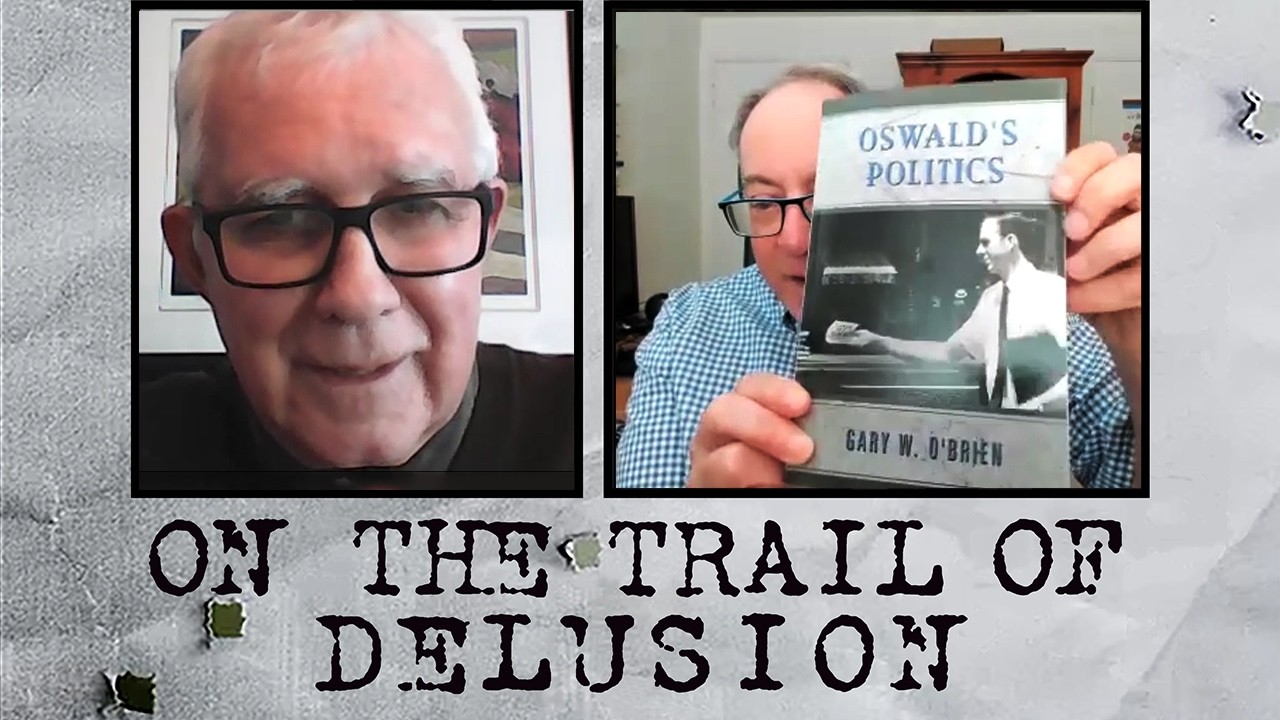
- On the Trail of Delusion, Episode 51, with Gary O'Brien on Oswald's Politics
It was a pleasure talking with Gary O'Brien, who also lives in Ottawa, about Oswald's politics. You can buy Gary's book here: Previous Relevant Blog Posts on Lee Harvey Oswald Episode 14 Scott Maudsley discusses Lee Harvey Oswald's antisocial personality disorder. Episode 27 Dr. Martin J. Kelly, Jr. talks about the psychology of Lee Harvey Oswald and Jack Ruby. Here is an AI summary of our talk: Executive Summary In this episode of On the Trail of Delusion, host Fred Litwin interviews Canadian scholar and former Clerk of the Canadian Senate Gary O'Brien, author of the book Oswald's Politics. The discussion focuses on Lee Harvey Oswald’s political writings, ideological evolution, and how his worldview connects to the assassination of John F. Kennedy—an area O'Brien argues was largely overlooked or mischaracterized by official investigations like the Warren Commission. Key Discussion Points 1. Re-examining Oswald’s Writings Neglected Documents: O'Brien emphasizes that primary writings like Commission Exhibit 25 (written returning from Russia) and Commission Exhibit 98 ("A System Opposed to the Communists") were ignored or dismissed as simple travel diaries. In reality, they articulate Oswald's specific political theories. Parallels to the SDS: O'Brien draws strong parallels between Oswald's 1962 writings and the Students for a Democratic Society (SDS) Port Huron Statement, noting Oswald frequently identified himself as a "student" and sought an academic environment for his Marxist studies. 2. Oswald’s Ideology and World Vision Hatred of the Modern State: O'Brien argues that Oswald was not a conventional Soviet-style communist or a simple "lone nut." Instead, his ideal system was a decentralized, libertarian-leaning local democracy with no centralized state, police, or monopolies. Selective Marxism: Oswald accepted Marx's moral critique of capitalism and the idea of the "withering away of the state," but rejected Soviet bureaucracy, vanguard parties, and centralized authority. Views on Russia and Cuba: Oswald viewed both the US and USSR as imperialistic modern states, writing that "Russia is a vile curse to Western man." Regarding Cuba, O'Brien notes Oswald supported anti-imperialism ("hands-off Cuba") rather than personal devotion to Fidel Castro, leaning toward a social-democratic "Castroism without Castro." 3. Link to Dealey Plaza Loss of Political Outlet: Following a public radio debate in New Orleans that exposed his time in Russia, Oswald realized his potential as an open political agitator was effectively over. Targeting the Symbol of the State: O'Brien suggests Oswald held no personal malice toward JFK, but viewed Kennedy as the leader of the oppressive modern state he hated. Precursor to 1960s Radicalism: O'Brien compares Oswald's mindset to the violent, underground factions that emerged later in the 1960s (such as the Weather Underground)—acting individualistically and destructively against state power. Previous Episodes of On the Trail of Delusion: Episode 1 My first guest was Robert Reynolds who is an expert on the JFK assassination files. Episode 2 Robert A. Wagner discusses his new book, JFK Assassinated. Episode 3 Gerald Posner discusses the JFK assassination and conspiracy theories. Episode 4 Dr. Martin J. Kelly, Jr. discusses conspiracy theories and the medical evidence in the JFK assassination. Episode 5 Steve Roe discusses the life of General Edwin Walker and Oswald's attempt to kill him. Episode 6 Gus Russo discusses his participation in the PBS Frontline documentary on Lee Harvey Oswald. Episode 7 Dave Perry tells some great stories about debunking JFK conspiracy nonsense. Episode 8 Nick Nalli explains some of the science behind the assassination. Episode 9 Alecia Long discusses Jim Garrison and his non-existent case against Clay Shaw. Episode 10 Don Carpenter discusses the life of Clay Shaw. Episode 11 Bill Brown discusses the murder of Officer J. D. Tippit. Episode 12 Eric Dezenhall discusses the relationship between the mob and JFK. Episode 13 Nick Nalli discusses the acoustics evidence and the Zapruder Film. Episode 14 Scott Maudsley discusses Lee Harvey Oswald's antisocial personality disorder. Episode 15 Document expert Robert Reynolds discusses what to expect in the upcoming JFK assassination file releases. Episode 16 A panel discussion on the document releases with Fred Litwin, Gus Russo, Robert Reynolds, Larry Haapanen, Mark Allen, and Steve Roe. Episode 17 An interview with author Michel Gagné about conspiracy theories. Episode 18 An interview with Phil Tinline about his book, Ghosts of Iron Mountain. Episode 19 An interview with Janet Banister, grand-niece of Guy Banister. Episode 20 The Marina Oswald Tapes. Episode 21 Dr. Chad Zimmerman discusses JFK's autopsy X-rays and photographs. Episode 22 Tour guide Daniel Evans talks about his years of researching the JFK assassination. Episode 23 Adam Gorightly discusses Fred Crisman, Thomas Beckham, Raymond Broshears and Kerry Thornley. Episode 24 A fun interview with Larry Haapanen who discusses the Garrison investigation, and his involvement with Project Blue Book. Episode 25 Dale Myers discusses the Tippit shooting and shows us some nifty animation. Episode 26 Brian Roselle discusses the timing of the first shot. Episode 27 Dr. Martin J. Kelly, Jr. talks about the psychology of Lee Harvey Oswald and Jack Ruby. Episode 28 Gus Russo talks about what happened to Lee Harvey Oswald in Mexico City. Episode 29 John-Paul Pagano discusses conspiracy theories, conspiracism and antisemitism. Episode 30 Dr. Robert Vitt talks about conspiracy theories, the early JFK researchers, and how to evaluate evidence. Episode 31 Josh Sundloff discusses conspiracy theories and his TikTok channel. Episode 32 A panel discussion of the single-bullet theory with Dr. Martin Kelly, Dr. Nick Nalli, Fred James and Scott Maudsley. Episode 33 Ernest Kearney discusses conspiracy theories and how to evaluate evidence. Episode 34 Steve Barber discusses the acoustics evidence and his visits with Robert Groden. Episode 35 Assassination researcher John Corbett stops in to talk about the case. Episode 36 Fred Litwin teaches Professor Robert Vitt's class at Long Beach City College. Episode 37 Steve Roe goes over the chain of custody of CE399. Episode 38 Todd Kwait discusses his documentary on the Warren Commission. Episode 39 Bill Brown gives us a tour of the Tippit murder scene. Episode 40 Fred Litwin reviews Sylvia Meagher's book Accessories After the Fact. Episode 41 Judge Burt Griffin talks about the Warren Commission and Jack Ruby. Episode 42 Journalist Terry Glavin drops in to talk about current events. Episode 43 Dr. Robert Vitt and I discuss how Sylvia Meagher treats Vincent Bugliosi's 53 pieces of evidence against Lee Harvey Oswald. Episode 44 I review Josiah Thompson's book, Six Seconds in Dallas. Episode 45 Jerry Dealey explains why he is sitting on the fence when it comes to the question of conspiracy. Episode 46 Jerry Dealey explains the ups and downs of the Texas School Book Depository. Episode 47 Joe Alesi presents from photos and letters from Ruth Paine. Episode 48 Robert Reynolds updates us on the JFK assassination records collection. Episode 49 Mark Stench turns the tables and interviews Fred Litwin Episode 50 Fred talks to Rob Clark who believes there was a conspiracy in the JFK assassination.
- Was Oswald Incensed by this Article?
Dallas Times Herald, November 19, 1963 Did Lee Harvey Oswald see this story? He read yesterday's newspapers every day at the the Depository, so it is likely he saw this -- probably on Wednesday, November 20, 1963. I am sure he would have been incensed by this story. This was discussed in the Warren Report. Just as he was probably angry about this story in the September 9, 1963, issue of the New Orleans Times-Picayune. Wesley Liebeler managed to get the Times-Picayune article into the 26 volumes, but not into the Warren Report itself. Here is a memo that Liebeler wrote to Rankin: Update Lee Harvey Oswald might have gotten wind of another American invasion of Cuba during his stay in New Orleans: Oswald writes that he infiltrated the DRE and that and that he called the New Orleans D.A.'s office with information about a bond issue that anti-Castro Cubans were selling for an invasion. Oswald must have been incensed at what the Kennedy administration was doing to Cuba. Previous Relevant Blog Posts about Lee Harvey Oswald Saint Lee Harvey was Good with Kids! Oswald liked kids, but does this matter? Was Lee Harvey Oswald on Acid? Was Oswald part of MK-Ultra? On the Trail of Delusion, Episode 14, Scott Maudsley on Oswald's Antisocial Personality Disorder A look at Oswald's motivations. Why Marina Was Interested in her Husband's Innocence She changed her views for her children. Did Lee Harvey Oswald Have a 'Crypto' Clearance? There is no evidence he had such a clearance. Was Oswald an Agent of the CIA, Part Two A look at the Lopez Report. Was Oswald an Agent of the CIA? James DiEugenio's does not read my posts. The Search for the Holy Grail Continues... James DiEugenio thinks erroneously that a CIA report on Oswald is secret. JFK Revisited: Were the Oswald Backyard Photographs Faked? Oliver Stone's so-called documentary gets it wrong. The Scholarship of James DiEugenio, Part Two The truth about the paraffin tests. The Scholarship of James DiEugenio - A Case Study What did Bill Turner actually write about the paraffin tests. Jim Garrison Claims Lee Harvey Oswald was a Victim I guess we should feel sorry for Oswald. Did David Ferrie Introduce Jack Martin to Lee Harvey Oswald in Banister's office? Garrison's office speaks to Jack Martin in December 1966. Did Delphine Roberts See Lee Harvey Oswald in Banister's Office? (Part Two) A look at Mary Brengel. Did Delphine Roberts see Oswald in Banister's Office? She didn't say so in 1967 Did David Ferrie Know Lee Harvey Oswald? They are in the same photo together but did they know each other?
- Robert Groden on the Three Tramps
Robert Groden, Ralph Schoenman, Dick Gregory and Stephen Jaffe were deposed by the Rockefeller Commission on March 26, 1975. Robert Groden on the Umbrella Man. Robert Groden was questioned about the three tramps. He believed that two of them were E. Howard Hunt and Frank Sturgis, but he would not state that it was definitive. Robert Olsen, counsel for the Commission, wanted to know if that was because Grosen was worried about a lawsuit. He said he wasn't concerned. But Groden was convinced that the three tramps were "involved in the assassination of President Kennedy." Money Quote: Mr. Olsen: Or because you don't want to expose them to any damage to their reputation, and so on? Mr. Groden: Let me state this as loudly and as clearly as I can. If I was worried about a lawsuit I wouldn't have taken a chance of being the man to liberate the Zapruder film. I am not worried about a lawsuit. Hunt and Sturgis are in all probability, cold-blooded killers by their own confessions, the way they have written. I have no fear of them. But if that is it not Hunt and Sturgis, the people who they are really are will go scot free, if people think it is Hunt and Sturgis. These men were to my way of thinking -- and I am totally in this -- were involved in the assassination of President Kennedy. They should be found and brought to trial. Mr. Olsen: You mean these derelicts were involved in the assassination? Mr. Groden: I would say beyond any shadow of a doubt at this point. Groden makes a big deal out of a supposed listening device in the ear of one of the policemen. The officer in question was Marvin Wise and he had cotton in his ear because of an infection. Here is how the HSCA described the three tramps: Previous Blog Posts on the Three Tramps Jim Garrison Discusses The Three Tramps Some incredible beliefs. The Three Tramps Introduction to the three tramps. Was Edgar Eugene Bradley One of the Three Tramps? Garrison's photo experts told him that Bradley was one of the tramps. Did Leander D'avy see Oswald with the Three Tramps? Some conspiracy theorists think D'avy is a good witness but he said he saw the tramps with Oswald in New Orleans. Was General Edward Lansdale in one of the pictures of the three tramps? Fletcher Prouty believed that Lansdale is one of the pictures of the tramps. Was Fred Crisman Behind the JFK Assassination? For a while, Garrison believed Crisman was a tramp. Was Fred Crisman one of JFK's Assassins? Crisman wasn't just a tramp, he was an assassin.
- Was Fred Crisman Behind the JFK Assassination?
Jim Garrison thought he was a very significant witness. Garrison subpoenaed Crisman to testify before the grand jury in New Orleans, but he had little to say. For quite some time, Garrison believed that Crisman was one of the three tramps. Here is an excerpt from Crawdaddy Magazine in 1975. Of course, we now know that Crisman was NOT one of the tramps. By the way, when I was last in Dallas, Robert Groden insisted that Crisman was one of the tramps. Garrison submitted three memos to the HSCA about Crisman. And, propinquity tied Crisman to Clay Shaw! Here is one of Garrison's memos to the HSCA, and don't worry, we'll be publishing the other two. It's all insane, in so many ways. What I find interesting is that you will not find one mention of Fred Crisman in Garrison's book, On The Trail of the Assassins. I wonder why. I have a complete chapter about Fred Crisman, and his so-called protege, Thomas Beckham, in my book On the Trail of Delusion - Jim Garrison: The Great Accuser.
- Did Leander D'Avy see Oswald with the Three Tramps?
Leander D'Avy is a witness that James DiEugenio believes helps establish that Clay Shaw was Clay Bertrand. Here is an excerpt from his book, Destiny Betrayed: (page 387) As DiEugenio says, D'Avy's interview (of November 29, 1967) was "utterly fascinating." We will get to that interview in a minute. Leander D'Avy was the doorman at the Court of Two Sisters, a bar/restaurant in New Orleans. He first contacted Jim Garrison's office on August 14, 1967. Gene Davis was a gay bar owner whom Dean Andrews once said was Clay Bertrand (Davis denied it). D'Avy believes he saw Lee Harvey Oswald at the Court of Two Sisters. It's interesting that while he saw Clay Shaw several times at the Court, he does not associate Shaw with Clay Bertrand. The next Garrison memo on Leander D'Avy is dated November 29, 1967: Garrison's notation on the bottom is intended for Lou Ivon and it reads: "Lou: Further information needed: 1. Photo of Louis Karno. 2. B/I Check (+ photo) of Mike Newman. 3. Last name of Gracie and Jose. (Let me know results of these checks + add them to the indicated files)." D'Avy has now embellished his story and brings in Dean Andrews. And, he now has Gene Davis telling him [in regards to Oswald] that "the kid has been behind the Iron Curtain." D'Avy was again interviewed on December 2, 1967. Here is the memo: Now D'Avy is certain that it was Lee Harvey Oswald at the Court of Two Sisters. Other people are now appearing at the Court - Sergio Arcacha Smith was there; Al Beauboeuf was there; David Ferrie looks familiar; Lawrence Howard was behind the bar at La Casa de Los Marinas; Novel looked familiar, Thornley looked familiar; Loren Hall looks familiar; and Guy Banister was in the Court talking to Gene Davis. Needless to say, Jim Garrison did not use Leander D'Avy as a witness in the Clay Shaw trial. In April, 1977, Leander D'Avy contacted military intelligence. He wanted to tell them his story. The FBI interviewed D'avy at military intelligence at Ft. Polk, Louisiana. Here is their report: The FBI transcribed the tape that D'Avy gave them. Here is the transcription: He claims in the tape that his lie detector test came out "negative." But, given D'Avy's mental state, I cannot tell if he means he passed or failed the test. The FBI then searched their files for information on D'Avy. And, they found an interesting tidbit: Leander D'Avy was interviewed by Belford Lawson and Jack Moriarty of the HSCA on June 23, 1977 in Washington. It appears that D'Avy just showed up: I have the full 33-page transcript, but I'll be only be posting excerpts here. D'Avy recounts his meeting of Oswald in 1962 - of course, we know this is impossible because Oswald is living in Dallas. He had earlier told Garrison 1963. But, he then starts to tell the story of going into the Court two weeks before the assassination: And, lo and behold, he now sees Lee Harvey Oswald with David Ferrie! As D'Avy says above, there were five people in the little apartment - Lee Harvey Oswald, David Ferrie, and three others. Well, who were they? They were the 3 tramps! And, one of the tramps now had whiskers! Might Gene Davis know the names of the three people? And, when asked for some details on Oswald, D'Avy had another bombshell - he had been slapped by Jack Ruby! The HSCA interviewers then tried to firm up exactly when D'Avy saw the men in the apartment. A fairly important question since Oswald was only in New Orleans for five months in 1963. Well, perhaps it was 1963, no? Just like that! 1963! Oh, and D'Avy said Oswald went to another bar that night as well: And, why did D'Avy wait so long to come forward with his story? Of course, he called Garrison in 1967, not 1968. It seems like he's off a year in everything. And the tramps? D'Avy then claims that he took a lie detector test for Jim Garrison: D'Avy describes being questioned by Jim Garrison: Towards the end of the interview, they asked a very interesting question: Interestingly enough, when searching for information on Leander D'Avy, I found this from the Opelousa Daily World of July 3, 1945: On July 8, 1977 Belford Lawson wrote a report about Leander D'Avy to Robert Tanenbaum, Deputy Chief Counsel. Here is their evaluation of D'Avy's credibility and their recommendations: Despite the fact that D'Avy's stories were ridiculous - and they could clearly see that - they still recommended further investigation. And so on December 16, 1977 HSCA investigators Bob Buras and L. J. Delsa met with Leander D'Avy at the Greyhound bus station in New Orleans. Here is the entire memo: D'Avy now says it was only the first and second tramp that he saw. And, Fred Crisman enters the scene. The report says D'Avy "identifies the photo of Fred Lee Crisman as a man that came around almost every week during 1963 and Gene Davis used to introduce him as "my daddy" in a joking manner. Crisman said he was from Baton Rouge." Of course, Crisman lived in the pacific northwest. Oh, and D'Avy says he also saw Thomas Beckham at the restaurant. On May 18, 1978, the HSCA interviewed Gene Davis, and he actually said he wasn't working at the Court in 1963. As I said at the beginning of this blog post, James DiEugenio found D'Avy's November 29th, 1967 statement to Garrison, "utterly fascinating." Joan Mellen also uses D'Avy as a witness to tie Shaw to Oswald. She believes that Betty Parrott (actually Parent), an FBI informant, corroborates D'avy's statements. She writes in her book, And Justice For All, that "that "FBI informant Betty Parrott knew Davis had been fired as night manager at the Court of Two Sisters for bringing Oswald upstairs." (page 123). Here is the report from Betty Parrott - note the last paragraph on the first page and the continuation on the second page: The timing of this memo is interesting. D'Avy had already talked to Garrison's office three times. Rather than being corroborating proof, this is perhaps evidence that there was an 'echo chamber' or a 'feedback loop' within the people in and around the D.A.'s office. We know that New Orleans was a cauldron of innuendo, rumors, and gossip, and Betty Parrott was one of the many people who were both speaking to Garrison and the FBI. The rumors even reached Shaw's lawyers. Here is a memo from Edward Wegmann from July 1967: This was right before D'Avy called Garrison, and the rumor here is that there was a relationship between Davis and Oswald. Might that have been D'Avy on the phone? Link Tracy Parnell also has a good discussion of Leander D'Avy on his website.
- Robert Groden on the Umbrella Man
Robert Groden, Ralph Schoenman, Dick Gregory and Stephen Jaffe were deposed by the Rockefeller Commission on March 26, 1975. Here is a short excerpt about the umbrella man: Money Quote: Mr. Groden: The man here with an open umbrella is the only one in the entire motorcade with an open umbrella on a day when it is no longer raining and it is windy. Immediately after the shots are fired the man stood there while all others ducked for cover, folded the umbrella, and looked after the motorcade, and walked to the edge and sat down. Mr. Olsen: Is there any significant to that? Mr. Groden: Well, they are very strange actions. The man has never been identified. At the moment the President's car passed in front of this man he punched the umbrella up and down and started to spin it and twirl it. It looks very much like he was part of the conspiracy, some kind of visual marking for the firing team. Mr. Olsen: So that the significance of this, in your opinion, is that it shows a man with an umbrella, and coupled with other testimony that has been offered, the conclusion that may be drawn from it is that he was delivering some signal? Mr. Groden: It would appear that way, yes. I can draw no other inference at all. To Robert Groden, the conspiracy inference is the only possible option. This is another example of where a conspiracy theorist jumps to a conspiratorial conclusion before considering something more mundane. I am not sure they the supposed firing team needed a visual signal. Wasn't Jim Hicks the communications man? Previous Relevant Blog Posts John Updike on the the Umbrella Man An early mention of the umbrella man. Dr. Wecht Cannot Rule Out a Flechette Wecht believes that Witt was a HSCA staff plant. Did The Umbrella Man Have Links to Clay Shaw? A case study in a ridiculous conspiracy theory. Oliver Stone doubles-down on the Looney Frontal Shot to the President Steve Roe exposes Oliver Stone.
- On the Trail of Delusion, Episode 50, with Rob Clark
My guest this week is Rob Clark who hosts The Lone Gunman podcast on YouTube. I can't believe it's my 50th episode! Here is an AI summary: Key Discussion Topics Origin of Interest & Background Rob Clark began researching the JFK assassination 35 years ago after being assigned John F. Kennedy for a high school president project. Oliver Stone’s 1991 movie JFK and subsequent file releases reignited his passion. He has hosted The Lone Gunman podcast for over 12.5 years (410+ episodes). Current State of JFK Research & NARA Digitization Clark describes the current state of research as "a mess." While most physical records have been released, the National Archives (NARA) has failed to provide accessible, searchable digital records (often publishing raw, non-OCR, high-resolution TIFF images page-by-page). They highlight independent efforts like the Malcolm Blunt Archives (digitized by Bart Kamp) as key resources superior to some official platforms for HSCA (House Select Committee on Assassinations) documents. Lee Harvey Oswald & Mexico City Clark notes his evolution from early conspiracy theories to analyzing tangible primary evidence (such as Oswald's handwriting across 1963 documents, rifle orders, and embassy letters). Clark concludes Oswald was definitely in Mexico City, explaining that irregularities on his Cuban visa application were likely administrative re-types and signatures executed by embassy personnel after Oswald left. JFK Conferences vs. Modern Media Both discuss how traditional JFK research conferences (e.g., Lancer, COPA) have become outdated, insular, or dogmatic. Litwin shares his experience being uninvited or protested for presenting newly uncovered files (such as Richard Case Nagell’s Stasi files from Germany). They argue podcasts, self-publishing, and open digital sharing allow researchers to reach wider audiences directly without conference gatekeeping. Sensationalism & Unreliable Witnesses They critique sensational claims and personalities surrounding the assassination (e.g., Tosh Plumley, Judith Vary Baker, Beverly Oliver, James Files, and QAnon presences in Dealey Plaza), emphasizing how exaggerated narratives harm genuine historical research. Rob Reiner Podcast, J.D. Tippit, and Sylvia Meagher They discuss Rob Reiner’s podcast (written with Dick Russell) and the lore surrounding Officer J.D. Tippit. Clark notes that digging into myths like Tippit at the Top Ten Record Store or Glaco station reveals how unverified stories become embedded conspiracy lore. Litwin critiques Sylvia Meagher’s Accessories After the Fact for discounting physical evidence linking Oswald to Tippit's murder. Rob Clark's Current Research Angle Clark shares his latest area of investigation: 1963 dynamics between anti-Castro exile groups (DRE / Directorio Revolucionario Estudiantil), the CIA, and gun-running operations in Dallas involving figures like Juan Salvat, John T. Mason, and ATF officer Frank Ellsworth. Previous Episodes of On the Trail of Delusion: Episode 1 My first guest was Robert Reynolds who is an expert on the JFK assassination files. Episode 2 Robert A. Wagner discusses his new book, JFK Assassinated. Episode 3 Gerald Posner discusses the JFK assassination and conspiracy theories. Episode 4 Dr. Martin J. Kelly, Jr. discusses conspiracy theories and the medical evidence in the JFK assassination. Episode 5 Steve Roe discusses the life of General Edwin Walker and Oswald's attempt to kill him. Episode 6 Gus Russo discusses his participation in the PBS Frontline documentary on Lee Harvey Oswald. Episode 7 Dave Perry tells some great stories about debunking JFK conspiracy nonsense. Episode 8 Nick Nalli explains some of the science behind the assassination. Episode 9 Alecia Long discusses Jim Garrison and his non-existent case against Clay Shaw. Episode 10 Don Carpenter discusses the life of Clay Shaw. Episode 11 Bill Brown discusses the murder of Officer J. D. Tippit. Episode 12 Eric Dezenhall discusses the relationship between the mob and JFK. Episode 13 Nick Nalli discusses the acoustics evidence and the Zapruder Film. Episode 14 Scott Maudsley discusses Lee Harvey Oswald's antisocial personality disorder. Episode 15 Document expert Robert Reynolds discusses what to expect in the upcoming JFK assassination file releases. Episode 16 A panel discussion on the document releases with Fred Litwin, Gus Russo, Robert Reynolds, Larry Haapanen, Mark Allen, and Steve Roe. Episode 17 An interview with author Michel Gagné about conspiracy theories. Episode 18 An interview with Phil Tinline about his book, Ghosts of Iron Mountain. Episode 19 An interview with Janet Banister, grand-niece of Guy Banister. Episode 20 The Marina Oswald Tapes. Episode 21 Dr. Chad Zimmerman discusses JFK's autopsy X-rays and photographs. Episode 22 Tour guide Daniel Evans talks about his years of researching the JFK assassination. Episode 23 Adam Gorightly discusses Fred Crisman, Thomas Beckham, Raymond Broshears and Kerry Thornley. Episode 24 A fun interview with Larry Haapanen who discusses the Garrison investigation, and his involvement with Project Blue Book. Episode 25 Dale Myers discusses the Tippit shooting and shows us some nifty animation. Episode 26 Brian Roselle discusses the timing of the first shot. Episode 27 Dr. Martin J. Kelly, Jr. talks about the psychology of Lee Harvey Oswald and Jack Ruby. Episode 28 Gus Russo talks about what happened to Lee Harvey Oswald in Mexico City. Episode 29 John-Paul Pagano discusses conspiracy theories, conspiracism and antisemitism. Episode 30 Dr. Robert Vitt talks about conspiracy theories, the early JFK researchers, and how to evaluate evidence. Episode 31 Josh Sundloff discusses conspiracy theories and his TikTok channel. Episode 32 A panel discussion of the single-bullet theory with Dr. Martin Kelly, Dr. Nick Nalli, Fred James and Scott Maudsley. Episode 33 Ernest Kearney discusses conspiracy theories and how to evaluate evidence. Episode 34 Steve Barber discusses the acoustics evidence and his visits with Robert Groden. Episode 35 Assassination researcher John Corbett stops in to talk about the case. Episode 36 Fred Litwin teaches Professor Robert Vitt's class at Long Beach City College. Episode 37 Steve Roe goes over the chain of custody of CE399. Episode 38 Todd Kwait discusses his documentary on the Warren Commission. Episode 39 Bill Brown gives us a tour of the Tippit murder scene. Episode 40 Fred Litwin reviews Sylvia Meagher's book Accessories After the Fact. Episode 41 Judge Burt Griffin talks about the Warren Commission and Jack Ruby. Episode 42 Journalist Terry Glavin drops in to talk about current events. Episode 43 Dr. Robert Vitt and I discuss how Sylvia Meagher treats Vincent Bugliosi's 53 pieces of evidence against Lee Harvey Oswald. Episode 44 I review Josiah Thompson's book, Six Seconds in Dallas. Episode 45 Jerry Dealey explains why he is sitting on the fence when it comes to the question of conspiracy. Episode 46 Jerry Dealey explains the ups and downs of the Texas School Book Depository. Episode 47 Joe Alesi presents from photos and letters from Ruth Paine. Episode 48 Robert Reynolds updates us on the JFK assassination records collection. Episode 49 Mark Stench turns the tables and interviews Fred Litwin
- Outside Contact Reports on Marguerite Oswald
Marguerite Oswald at home in her shrine to her son. Money Quote: She claims she is "under wraps" now, which she explained to mean under total and constant surveillance, with unnamed persons moving to thwart her every move. Example: she has never been able to publish book or major article ... several months ago she "thought I would finally be recognized", contacted 26 major publishers, all turned her down. I don't know if Richard Schweiker ever spoke to Marguerite and I doubt she gave anything of value to his sub-committee. Here is an outside contact report from the HSCA: Money Quote: Mrs. Oswald then stated that "you are not interested in the most important people." By this and her following comments I had the impression that she was speaking of a power which included the CIA but was even more powerful. She stated that "The CIA is only a part of it all, My whole family was taken over. I will tell you that for the record." She stated that the "minds" of the members of her family have been taken over by "an incredible force." She further states that "I was taken over even before the assassination. Even before they got Lee." She would not state when she thought this had occurred. Some bonus Marguerite Oswald content: Previous Relevant Blog Posts on Marguerite Oswald Saint Lee Harvey was Good with Kids! JFK Facts tries to paint Lee Harvey Oswald as a good guy. Did the Jewish People Hire Jack Ruby to Kill JFK? Marguerite Oswald goes to the FBI with quite the story. Marguerite Oswald Sends a Telegram to Jim Garrison Garrison got her upset. Garrison Investigators Talk to Marguerite Oswald No shortage of crazy stuff here.
- John Connally's Back Wound
The bullet hole in the back of Connally's suit jacket. Unfortunately, Nellie Connally had the jacket dry-cleaned after the assassination. Hat tip: Tim Nickerson. The horizontal elongation of the wound in John Connally's back proves that it was caused by a bullet that was yawing. Here is Dr. Shaw's operative report: Dr. Shaw's report was written on the day of the assassination and he writes that "the wound of entrance was approximately three cm in its longest diameter." When Dr, Shaw testified before the Warren Commission, some five months later, he described the wound as follows: He explained this during an interview with the HSCA: Here is the diagram that Dr. Shaw submitted to the Warren Commission: But the wound was in the horizontal plane. Connally removed his shirt for the HSCA and they examined his scar: The holes in Connally's clothes were also elongated horizontally: Here is an FBI report: Dr. Cyril Wecht also noticed that Connally's back wound was elongated in the horizontal plane. Here is an excerpt from his testimony before the Rockefeller Commission: Dr. Wecht believed the horizontal nature of Connally's back wound meant that the bullet came from the right side or right rear: Larry Sturdivan dismissed that possibility: Sturdivan went into more detail in his book, The JFK Myths: In other words, there is no way that a bullet could directly hit Connally from the right rear at an acute angle and then exit from the right front of his chest. Here is how the HSCA analyzed Connally's back wound: Connally's back wound supports the single-bullet theory, and Dr. Wecht's alternative explanation -- that the bullet entered at an acute angle -- just doesn't hold much water. Previous Relevant Blog Posts on the Medical Evidence On the Trail of Delusion, Episode 21 with Dr. Chad Zimmerman Dr. Zimmerman has examined JFK's autopsy photographs and x-rays and I have also included his notes from that day. Was Hoover's Warren Commission Testimony Altered? Was Hoover's testimony altered to hide the medical evidence? The Parkland Doctors, Part Six A look at Dr. McClelland's recollections over the years. Marilyn Sitzman on JFK's Head Wound Sitzman, who was standing right behind Abraham Zapruder, thoughts the shots came from the TSBD and that she clearly saw Kennedy's head wound over the right ear. John Stringer on JFK's Wounds and his Autopsy Photographs Stringer was very clear that he took the photographs of JFK's brain. The Parkland Doctors, Part One Attending physicians often make mistakes in determining the nature of gunshot wounds. Should we care what the Parkland doctors think? The Parkland Doctors, Part Two A look at what the Parkland doctors wrote and what they said. The Parkland Doctors, Part Three The Boston Globe interviewed some of the Parkland doctors in 1981. The Parkland Doctors, Part Four A 1992 article in the Journal of the American Medical Association has some interesting comments from a few of the Parkland doctors. The Parkland Doctors, Part Five An interesting interview with Dr. Robert McClelland. Why Autopsies are Needed The doctor treating John Lennon was mistaken about his wounds. Dr. Cyril Wecht Complains Wecht complains about the HSCA's forensic pathology panel. Dr. Cyril Wecht writes to Dr. Michael Baden Wecht has a suggestion for Dr. Baden. The Wecht Conclusion that Dare Not Speak Its Name, Part Two Wecht's memoir mentions his examination of the autopsy materials in 1972 but neglects to talk about his conclusion that the fatal head shot came from behind. The Wecht Conclusion that Dare Not Speak its Name James DiEugenio's obituary of Dr. Wecht leaves out his conclusion that the fatal head shot came from behind. Dr. Cyril Wecht (1931 - 2024) זיכרונו לברכה My obituary for Dr. Cyril Wecht. Dr. Cyril Wecht Rules Out a Head Shot From the Front A letter from Dr. Wecht to Thomas Stamm on the head shot. Sylvia Meagher and Dr. Cyril Wecht Discuss the Head Shot A letter from Dr. Wecht to Sylvia Meagher on the head shot. "JFK Revisited" Misleads on JFK's Throat Wound Dr. Wecht believes that JFK's throat wound was one of exit. "JFK Revisited" Misleads on JFK's Brain, Again... Dr. Robert Kirschner's consultation with the ARRB explains a mystery in the documentary. "JFK Revisited" Misleads on the Weight of JFK's Brain JFK Revisited makes a big deal about the weight of JFK's brain and ignores a non-conspiratorial explanation. JFK Revisited Distorts John Stringer's Testimony Oliver Stone's so-called documentary makes it sound like the autopsy photographer said that he did not take the photos of JFK's brain that are in the current inventory, "JFK: Destiny Betrayed" Misleads on Dr. Charles Crenshaw Oliver Stone's so-called documentary series, JFK: Destiny Betrayed, features Dr. Charles Crenshaw to bolster its claim that President Kennedy was shot from the front. Viewers are not informed of Dr. Crenshaw's credibility problems. "JFK: Destiny Betrayed" Misleads on JFK's Head Wound, Part Three Oliver Stone's so-called documentary, JFK: Destiny Betrayed, misleads viewers on the opinions of Parkland Hospital doctors and Bethesda witnesses regarding JFK's head wound. "JFK: Destiny Betrayed" Misleads on the Harper Fragment Oliver Stone's so-called documentary series, JFK: Destiny Betrayed, misleads viewers into thinking the Harper fragment was occipital bone that came from the back of Kennedy's head. Dr. Joseph Dolce: Another Problematic Witness from "JFK: Destiny Betrayed" Have a look at Dr. Joseph Dolce's bad judgment "JFK: Destiny Betrayed" Misleads on JFK's Head Wound, Part One Oliver Stone's so-called documentary series JFK: Destiny Betrayed uses a variety of supposed witnesses to allege that the wound in the back of Kennedy's head was one of exit. Audrey Bell is one such witness and she doesn't have much credibility. "JFK: Destiny Betrayed" Misleads on JFK's Head Wound, Part Two Oliver Stone's so-called documentary series, JFK: Destiny Betrayed, tries to make the case that because Parkland Hospital doctors saw cerebellum extruding from Kennedy's head wound, that it indicated an exit wound. "JFK Revisited" Misleads on Kennedy's Back Wound While Gerald Ford edited some language in the Warren Report, he did not change the location of the back wound. Autopsy photographs show exactly the location of the back wound. "JFK: Destiny Betrayed" Misleads on JFK's Autopsy Oliver Stone's so-called documentary series, JFK: Destiny Betrayed, alleges that autopsy pathologists were told to fit the wounds to a presupposed conclusion. On the Trail of Delusion, Episode 2 with Robert A. Wagner A podcast with Robert Wagner who has written an important book on the medical evidence.
- Thomas Powers Reviews "Marina and Lee" and "The Oswald File"
Thomas Powers won a Pulitzer Prize in 1971 together with Lucinda Franks for his articles on Weatherman member Diana Oughton. New York Times, October 30, 1977 Money Quote: It is not just easy, but almost irresistible, to make fun of the Kennedy assassination skeptics, with their Oswald doubles and triples, the ectoplasmic gunmen on the grassy knoll, the phantom C.I.A. agents hovering over Oswald's shoulder, the logical proof that Oswald, the so-so Marine sharpshooter, could not have fired the fatal shots. They remind me of those arguments that Marlowe or Bacon must have written "Hamlet," for no better reason, when you got down to it, than that writing "Hamlet" must have been beyond a bumpkin of no breeding from Stratford-on-Avon. But conspiracy-spinning isn't amusing, because it isn't a game. Doubt has become the last frontier of the American dissidents the point they will not yield. Once upon a time, they believed America might transcend racism, poverty, injustice and war; now they are hunting villains among the ectoplasm. If that strikes you as funny, well . . . it doesn't me. Powers takes apart Michael Eddowes' book, The Oswald File. Eddowes was the writer who was convinced that Lee Harvey Oswald had been replaced and that an imposter was in his grave. Oswald's body was exhumed and his theory was found to be ridiculous -- the body was indeed that of Oswald's. Previous Relevant Blog Posts on Marina Oswald Saint Lee Harvey was Good with Kids! Perhaps but he beat his wife. On the Trail of Delusion, Episode 20: The Marina Oswald Tapes The FBI bugged Marina's phone after the assassination, and here are the highlights. Why Marina Was Interested in her Husband's Innocence Marina was interested in any development that would absolve her former husband of Kennedy's murder "for the sake of the kids." Morley's Interview of Marina Oswald Porter Fizzles! Morley forgets to ask Marina the important questions. Was Marina Oswald Involved in the JFK Assassination? Fletcher Prouty writes that Marina Oswald might have been involved. Jim Garrison Claims Lee Harvey Oswald was a Victim Garrison writes to Marina Oswald. Marina Oswald's Doctor was a Homosexual! Here is a memo written to Jim Garrison by Roger Craig. Jim Garrison's Grand Juries... Marina Oswald was fearful of Garrison's subpoena.