

Professor Pearcy's Bad History Lesson

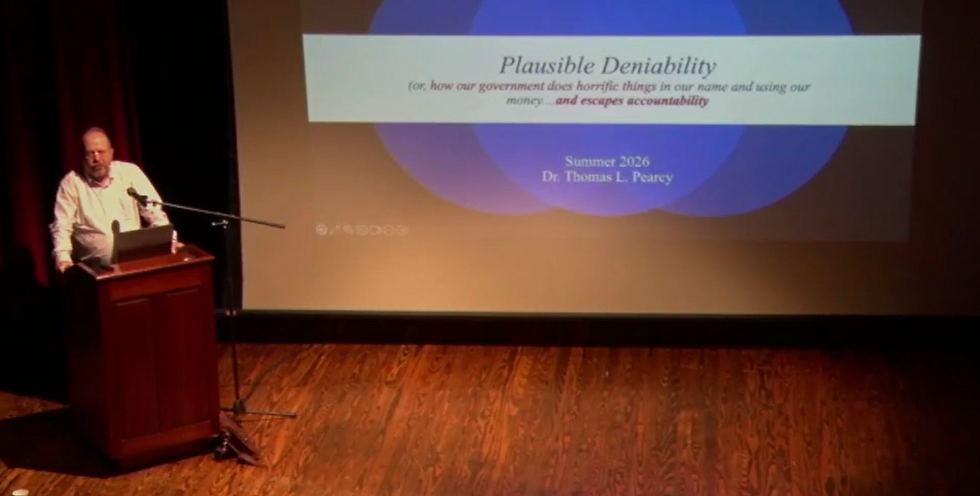
The people who came to hear an esteemed historian lecture on a fairly important topic instead heard a conspiracy theorist spouting a bunch of recycled speculations and factoids. He doesn't get around to discussing his supposed important document finds for over an hour, until my point ten below. And thus, the conspiracist part of his lecture helps us assess the credibility and reliability of his personal account of what happened in the SCIF.
Pearcy's performance should be embarrassing to Jefferson Morley who hoisted his implausible claims through his JFK Facts Substack.
Should Anna Paulina Luna decide to have Professor Pearcy testify before her Committee, I hope that some of the members will investigate and cross-examine him properly. I suspect that Pearcy is not quite ready for prime time.
There were a number of memorable moments during his speech, and since this a very long post, I have divided them into categories:
His claims of seeing a nonexistent Inspector General's report and an unredacted Hawkins report (points 10 -13)
Dealey Plaza buff arguments (points 5 - 9)
The dismissive Pearcy (point 1)
Deep State nonsense (all other points)
Here is a complete transcript of Pearcy's lecture.
Here are the highlights in chronological order.
Pearcy mentions my blog post (21:14)
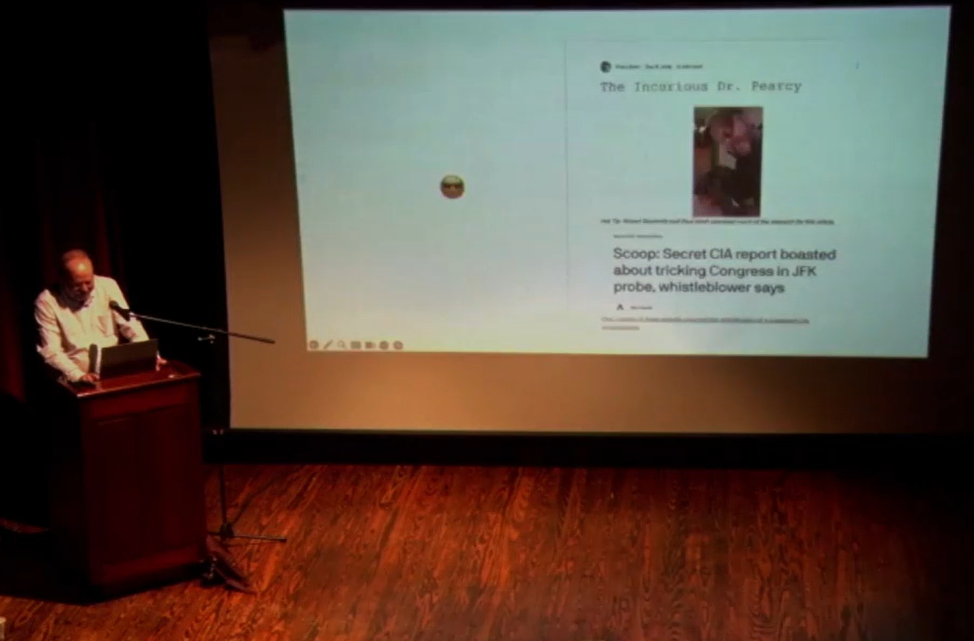
Pearcy: First, one of the great things about this experience has been, I had never been trolled before, and I love being trolled. Some nut writes this story about the incurious Dr. Pearcy, and I showed this to my class. I was like, "This guy lit into me. 'He's making these things up. We just, oh my God, that document's already been in the public realm for 30 years, and he doesn't know what he's talking about.'" And he insulted me, not with that picture, but included my buddy Mac. I mean, that's like a declaration of war, you know. He's getting my dog involved, my son's dog. But I start there because, it was for me, I actually reached out to Morley. I said, "Jeff," he's like, "don't worry about it. They're they're, people talk about things that they don't know anything about, and the end."
I am glad he noticed my blog post, but I would have preferred a substantive response rather than a complete dismissal. Paul Hoch, Robert Reynolds and I put a lot of work into that post and we were not trying to troll Pearcy -- we were trying to clarify some of the issues, and share some of his documented record as a conspiratorial JFK buff.
And how did I insult him? Pearcy claims it's "like a declaration of war." Just by including a photo of Pearcy with his dog? Is being flippant the only response he can make?
“I encourage my students not to believe me,” Pearcy explained. “I want them to go find the documents. I want them to think critically and not just to accept someone else’s opinion.”
The Sixth Floor Museum is a False Flag Operation (28:05)
Pearcy: Now, my course on disinformation has evolved over time because more
information has become available, and I'm going to walk way along the edge of
ice here. If you, if anyone sees a black Suburban, let me know, okay. One really good example of a false flag operation is the Sixth Floor Depository in Dallas, Texas. If you've ever been there, it is completely a false flag operation, and I know the people that run the false flag operation. I will not say it here because I still enjoy family life, but we'll probably get that in the Congressional Record at some point.
Is Stephen Fagin part of the CIA? I'll have to ring my colleagues at Langley and find out more.
James Angleton Determined that JFK Needed to Die (29:55)
Pearcy: I was asked by a friend, before we started tonight, about the oath that I took to protect our nation, and I would never ever violate an oath to protect our nation. I know where our nuclear weapon systems are located, the warheads, the propulsion, the guidance. I'm aware of these things. I would, would be killed before I would betray my country. I believe that people who do awful things in our names, things that, and you can run up with the Epstein files, whatever example somebody wants to pull up with -- avoiding accountability, just because you can, is not national security. And, the Director of Counterintelligence deciding in October and September of 1962, that John Kennedy needed to die, that's not in our national security. That's because he had just issued a National Security Action Memorandum 263 which ordered all troops withdrawn from Vietnam by December of 1965. That's when the decision was taken that he needed to die.
So, James Angleton decided that Kennedy "needed to die" in September and October of 1962. And all because of NSAM 263?
But NSAM 263 was issued in October of 1963. Did Pearcy just get the date wrong of when Angleton issued the order to kill JFK. If Angleton only decided in October 1963, he would have had to work pretty fast, no?
NSAM 263 said "The objectives of the United States with respect to the withdrawal of U.S. military personnel remain as stated in the White House statement of October 2, 1963." That statement indicated a belief that the troops could be withdrawn sometime in 1965 predicated upon the success of South Vietnamese troops to stop the insurgency.
And Pearcy doesn't mention clause 1:
It remains the central object of the United States in South Vietnam to assist the people and Government of that country to win their contest against the externally directed and supported Communist conspiracy. The test of all decisions and U.S. actions in this area should be the effectiveness of their contributions to this purpose.
CIA Talking Head Claims the Agency Killed Six Million People (42:15)
John Stockwell: We've set out to overthrow functioning constitutional democracies in over 20 countries. We manipulated elections in dozens of countries. We created standing armies and directed them to fight. We went after to organize ethnic minorities to encourage them to revolt. The first thing we did in Nicaragua was to go to the Mosquito Indians, who had never gotten along with the other people in Nicaragua very well, and give them more money than they had seen in the entirety of history, and arms and training and rationales and sanctuaries in Honduras and sent them into Nicaragua to attack, kill, fight, rape, burn, pillage, and this has been a technique the CIA has used in Nicaragua, in Thailand, in Vietnam, in Laos, in the Congo, in Iran, Iraq, with the Kurds in different parts of the world. We created, trained, and funded death squads like the Treasury Police in El Salvador, and we've assassinated world leaders, including the United States president in 1963. And I'll get to that in more detail in just a moment. You can never be sure how many people are killed in the jungles of Laos or the hills of Nicaragua, but adding them up as best we can, we come up with a figure of six million people killed. Minimum figure, it has to be more than that. These things are all done in countries of the third world, where the governments don't have the power to force the United States to stop destabilizing the country and brutalizing their people.
John Stockwell lost a lot of his credibility when he also became a JFK assassination conspiracist. Here is a blog post that has a document he wrote after meeting with fabulist Tosh Plumlee.
Stockwell claims that the CIA assassinated JFK, and promises to get into more detail later in his speech. Here is what he later said about the JFK assassination: (50:00)
Stockwell: John Kennedy, the president, and his brother Bobby, the Attorney General, had for years been waging a war against the Mafia, trying to put the leaders in jail, throwing Carlos Marcello, the Don from New Orleans, out of the country, going after them in a serious, systematic way, and it turned out that there were numerous threats and indications of the Mafia's plans to kill the Kennedy brothers, the war as they saw it between themselves and the Kennedy brothers. So what happened was a team of what they call CIA renegades, because it wasn't the coat and tie people inside the building like myself and David McMichael. I think is sitting in the back, CIA officers who were of the establishment inside. It was the renegades down in Florida who were working this destabilization activity against Cuba, working with Cuban exiles, overlapping greatly with the Mafia, which was involved in this flow of drugs from Cuba into the United States. These people plotted a military-style ambush in Dallas, and they set up a team of shooters on the top of buildings. They had the cooperation of someone in the Secret Service. They had the cooperation of the Dallas police. They got the parade route redirected. They got Kennedy into this, the cars into this place where we would have to make 120-degree turn. The Secret Service driver stopped when the bullets began flying, and anyone who's been through that kind of training -- and I've been through their bang and burn courses --- they drill it into you that when the bullets start flying in a situation like you have a president or yourself or something, you mash down on the gas and you get the hell out of there. You don't stop and look around as a seasoned Secret Service driver did, in fact, and Kennedy was shot down short distances from shooting stations, probably four of them, firing probably seven shots. He was hit twice: once in the back, once in the front of the neck, and twice in the head. Connally was hit once or twice. Two bullets were fired on each side of the thing, the convoy then blasted away and got out of there. Immediately, the FBI launched the cover-up. The announced purpose by the people in the establishment being to prove, to reassure, as they put it, the nation that it was the work of the lone assassin Lee Harvey Oswald. The evidence was tampered with massively. The president's body was altered. The photographs of the autopsy were altered, and forty-nine witnesses were killed. So they could not blow the whistle and testify and blow this thing open. Until this day, despite the fact that the House Committee in 1979 concluded that it was a conspiracy, there has been no formal investigation by the Justice Department of the conspiracy to kill our president. This was nothing less than a coup d'état.
Forty-nine witnesses were killed? The conspirators had the cooperation of the Dallas police and the Secret Service? The motorcade route was changed? JFK's body was altered? The autopsy photographs were altered?
Perhaps Professor Pearcy could have found a better expert.
Katzenbach and Hoover (50:44)
Pearcy repeats his claim that Deputy Attorney General Nicholas Katzenbach was not interested in the truth about the assassination.
Pearcy: President Trump issued this executive order, in the three previous investigations into the assassination, and by the way, Jefferson Morley even, let alone Representative Luna, did not know what I'm about to tell you. When the Warren Commission investigated the assassination, by the way, the decision was made what the conclusion was within 24 hours. There's something called the Katzenbach memo, who was the acting, the Deputy Attorney General under Bobby Kennedy. The day that John Kennedy was buried. Katzenbach wrote a memo and said, "We've got to convince the American people that this is what happened."
But J. Edgar Hoover let it be known, the night of the assassination that, as Mark Lane said, "Case closed. We've got our man."
I covered this in my blog post on Pearcy's radio appearance. Katzenbach said nothing of the kind.
As for Hoover, like many people, he was convinced early on that Oswald was the assassin (how could they not, the evidence was overwhelming), but at no time did his agents stop investigating, and leads were coming in all over the place.

Pearcy on the Medical Evidence (55:45)
Pearcy: Groden became the forensic photographer for the House Select Committee on Assassinations. A couple of important things happened in the 70s. Now the story is the same. The House Select Committee was supposed to rubber stamp the Warren Commission report, and they were going to do this. Two things happened. First, Robert Groden. So, Groden goes in there after he's on Geraldo Rivera, and the first thing he does, In those days, you didn't have Photoshop or AI, and it was very expensive to amend or alter photography, and there were very few organizations that did it well. None better than the U.S. intelligence community. They used a technique called matting, M-A-T-T-I-N-G. And Groden pointed out that if you look at a matted photograph under a 3D viewer, you can see the actual photograph. And he told me about this. He literally did what any good curious historian would do. Once he realized what was going on, he looked at the actual photographs, and if you've ever seen an actual photograph, the photograph that was released is that there's a very nice, neat entry hole here and a skull flap. The actual photographs aren't so pleasant. I know the radiologist who conducted radiology on the president's remains that night. Gerald Custer. Now, why he did this, I don't know. He alarmed me when he said it, but he was like, he said that whole, there was no brain. Of course, there wasn't. It had already been removed. But he said I stuck my fist inside the president's head. I'm like, dude, you are not well. You know why? Why would you honkin' do that? But the point is, Groden discovers, looking at the actual photographs, the truth that the entire back of the head is gone. And oh, by the way, the wound that was supposed to have gone through the president and out his neck and blew off the right nipple of Governor Connally, so now we have a one-nipple governor. That that bullet wound in the lower spine had no trajectory; it went in about an inch and it fell out on the floor. And Dr. Humes picked it up in the autopsy room and handed it to agents Sibert and O'Neill, but that story didn't break until 1980. And my paranoid friend David Lifton broke that story.
Where do I have even start with this? Robert Groden couldn't convince any of his colleagues at the HSCA that any of the autopsy photographs had been altered. Groden "discovers" that the whole back of the head is gone? Pearcy believes that the first bullet hit JFK in the back, went in an inch, and fell out during the autopsy, and that Dr. Humes picked it up.
These are not the words of an historian. Even Pearcy's friend David Lifton was never that careless with details.
The Acoustics Evidence (58:42)
Pearcy buys into the acoustics evidence and doesn't say one word about the NAS conclusion that the Dictabelt did not record the shots.
Pearcy: But, the other thing that happened, along with the autopsy pictures, is they were literally preparing to wind it up, and a little old lady, a little person, a sweet old person, a sweet person, younger than me, calls up the House Select Committee and says, "Hey, why don't you come out to Dallas, and in the Dal-Tex Building there are records, and there are dictabelts. She said there was a police officer in the motorcade that day who had his microphone stuck on. You might want to hear that recording. Yeah, that might be a good idea. So Blakey goes out there, they listen to it, and the official conclusion of the House Select Committee on Assassinations was that there was a 90 percent probability of a conspiracy. And literally, the Warren Comm -- we have two standing decisions: One is that Oswald did it alone. One is that conspiracy, meaning more than one person. But the cool thing about the dictabelt is the acoustics in Dealey Plaza are pretty straightforward. So they did acoustic fingerprints. So enterprising Groden, more recently, superimposed the actual shots that were picked up on the microphone onto the video, and that's what I'd like to show you now.
Pearcy then plays the Zapruder film with the sounds of four shots superimposed on the video. But he does not mention that the HSCA agreed with the Warren Commission that Oswald fired three shots and killed JFK.
The Harper Fragment (1:02:10)
Pearcy claims that the Harper fragment was found 75 feet to the rear of the limousine.
Pearcy: There was something called the Harper fragment, a piece of the skull that was found 75 feet to the left rear of the limousine, by a law student.
That is just not true. The Harper fragment was found to the left front of the limousine, completely in line with a shot from the rear.
Gordon Arnold on the Grassy Knoll (1:02:22)
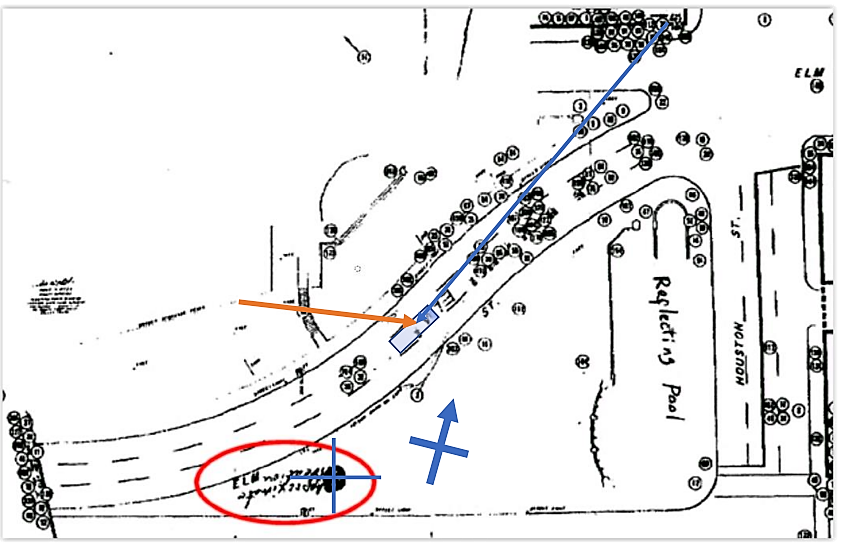
Pearcy then recounts the story of Gordon Arnold, who was a star figure in the series "The Men Who Killed Kennedy."
Pearcy: In the aftermath of all this, of course, there were a lot of people, there's an active-duty soldier, on the grassy knoll, filming. And he hears a bullet come over his head. He's seen live action. And a guy trembling approaches him and says, "Were you filming that, I need your camera." And he's like "dude, on my life, this is my mother's camera." Smart guy. But the guy grabbed his camera and ripped the film out of it. And this happened over and over all over Dealey Plaza. There were no Secret Service agents on the ground in Dallas that day. Not one. Zero. No FBI agents. Nothing. That's all part of the way he was assassinated and if you are interested, I can explain that later.
Gordon Arnold didn't come forward with his story until 1978, and there is no evidence to support any part of his story. You can read more about Gordon Arnold here.
10. The Discovery of the "Document" (1:10:00)
Here is Pearcy's description of how he came across the document that is central to his account of being a whistleblower.
Pearcy: Anyway, I happened upon—I ordered a folder that was so sensitive that everybody in the Compartmented Information Facility had to vacate. Even the CIA historian. Nobody had clearance except me to be there when this box arrived. Those things have to be couriered ... by people who have the clearance equal to the contents of the box. And a courier is always accompanied by an M4-toting person that helps make sure that they get there. And if the tape—if the packaging has been messed with, a federal law has occurred. There—it's serious. So, this thing shows up.
I'm going through this, and here's this folder in the middle. I didn't—my search terms did not include JFK, or the assassination, or Lee Harvey Oswald. None of those things. And that's what makes the story kind of funny. But I pulled this folder out. I had the legal authority and right to do so. And it was literally a 50-page Inspector General's report after the House Select Committee had—G. Robert Blakey had visited Langley. They had completely forged—now when I say forged, when you say sanitize and redact, you draw lines through it. That's not what I'm talking about. They had their own bindery, and they do a beautiful job of it. And—and the Mexico City records, the people that call me incurious are sure that I don't know what I'm talking about, because there was a sanitized version of this released, and so I don't, you know—and none of them have ever been in the box where I was. I know what I worked with. I remember the search terms, the Boolean logic combination that I used perfectly. I have a photographic memory when it comes to this stuff.
But literally, they did an internal review, a secret internal review to see if they had fooled Congress and the American people. And it was very disrespectful of G. Robert Blakey. I won't go into detail here, but this is why I finally reached out to Morley in 2018. These, the senior CIA brass that accompanied—the one person that accompanied Morley [sic] and took him these falsified records, they are praying literally to God. I mean, they were nervous, because if he asks any questions, "Well, what about this?", they're in trouble. But the Agency knows that unless you've been in the Agency, you have no way of having any clue what they do or don't have.
So Blakey sits down, goes through these things, stands up, says, "I have no questions." And the after-action report said G. Robert Blakey is the most uncurious human being I have ever interacted with.
And that is CIA after-action report speak for "What a dipshit." I mean, I—pardon the language, but they're making fun of him. You know, they got away with it.
So, Pearcy enters some Boolean-logic search terms seemingly related to the 1980 Romero assassination, and is given a box of documents. The Inspector General's report is inside this box -- clearly this report has been filed erroneously in this box. And so if the filing of this report is in error, then the only way the CIA could possibly retrieve that document is to use Pearcy's search criteria to get the same documents.
The SCIF (1:15:20)
A SCIF is a Sensitive Compartmented Information Facility. It's a specially built room so that people can discuss and look at classified national security information.
Pearcy: So I see this IG report, and I'm like, "Well, this rocks. We did it, and we covered it up." The important thing is, is that IG report—that Inspector General's report—details methodically and painstakingly exactly how the Central Intelligence Agency did this. Sometime later, I'm downstairs—and I'll show you something kind of funny in a moment—but I was in an area called the Declassification Center. And these sites are not places where there's water fountain chit-chat. No, you don't speak to the people who work in the SCIF next to you. You have no idea what they do, they have no idea what you do. The SCIF right next to where I worked in this building was labeled the "Terrorist Media Center." So when we went into Abbottabad and we got Bin Laden, and we got his hard discs and we got his floppies and his jump drives, they were in that SCIF within 24 hours where intelligence analysts work with them. But it's a weird and interesting kind of a place to work. So I go downstairs to this area where the CIA historians have never been. You do not enter unless you have a reason to, and I did. I was actually looking at the assassination of Archbishop Romero. So I'm down there, and oddly enough, there's a SCIF within a SCIF, so kind of a vault within a vault. And over here's this vault within a vault, the door's open, and then there's this woman named Mary speaking very loudly in a Northport, New York accent, and I'm cracking up. But it's hard to read about Archbishop Romero's assassination and, and you know ... and that's an environment where you cannot act surprised at anything. And my assistant person who was helping me with redactions said, "Oh, don't, don't bother, don't worry about her. That's just Mary. She takes care of making sure certain Kennedy artifacts will never see the light of day."
Now, of course, Tom Pearcy wants to say, "WTF?" Right? "What... what..." you know. But I had to act like I didn't hear it. But afterward, as I stand up to leave, she said, "Would you like to meet Mary?" And I was like, "Ah, sure, you know, why not?" And, I go into this room where they have a list of every human being that's ever entered. There were 50 names on it. I did not sign it because I introduced myself to her as the nation's Joint Historian, and we had a nice chat. But as we're chatting, I'm just looking around, and there was a video, a movie, of Lee Harvey Oswald meeting with the CIA station chief in Mexico City in September of 1963. That's very significant for reasons I, I won't address here, but if anyone has questions afterward, I absolutely will.
A video of Oswald meeting with the CIA Station chief in Mexico City? And a woman who makes "sure certain Kennedy artifacts will never see the light of day."
Pearcy talks about "my assistant person who was helping me with redactions." Who is this person, and is this person a witness who can confirm Pearcy's story about such a SCIF?
Pearcy then shows the floor plan of the building and then talks further about this SCIF: (1:19:39)
Pearcy: And inside the Declassification Center is the... what I dubbed, and, and trolls immediately pounced on, and the CIA denounced its existence, of course... but I told Morley, I said, "That's the Kennedy SCIF. That's where they keep things that literally nobody knows exist—artifacts as well as documents."
The Kennedy SCIF? For artifacts and documents?
The Search Terms (1:20: 58)
Pearcy was recently in a meeting with Jefferson Morley, Anna Paulina Luna and representatives from the CIA.
Pearcy: Okay, we have told them ... I have told them ... I will not tell you the terms that I used to conduct this search, and, and I won't ever. Representative Luna has pressed this and said, "We need to get Dr. Pearcy access to a discrete server in the intelligence community where he can locate these materials." And I've coached them: We, we need to arrange to have them couriered, because the CIA will, from the moment they know where this is, the documents become in play. Well, I got a call late that night. They said, "Never mind. CIA is not going to let us do it. They're demanding that Representative Luna go in by herself."
I am not sure what the problem is. Luna can go in with Pearcy's search terms and retrieve the box. Has she done this?
13. Pearcy's Annotation (1:25:25)
Pearcy says he annotates every document he has seen and has assigned his own alphanumeric values as well.
Pearcy: I remember... I literally, every document that I've ever brought out of an archive for any reason anywhere in the world, I assign an alphanumerical value to it and I write an annotation to it, so that at a moment's notice, thousands of documents, I can pinpoint exactly what it is that I need. I just donated all that to the
government of Panama, by the way. But they can't find this document. And they pled with me—until Representative Luna lit into them and said, "Stop it. It isn't going to happen your way. It's going to happen our way." They plead with me, honest to
goodness, to tell them how to find this document. And that ain't going to happen.
Those poor CIA people -- pleading with Pearcy and he just won't help.
Was there not some identifying number on the document in question? How about the actual title?
Lyndon Johnson and NSAM 273 (1:42:59)
Pearcy misleads the audience about NSAM 273:
Pearcy: And the two culprits there that Americans ought to know about are: One, Lyndon Johnson comes in and says... the day that Kennedy is buried, he issued National Security Action Memorandum 274 [sic] which reversed everything.
2. The objectives of the United States with respect to the withdrawal of U.S. military personnel remain as stated in the White House statement of October 2, 1963.
Lady Bird Johnson and Bell Helicopter (1:43:30)
Pearcy makes an erroneous claim about Lady Bird Johnson:
Pearcy: Lady Bird was the principal shareholder in Bell Helicopter, you know. She... I have a problem with that.
Pearcy Makes Precautions in Case He Disappears (1:46:41)
Pearcy is asked by a member of the audience if he is concerned about his safety.
Pearcy: I'm not, but my family is concerned. My wife made me give her the names of the attorneys in Pittsburgh and Washington that would help her find me if I disappeared. And by the way, the biggest law firm in, in Pittsburgh and a very famous attorney in, in Washington will work for... will help me pro-bono if I, you know, disappear or get in trouble.
Who Killed Kennedy (1:49:46)
Pearcy: Nobody asked me who killed Kennedy. Why did I do what? Oh, James Angleton was the director of counterintelligence at the Central Intelligence Agency. This is documented; Jefferson Morley has established this. Uh, the day ... we know that Oswald was CIA. That's not a question. A man by the name of Joannides was in charge of counterintelligence in Miami, and he ran Oswald. Joannides answered to James Angleton, who was chief of counterterrorism [sic], and Oswald was sheep-dipped. He was very much made to look like a communist. In those days, to have a, a television camera show up when somebody's picketing was not as common as it is today, but cameras showed up and they showed him. I will say, regarding Oswald ... the CIA right after the assassination said, "Well, we have one photograph of Oswald and here it is," and they showed some dude that was heavier than I am and about four foot, and everybody's like, "This is not Oswald."
In the Inspector General's report that I referenced, they reported that they have 2,300 high-quality photographs of Lee Harvey Oswald in Mexico at the Soviet and Cuban embassies. The reason for those was if Oswald ... Oswald, by the way, was exactly what he said he was: a patsy. He did not know his role in this. But if, in the... the misfortune that Oswald had lived, the Agency needed evidence that he was a communist to pitch this to the American people. And so we have a lot of high-quality Hasselblad cameras focused on him and his movements in Latin America and in the Soviet Union. But yeah, the agency did that. You really want to know... Well, I'm gonna go out on a limb here, and if you see a Suburban circling, you rescue my ass. Okay, here's how it happened.
You've heard of Carlos Marcello, right? The godfather in New Orleans, who also was responsible for Texas. The best evidence suggests right now that Angleton made the decision. Joannides would have been involved with it. Oswald would not have been involved with it. Hoover would not have known about it. Hoover had instructions to act in case of this or that. But the CIA had worked with Marcello for years, with the Mafia. We arranged for Marcello to go to Marseilles and hire a "wet" team. We paid them—and those of you who are old enough to have been around then, or your parents, you'll love this—with our tax dollars. We paid them in heroin, because heroin is an easy way to launder money. Right now... we did the same thing, by the way... What's that? Right. We did the same thing, by the way, in, in Panama and South America in the '90s when all of that cocaine was flooding into the Americas, into East Los Angeles specifically. But we... yeah, the French Connection. We, we, we paid this team, and the Marseilles wet team's technique is to get uniforms and badges—police and military, Secret Service, anything that they need—and they would come onto the scene and, and do their thing. The most... I... there were three shooters, I think there were five shots. I only hear four on the dictabelt, but I think there's a fifth.
Pearcy can't even get the Joannides story straight. Joannides was not the head of counterintelligence in Miami and he did not report directly to James Angleton. And Joannides did not run Oswald.
Of course, no one would have ever believed that Lee Harvey Oswald was a Marxist unless there were 2,300 photographs of him visiting the Soviet and Cuban embassies in Mexico City.
Pearcy's lecture was incredibly unpersuasive. The audience did not hear an esteemed historian, they heard the rantings of a raging conspiracy theorist. No matter how good and reliable his work on Latin America may be, when it comes to the JFK assassination, he is not credible.
Previous Relevant Blog Posts on Thomas Pearcy
An analysis of Pearcy's interview on Indiana radio.
A supposed CIA whistleblower wasn't very curious.


