Search Results
Search this site
1274 results found with an empty search
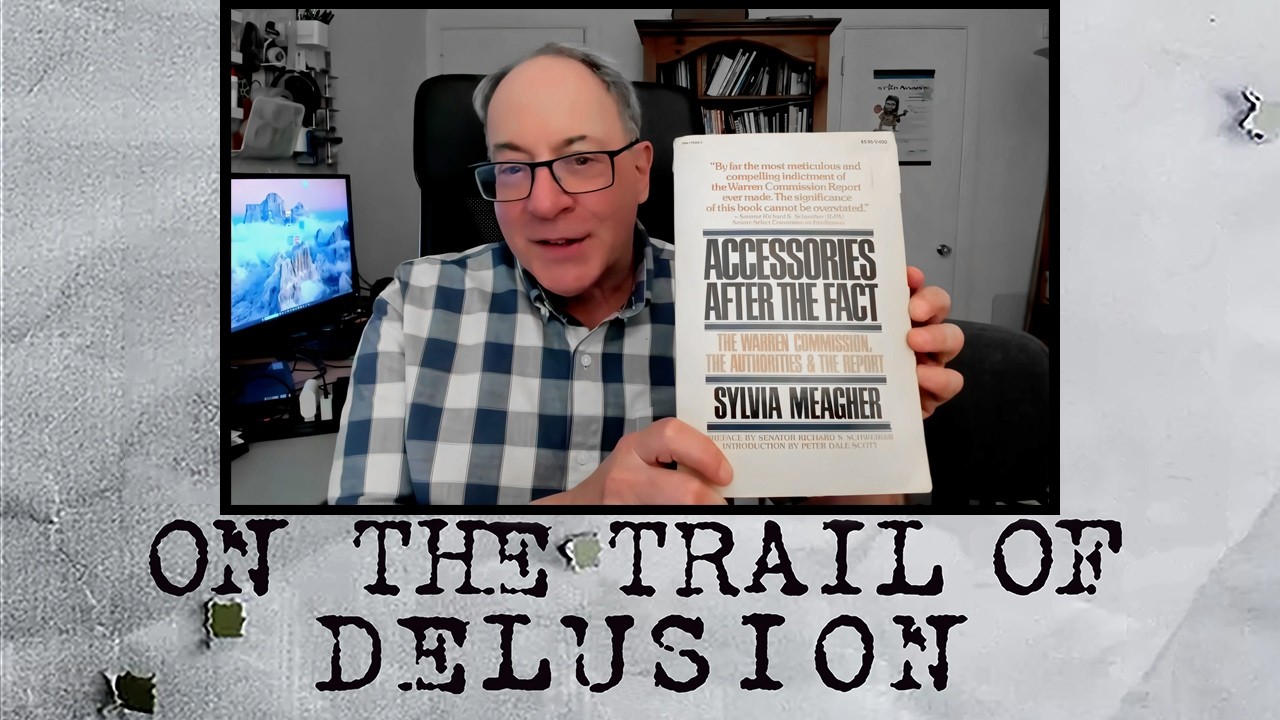
- On the Trail of Delusion, Episode 40, Accessories After the Fact
On this episode, I review Sylvia Meagher's book, Accessories After the Fact: The Warren Commission, the Authorities & the Report on the JFK Assassination. Here is a link to Meagher's critique of the Warren Report from November 1964. It's not very impressive -- she even has a section on mysterious deaths (page 18). Here is some text from my upcoming book, a history of conspiratorial thinking in the JFK assassination, on Sylvia Meagher: (hat tip to Bill Brown for some of this) Helen Markham, Barbara Davis, Virginia Davis, William Scoggins, Sam Guinyard, Ted Callaway, Warren Reynolds, Pat Patterson and Harold Russell all identified Lee Oswald as the man they saw either shoot Tippit or run from the scene immediately afterwards with a gun. Jimmy Burt, Bill Smith, Domingo Benavides and L.J. Lewis saw the cop-killer but couldn't positively identify the guy as being Lee Oswald. However, they did not say the guy was not Oswald, either. And so thirteen people saw the shooting and/or the man flee the scene. Nine out of the thirteen identified Oswald. Four couldn't be sure. None of the thirteen said the cop-killer was not Oswald. None of this mattered to Meagher. To her, Scoggins was not a credible witness because a bush obstructed his view; Markham could be discounted because she was slightly crazy; and the identifications of the Davis sisters, Ted Callaway and Sam Guinyard were useless because Meagher believed the lineups at the police station were tainted. She discounted the other witnesses who saw Oswald running from the scene because they were not contacted until the end of January, 1964, and did not select Oswald’s photograph from a group of pictures. But Scoggins said he saw Oswald approach Tippit and that he then heard the shots. He momentarily lost sight of Oswald because of some shrubbery but saw Oswald, with his revolver in his hand, run south on Patton. The Davis sisters saw Oswald run across their lawn and unload a couple of cartridges from his revolver – which they later collected and gave to the police. Meagher says that Warren Reynolds did not identify Oswald but changed his testimony in July 1964, after he had been shot in the head. She does not tell her readers that in January 1964 Reynolds told the FBI that “he is of the opinion Oswald is the person he had followed on the afternoon of November 22, 1963.” Meagher concluded that “The eyewitness identifications are highly vulnerable and would have been torn to shreds in a courtroom.” But any of these witnesses could have identified Oswald in a courtroom. The quality of the lineups would have been immaterial. And Meagher was incredibly unfair to Helen Markham. The testimony of Helen Markham, the other eyewitness to the shooting, has been denounced sufficiently by critics of the Warren Report. I do not wish to further belabor the point that she lacks any semblance of credibility. She said that she was alone with Tippit for 20 minutes before an ambulance arrived, and that Tippit-—who is said to have died instantaneously—tried to talk to her; she was in hysterics and somehow managed to leave her shoes on top of Tippit’s car (CE 1974); sedatives had to be administered before she was taken to view the line-up at about 4:30 p.m. on Friday. It does indeed sound strange that Markham managed to leave her shoes on top of Tippit’s car, but Meagher doesn’t tell her readers that these were her work shoes [Markham was a waitress] that she was carrying in a bag. Meagher says that “sedatives had to be administered,” but this is not true at all. She was on the verge of fainting at the police station and they gave her some ammonia – which is a stimulant, not a sedative. And Markham heard “gurgling” sounds from Tippit’s body which she misinterpreted as an attempt to speak. Given the shock that Markham was in, it’s not surprising she lost track of time. Meagher quotes this testimony from Markham: Mr. Ball: Now when you went into the room you looked these people over, these four men? Mrs. Markham: Yes, sir. Mr. Ball: Did you recognize anyone in the line-up? Mrs. Markham: No, sir. Mr. Ball: You did not? Did you see anybody—I have asked you that question before—did you recognize anybody from their face? Mrs. Markham: From their face, no. Mr. Ball: Did you identify anybody in these four people? Mrs. Markham: I didn’t know nobody . . . I had never seen none of them, none of these men. Mr. Ball: No one of the four? Mrs. Markham: No one of them. Mr. Ball: No one of all four? Mrs. Markham: No, sir. Mr. Ball: Was there a number two man in there? Mrs. Markham: Number two is the one I picked. . . . Number two was the man I saw shoot the policeman. . . . I looked at him. When I saw this man I wasn’t sure, but I had cold chills just run all over me. . . . (3H 310-311) Meagher noted that “reading this testimony about the “identification” on which the Commission relied, I feel a few cold chills too." When Markham is asked if she could identify anybody in the four-person lineup and she replied “I didn’t know nobody,” and then further replied “I didn’t know nobody,” Markham thought he was talking about a time before the shooting. Meagher then implies that Markham wasn’t sure of her identification of Oswald. But Meagher leaves out Markham’s testimony after her remark about “cold chills.” Mr. Ball: When you saw him? Mrs. Markham: When I saw the man. But I wasn’t sure, so, you see, I told them I wanted to be sure, and looked at his face is what I was looking at, mostly is what I looked at, on account of his eyes, the way he looked at me. So I asked them if they would turn them sideways. They did, and then they turned him back around, and I said the second, and they said, which one, and I said number two. So when I said that, well, I just kind of fell over. Everybody in there, you know, was beginning to talk, and I didn’t know just – … Mr. Ball: Did you recognize the man from his clothing or from his face. Mrs. Markham: Mostly from his face. Mr. Ball: Were you sure it was the same man you had seen before? Mrs. Markham: I am sure. … Mrs. Markham: When we looked at each other, he just stared, just like that. I just don’t know. I just seen him – I would know the man anywhere, I know I would. Here is the book review from the December 19, 1967, issue of the San Francisco Examiner [item 4]: Here is where Stanley got his Meagher quote: (emphasis added in page 237 in the Kindle edition of Accessories After the Fact) From his arrest on Friday to his death on Sunday, Oswald declined to conceal his face; he never appeared cowed or ashamed but maintained his personal pride and dignity and seemingly full confidence in his ultimate vindication. He charged on a number of occasions that he was being railroaded, that he was “a patsy,” and that he was the victim of a frame-up. He was pitifully unsuspecting of the fate that he was to meet in the police basement. Some police officers and Dallas officials saw this as arrogance and resented his failure to panic or grovel. Was his behavior characteristic of guilt, or of innocence? There is no objective test which can be applied, and the answer will depend on one’s personal predisposition toward Oswald and one’s private attitudes toward the nightmarish events that transpired in Dallas. What can be said without uncertainty is that the Warren Commission did not at any stage of its work appear to regard seriously the possibility that Oswald was the victim of a frame-up. The Commission has calmly accepted the explanation that no transcript of the interrogation was made. Fritz testified that he had no tape recorder, his past requests to his superiors for one having been denied. He was not asked why he had not borrowed a tape recorder; the FBI and Secret Service agents who were present at the interrogations were not asked why they had not offered one to Fritz. It is not necessary to belabor this issue: the point is that the Commission was uncritical, un-skeptical, and complacent in dealing with the Dallas police—not on this question alone but also on other aspects of the case, including flagrant discrepancies or contradictions in the testimony and the suspect conduct or explanations of certain officials. But here is what Stanley said about this paragraph in his review of Accessories in the San Francisco Examiner of November 26, 1967: This MAY be the behavior of a calm and innocent man faced by a charge of terrifying proportions and evidence that was at the very least deeply subversive of his interests. It might also be the behavior of a megalomaniac twisted by a lifetime of losing who finally emerges as the man of the hour. Robert Oswald said Lee always loved intrigue, never anonymity. But then I suppose Robert might also be included in the high level of conspiracy. Sylvia Meagher has read all the Report and all the 26 volumes of evidence, but I doubt that it was indispensable to her viewpoint. Her book is as much a brief for the Oswald defense as was Mark Lane's "Rush to Judgment." At least Lane admitted as much. Here is the Chicago Tribune review of Meagher and her index from December 31, 1967: Previous Episodes of On the Trail of Delusion: Episode 1 My first guest was Robert Reynolds who is an expert on the JFK assassination files. Episode 2 Robert A. Wagner discusses his new book, JFK Assassinated. Episode 3 Gerald Posner discusses the JFK assassination and conspiracy theories. Episode 4 Dr. Martin J. Kelly, Jr. discusses conspiracy theories and the medical evidence in the JFK assassination. Episode 5 Steve Roe discusses the life of General Edwin Walker and Oswald's attempt to kill him. Episode 6 Gus Russo discusses his participation in the PBS Frontline documentary on Lee Harvey Oswald. Episode 7 Dave Perry tells some great stories about debunking JFK conspiracy nonsense. Episode 8 Nick Nalli explains some of the science behind the assassination. Episode 9 Alecia Long discusses Jim Garrison and his non-existent case against Clay Shaw. Episode 10 Don Carpenter discusses the life of Clay Shaw. Episode 11 Bill Brown discusses the murder of Officer J. D. Tippit. Episode 12 Eric Dezenhall discusses the relationship between the mob and JFK. Episode 13 Nick Nalli discusses the acoustics evidence and the Zapruder Film. Episode 14 Scott Maudsley discusses Lee Harvey Oswald's antisocial personality disorder. Episode 15 Document expert Robert Reynolds discusses what to expect in the upcoming JFK assassination file releases. Episode 16 A panel discussion on the document releases with Fred Litwin, Gus Russo, Robert Reynolds, Larry Haapanen, Mark Allen, and Steve Roe. Episode 17 An interview with author Michel Gagné about conspiracy theories. Episode 18 An interview with Phil Tinline about his book, Ghosts of Iron Mountain. Episode 19 An interview with Janet Banister, grand-niece of Guy Banister. Episode 20 The Marina Oswald Tapes. Episode 21 Dr. Chad Zimmerman discusses JFK's autopsy X-rays and photographs. Episode 22 Tour guide Daniel Evans talks about his years of researching the JFK assassination. Episode 23 Adam Gorightly discusses Fred Crisman, Thomas Beckham, Raymond Broshears and Kerry Thornley. Episode 24 A fun interview with Larry Haapanen who discusses the Garrison investigation, and his involvement with Project Blue Book. Episode 25 Dale Myers discusses the Tippit shooting and shows us some nifty animation. Episode 26 Brian Roselle discusses the timing of the first shot. Episode 27 Dr. Martin J. Kelly, Jr. talks about the psychology of Lee Harvey Oswald and Jack Ruby. Episode 28 Gus Russo talks about what happened to Lee Harvey Oswald in Mexico City. Episode 29 John-Paul Pagano discusses conspiracy theories, conspiracism and antisemitism. Episode 30 Dr. Robert Vitt talks about conspiracy theories, the early JFK researchers, and how to evaluate evidence. Episode 31 Josh Sundloff discusses conspiracy theories and his TikTok channel. Episode 32 A panel discussion of the single-bullet theory with Dr. Martin Kelly, Dr. Nick Nalli, Fred James and Scott Maudsley. Episode 33 Ernest Kearney discusses conspiracy theories and how to evaluate evidence. Episode 34 Steve Barber discusses the acoustics evidence and his visits with Robert Groden. Episode 35 Assassination researcher John Corbett stops in to talk about the case. Episode 36 Fred Litwin teaches Professor Robert Vitt's class at Long Beach City College. Episode 37 Steve Roe goes over the chain of custody of CE399. Episode 38 Todd Kwait discusses his documentary on the Warren Commission. Episode 39 Bill Brown gives us a tour of the Tippit murder scene. Previous Relevant Blog Posts on Sylvia Meagher The Housewives Underground My review of Kaitlyn Tiffany's new book. Jim Garrison's No-Show Meagher comments on Garrison's failure to appear on a radio show. Sylvia Meagher on the Sewer Shot and Jim Garrison An excerpt from a letter Meagher sent to Thomas Stamm. A Vincent Salandria - Sylvia Meagher Exchange on Jim Garrison Salandria tries to make up with Meagher. Sylvia Meagher Corresponds with Philippe Labro Philippe Labro was a French journalist who covered the JFK assassination for France-Soir. Sylvia Meagher writes Bud Fensterwald Fensterwald invites Meagher to join his organization. She refuses because of Jim Garrison. Sylvia Meagher's Review of "The Kennedy Conspiracy" by Paris Flammonde A scathing review of Flammonde's book about the Garrison investigation. Mary Ferrell and Sylvia Meagher Discuss Jim Garrison An exchange of letters about Jim Garrison. Jim Garrison's Code and Sylvia Meagher Garrison comes up with a crazy code and Sylvia Meagher calls him out. Sylvia Meagher's Ode to the District Attorney of New Orleans Meagher also wrote poetry. Sylvia Meagher Writes Clay Shaw with an Idea Meagher's very good idea shows that Garrison didn't care to learn the truth. Kerry Thornley Writes Sylvia Meagher in 1970 Thornley tells Meagher about an article illustrating Garrison's pre-occupation with the JFK assassination. Tom Bethell Writes Sylvia Meagher about the Shaw Trial Bethell wrote Meagher about Charles Spiesel and his ridiculous testimony at the Clay Shaw trial. Sylvia Meagher's Letter to Look Magazine Sylvia Meagher's terrific letter to Look Magazine in response to their article "The Persecution of Clay Shaw." Sylvia Meagher Congratulates Clay Shaw On His Acquittal She was very pleased with his acquittal. Sylvia Meagher and Jim Garrison, Part One Meagher writes Clay Shaw a letter and his response is just terrific. Sylvia Meagher and Dr. Cyril Wecht Discuss Jim Garrison Dr. Wecht didn't think too much of Garrison, either. Mike Farrell, of M*A*S*H fame, and Sylvia Meagher Meagher educates Farrell on Jim Garrison. When will Oliver Stone Admit he was Wrong about Clay Shaw? A plea to Oliver Stone with a compilation of Meagher's writings about Jim Garrison. Sylvia Meagher on the Clay Shaw Case Howard Roffman writes a letter to Harold Weisberg about Sylvia Meagher. Penn Jones' Phone Call with Sylvia Meagher This phone call broke their relationship. Sylvia Meagher and Jim Garrison, Part Two An unpublished Meagher memo on the trial of Clay Shaw. Sylvia Meagher and Jim Garrison, Part Three - a never before published article by Meagher Another unpublished Meagher memo on the Garrison investigation and Warren Report critics. Garrison's Playboy Interview - What Couldn't Be Printed Sylvia Meagher's letter to the Editor regarding Garrison's interview in Playboy Magazine. Sylvia Meagher's Reaction to the Verdict in the Shaw Trial Meagher writes Harold Weisberg with her comments on the verdict. Two Letters to Jim Garrison about "A Heritage of Stone" James Phelan and Sylvia Meagher write Garrison letters about his book. Kerry Thornley writes Sylvia Meagher An exchange of letters between Thornley and Meagher. Did RFK Tell Garrison that there were guns between him and the White House? Meagher writes Thornley about Lane's comment on RFK. Was Jim Garrison Napoleon or Rasputin? Meagher writes Thornley with an opinion. M. S. Arnoni and Sylvia Meagher Take On Jim Garrison... Exchange of letters between Meagher, Arnoni and Garrison. Jim Garrison Blows His Top Meagher writes Weisberg about the damage Garrison is doing to critics of the Warren Report. James Phelan Writes to Richard Popkin Meagher replies to the New York Review of Books regarding Popkin's article on Garrison. Sylvia Meagher Replies to Richard Popkin An exchange of letters between Popkin and Meagher.
- MK-Ultra -- Once Again
Anna Paulina Luna held hearings on MK-Ultra last week, and Stephen Kinzer, author of the 2019 Poisoner In Chief: Sidney Gottlieb and the CIA Search for Mind Control, and Tom O'Neill, author of the 2019 Chaos: Charles Manson, the CIA, & Secret History of the Sixties, testified on the program. Kinzer made the sensible suggestion that the CIA unredact all the current documents on MK-Ultra. But O'Neill continued with the conspiracy nonsense from his book Chaos. Here is an excerpt from his written statement: First, O'Neill discusses Louis Jolyon West's examination of Ruby in his jail cell. He made a few typos in his written statement - Arlen's name is Specter, not Spector. And O'Neill typed "West had suffered" when he meant that "Ruby had suffered." The paragraph about West is fundamentally wrong. West interviewed Ruby for just one hour, in a private interview room in the Dallas jail, on April 26, 1964: Note that Ruby had struck his head against a wall before West interviewed him. The next morning West examined Ruby for an hour and half, and he improved. O'Neill believes that West injected Ruby with some drug, during those two short sessions, and that accounted for Ruby's change from previous examinations. West never had "several hours alone" with Ruby as alleged by O'Neill. West did spend more time with Ruby later on, but Ruby's mental problems were evident before West got involved with the case. Did Dr. Louis Jolyon West Ask to Examine Jack Ruby in November 1963? There is no evidence that Dr. West petitioned the court to examine Jack Ruby before his trial. Did the CIA use a MK-Ultra Psychiatrist to Interfere with Jack Ruby's Case? There is absolutely no evidence that Dr. Louis Jolyon West interfered with Jack Ruby's case. Jefferson Morley Responds to my Post on MK-Ultra and Jack Ruby And here is my reply. Ruby was on a downward spiral. The trial, the guilty verdict, and the imposition of the death penalty, all caused Ruby to become increasingly mentally unbalanced. What really affected Ruby was the right-wing notion that Jews were behind the assassination of JFK. The reaction of the John Birch Society got to him. They always referred to Ruby as Rubenstein so as to emphasize a Jewish component of a supposed conspiracy to kill JFK. And that made Ruby worry that the Jews might be blamed (however unfairly) for the murder of Kennedy. Robert Kaplan, a forensic psychiatrist from the University of Wollongong in Australia described his downward spiral in a 2015 paper: Even at Ruby's trial, several witnesses wondered about his sanity. Here is an excerpt from the testimony of William Serur, a friend of Ruby's who testified on his behalf: Here is another excerpt from Mr. Serur's testimony: And Bill Howard, another friend of Ruby, said the following: And Dr. Manfred Guttmacher, a psychiatric witness for the defense, bolstered the case that Ruby was insane: Here is how this was reported in the New York Times: New York Times, March 11, 1964 This was all before the involvement of Dr. West. In addition, West's involvement with MK-Ultra was on a project involving hypnosis. West was testing to see if certain drugs could make it easier to hypnotize people. And his testing required sensory isolation: Kinzer's book only mentions Louis West once: West's interest was in using sensory isolation along with the use of various drugs. Could West have induced psychosis in Jack Ruby in two short visits in the jail? Dr. W. R. Beavers examined Ruby just a day after West. Here is a paragraph from his report: Here is his discussion: The second possibility of a toxic psychosis could be entertained but is considered unlikely because of the protected situation and the fact that his thought and his mood seems to be extremely closely related. Beavers dismissed the idea of "toxic psychosis" for two reasons. And none of the people close to Ruby ever supported O'Neill's allegation, as far as I can see. In addition, O'Neill's description of Ruby's testimony is not quite right: Here is the description of Ruby's testimony from Specter's book, Passion for Truth: (pages 112 - 114) Quite a different description that that of O'Neill's, who didn't include this quote: It turned out that Jack Ruby had been in charge from the time the deposition began, or even before it began. I didn't know that until I read the transcript of the first part of the deposition. As Ford put it to me recently, Ruby "flaunted his power and presence. He was a strange guy." O'Neill finds it strange that Ruby told the Chief Justice Warren that "they're cutting off the arms and legs of Jewish children in Albuquerque and El Paso." This tells me that he does not understand the importance of antisemitism in Ruby's life and his reaction to the Weissman ad in the Dallas Morning News on the morning of November 22nd. "JFK: Destiny Betrayed" Misleads on Jack Ruby A look at the motivations of Jack Ruby. O'Neill also believes that West was successful in using LSD to alter memories, etc. Kinzer writes in his book that MK-Ultra was a massive failure. For ten years, Gottlieb directed systematic, intense, and far-reaching research into mind control. Finally he and his comrades were forced to face their cosmic failure. Their research had shown them that mind control is a myth -- that seizing another person's mind and reprogramming it is impossible. Towards the end of the hearing, Anna Paulina Luna brought up Jack Ruby one more time: (1:41:10) Anna Paulina Luna: So, just before we wrap up, is it, in your expert opinion, that Jack Ruby and Manson were assets of the intelligence agencies specifically pertaining to MK-Ultra? Were they MK-Ultra victims? Tom O'Neill: Theoretically, Manson, I've never been able to prove absolutely. Jack Ruby. I believe, this is something else. The Warren Commission investigation -- on the Warren Commission was Allen Dulles, the former CIA director, who authorized and ran MK-Ultra until he was fired by President Kennedy. The liaison to the committee for the CIA, who handled the information coming from the CIA back and forth to the Warren Commission, was Richard Helms, who was a direct supervisor of Jolly West. They knew who West was, they knew that what West was capable of, and what they had paid him to do, and what he had reported to them that he could do, including inducing mental disorders in people. That was never disclosed to the Commission, as far as anyone knows. So, I believe that West was put in there to keep Jack Ruby from telling his story. Anna Paulina Luna: Wow. Allen Dulles did approve MK-Ultra. But, I see no evidence that Richard Helms was Dr. West's supervisor. I always thought that Sidney Gottlieb was his supervisor. And while Helms might have known about MK-Ultra, I doubt he knew all the particulars of every single project in the program. Both Dulles and Helms might have never known who Dr. Louis Jolyon West was. And I should add that Ruby had lots of time to "tell his story" before he was examined by Dr West. And what he said before West's examination, and what he said after West's examination, was the same. And if the conspirators had to stop Ruby from "telling his story" then why did they wait until the end of April 1964 to act. That gave Ruby five months to spill the beans, no? Here is what Jack Ruby told the FBI on November 24, 1963: And here is a link to Jack Ruby's final statement. I certainly hope that more documents are released -- although the remaining boxes of MK-Ultra appear to be related to a forgery case funded under the auspices of MK-Ultra. I do agree with Kinzer's suggestion that all the redactions be removed from current documents. The scandal of MK-Ultra doesn't need Jack Ruby and the JFK assassination. There is no need to further sensationalize MK-Ultra. Lastly, this story from Wired Magazine is a must-read on MK-Ultra. “MK-Ultra is now used in a particular rhetorical way when you're talking about something being an inside job,” says [psychologist Michael] Wood. “It’s because MK-Ultra has shown the US government is not above committing horrible acts against its own people. Whenever something goes wrong, MK-Ultra is an easy thing to blame and an easy online buzzword to use.” Previous Blog Posts on Anna Paulina Luna Jefferson Morley Gets a New Job Morley will now work for Luna's Committee, but it's not clear what he will be doing. Soviet File Given to Luna Proves a KGB Operation Something really interesting from Luna's work but no one wants to talk about it. Historian Alexis Coe on Luna's JFK Hearings A first-hand account of Luna's hearings. Luna Talks to Rogan about Interdimensional Beings and the Ark of the Covenant Some highlights of Luna's visit with Joe Rogan. Luna Comes up with a Bombshell! Luna says the Russians will be giving us their JFK files in the fall. The MAGA Crowd Gets The JFK Assassination Conspiracy They Need Luna, Bannon, and Tucker believe some crazy things about the assassination. Luna's Ridiculous Hearing Luna's second hearing -- I don't know what was worse - the silly testimony of the witnesses or the brainless questions of the committee members. Jefferson Morley's Congressional NothingBurger An analysis of Congresswoman Luna's Congressional Hearings Is Congresswoman Luna a Luna-tic? Congresswoman Luna doesn't really know much about the JFK assassination. Is Congresswoman Luna a Luna-tic? Part Two Have a look at the book on Luna's desk Anna Luna's JFK Conspiracy Circus A link to an excellent article by Michael Isikoff. Congresswoman Luna Finds a New Witness Here is the conspiracy witness who knows the truth.
- Richard Dudman Writes Mark Lane
Richard Dudman Richard Dudman was a reporter for the St. Louis Post-Dispatch. Here is what he wrote in The New Republic in December 1963: A few of us noticed the hole in the windshield when the limousine was standing at the emergency entrance after the President had been carried inside. I could not approach close enough to see on which side was the cup-shaped spot that indicates a bullet had pierced the glass from the opposite side. Note that he couldn't get that close. Here is what he wrote in the St. Louis Post-Dispatch of December 1, 1963: Here he says "This correspondent and one other man saw the hole, which resembled a bullet hole ..." Robert Branson's column from the December 15, 1963 issue of the Battle Creek Enquirer, mentions the other reporter: Other reporters did not get that close either. And Richard Dudman walked back the claim in an article in the November 22, 1988 edition of the Bangor Daily News: Previous Relevant Blog Posts on Mark Lane Was Jim Garrison a Prophet of the American People? Lane discusses Jim Garrison on television in New Orleans. Mark Lane and J. C. Price Lane cuts out a scene in which Price says the man he saw might have been carrying a hat. Mark Lane: The Rush to Publication An excellent article from the Dallas Morning News on Lane's witnesses. Mark Lane and Warren Reynolds Lane cuts out a few of Reynolds' answers. Mark Lane and Napoleon Daniels Sylvia Meagher was incensed at Lane's inclusion of this story in his film. Mark Lane and Charles Brehm A good case study in Lane's intellectual dishonesty. G. Robert Blakey on Mark Lane Robert Blakey and the HSCA were very critical of Mark Lane. George Lardner on Mark Lane Mark Lane and the HSCA. When Mort Sahl Kicked Mark Lane Out of his House An interesting anecdote from Mort Sahl's book, Heartland. Should We Blame Mark Lane? Some ads for Lane's film Rush to Judgment. In Defense of the Warren Commission A Garry Wills opinion piece on Mark Lane. Victor Navasky Reviews Mark Lane's "A Citizen's Dissent" Navasky tests Lane's book and finds it wanting. Mark Lane and Jonestown A New York Times profile of Lane and his involvement with Jonestown. New York Times Profile of Mark Lane An apt profile. Nightmare Brought to Life An opinion piece by Anthony Lewis in the New York Times on Mark Lane and Jonestown. Mark Lane, Again An opinion piece from the Washington Post Mark Lane: A Bent for the Macabre Side A good opinion piece from the Philadelphia Bulletin. Sylvia Meagher Corresponds with Philippe Labro Meagher tells Labro a story about Mark Lane. Mark Lane and The Progressive Even a left-wing magazine like The Progressive found Mark Lane hard to take. Mark Lane on Clay Shaw Mark Lane's addition to the 1992 edition of Rush to Judgment is eye opening. Mark Lane on the Joe Dolan Show Lane tells Dolan about Garrison's amazing evidence. Did the CIA Try to Kill Mark Lane? Lane makes a startling allegation. Mark Lane: The Left's Leading Hearse-Chaser A profile from Mother Jones magazine. Mark Lane vs. Sylvia Meagher Lane and Meagher feuded about a blurb for her book. The Case Against Mark Lane A profile from Esquire Magazine. Mark Lane saw a conspiracy - as usual An article from the Tampa Bay Times. The Mark of Zorro An Anthony Lewis column on Mark Lane from 1978. Mark Lane's Scholarship! Howard Roffman finds that Mark Lane's scholarship is lacking. Mark Lane, Conspiracy Addict A profile of Mark Lane in Newsweek. Mark Lane offers to introduce Jim Garrison to "Mr. Candy" Mark Lane offers to introduce Jim Garrison to a witness that, for $25,000, would tie Jack Ruby with Clay Shaw. Redactions, Redactions, Redactions... This post has a good case study of how Mark Lane exploited a redaction in a document. "I Know Who Killed JFK," Part Three Lane tells the Danish press he knows who killed JFK. Mark Lane Said that Clay Shaw Was a "Powerful, Domestic Force in the Assassination." Lane speaks at the Louisiana State Bar Association.
- Garrison Had People Scared
This file was written before it was known that Garrison was investigating the JFK assassination. Money Quotes: JUDGE MACHAUER said that he is convinced that District Attorney JIM GARRISON is psychotic, and that his ability for clever political acting is concealing this reality from popular public consumption. ... MACHAUER stated that it is GARRISON'S completely immoral public accusations against other public officials using cleverly contrived charges without any regard for substance or truth, which has virtually all the public officials scared of GARRISON. Previous Relevant Blog Posts on Jim Garrison New York Times Editorial on the Death of Jim Garrison They said that "Mr. Garrison was a vulgar political survivor. And the perpetrator of what could have been a judicial tragedy." Was Jim Garrison a Prophet of the American People? Mark Lane goes overboard. Jim Garrison's "Reign of Terror" William Gurvich said that Garrison wanted Walter Sheridan roughed up. Gaeton Fonzi's Notes from a Discussion with Jim Garrison Garrison feeds Fonzi lots of nonsense. The Bar and Jim Garrison An editorial from the Wall Street Journal on pre-trial publicity. Sylvia Meagher on the Sewer Shot and Jim Garrison Meagher writes Thomas Stamm about Garrison. Jim Garrison and the Media An article from Newsweek about the favorable treatment of Garrison in the media. A Vincent Salandria - Sylvia Meagher Exchange on Jim Garrison Salandria tries to make up with Meagher after their split over Garrison. Oliphant Cartoon of Jim Garrison A cartoon on Clay Shaw's acquittal. Jim Garrison's Great Escape A Tom Bethell article on Garrison. Letters to Jim Garrison A Tom Bethell memo with excerpts from letters sent to Garrison. Sidney Zion on Jim Garrison Some excerpts from Zion's book on Garrison. Jim Garrison's Interview After the Shaw Acquittal Garrison cannot answers the question of why he initially suspected Clay Shaw. Letter to the Editor: Garrison's Follies A good letter to the editor in the San Francisco Examiner. People Were Frightened of Jim Garrison Garrison had a lot of power and people in New Orleans were scared. Dr. Robert McClelland on Jim Garrison McClelland told Weisberg that Garrison was a psychopath. Jim Garrison on Johnny Carson Garrison lied in his book about his appearance on the Tonight Show. Sylvia Meagher's Excerpts from Turner's Article on Jim Garrison Meagher makes fun of Turner's article. The Second Coming of Jim Garrison A good article by Edward Jay Epstein. Garrison, White-Collar Demagogue A good review of Epstein's book on Garrison. GQ Magazine - "The Case Against Jim Garrison" An article on Garrison and letters to the editor. Did Donald Trump Get this from Jim Garrison? Garrison thought he could do anything. Ray Palmer's Letter to Jim Garrison The father of UFOs writes Garrison a letter. Jim Garrison: The Uninquisitive District Attorney Some case studies showing that Garrison couldn't really care to investigate certain leads. Garrison's "total contempt for American justice" A few articles about Stephen Tyler's documentary on Garrison. What Garrison Proved An article from The New Republic after Clay Shaw's acquittal. David Lifton on Jim Garrison Lifton writes Bud Fensterwald about Garrison. Leo Sauvage on Jim Garrison Sauvage writes Bud Fensterwald about Garrison. Jim Garrison's Code and Sylvia Meagher The complete story of Garrison's codebreaking. David Lifton's Memo on Jim Garrison and Kerry Thornley Lifton sent a memo to Warren Commission critics in 1968 about Garrison. Mary Ferrell and Sylvia Meagher Discuss Jim Garrison Excerpts of letters send in 1970 about Garrison. Josiah Thompson on Jim Garrison's Shot from the Sewer Thompson writes the L.A. Free Press about the shot from the sewer. Sylvia Meagher and Dr. Cyril Wecht Discuss Jim Garrison Wecht wasn't happy with Garrison's tactics. William Gurvich's Brother on Jim Garrison Garrison's son writes a letter and Gurvich's brother replies. Garrison's Circus An editorial cartoon on Garrison's investigation. Garrison's Plea Bargains Harry Connick Senior's view of Garrison. Jeremy Gunn on Oliver Stone, Jim Garrison, and Fletcher Prouty Jeremy Gunn of the ARRB made some choice comments on Garrison, Stone, and Prouty. Jefferson Morley Doesn't Understand Jim Garrison's Homophobic Prosecution of Clay Shaw Morley doesn't get Alecia Long's excellent book on Garrison. Jim Garrison Interview on the Mike Wallace Show, September 1967 An interview full of Garrison craziness. "Garrison -- Unfit to Be D.A." A WDSU-TV editorial on Garrison after Shaw's acquittal. Jim Garrison's Dereliction of Duty Garrison ignored his duties to spend time on his JFK assassination investigation. What Ever Happened to Jim Garrison? Oliver Stone's documentary series leaves out Garrison. Jim Garrison - A Spectacular Demagogue A very good article by Haynes Johnson. Jim Garrison's Prosecution was "Demagogic" An article on Garrison from the New York Law Journal. Garrison Claimed the CIA was also Behind the RFK and MLK Assassinations... Garrison was interviewed by Thomas Buchanan after the Shaw trial. Jim Garrison's Shot from the Sewer Garrison's press releases about the sewer shot. A Candid Appraisal of Jim Garrison from the CIA A handwritten note on Garrison. Jim Garrison's Homosexual Shakedown Operation Garrison was blackmailing gay people. Jim Garrison's Ridiculous Interview with the Boston Phoenix More craziness. Jim Garrison's "fatally flawed case built on flimsy evidence." The New Orleans Times-Picayune looks back at the Garrison investigation. Garrison vs. the people An editorial from the Chicago Daily News after Shaw's acquittal. Jim Garrison Discusses The Three Tramps At a conference in New Orleans, Garrison talks about the tramps. When Shaw was Arrested, What Serious Evidence did Garrison have that he Conspired to Kill JFK? The challenge is still open. M. S. Arnoni and Sylvia Meagher Take On Jim Garrison... An article from Arnoni's The Minority of One and some responses. Harold Weisberg on Jim Garrison Excerpts from an interview with Weisberg. Was Jim Garrison Napoleon or Rasputin? Meagher thought he was Rasputin. A Tremendous Paul Conrad Cartoon about Jim Garrison One of the best cartoons ever on Garrison. Garrison's "Cheap, Vulgar Show" An editorial from the Charlotte Observer.
- Sylvia Meagher's Critique of Jim Garrison's Book
Philip Pochoda Sylvia Meagher was hired by Prentice-Hall in 1986 to act as a referee for Jim Garrison's new book. Meagher accepted the job: Garrison then sent in his last chapter: Here is her report, and here. Meagher recommended that Prentice-Hall publish Garrison's book largely because he now believed that Lee Harvey Oswald was totally innocent. In 1967, Garrison had said that Lee Harvey Oswald was a co-conspirator with Clay Shaw, and that incensed Sylvia Meagher. In her analysis, Meagher couldn't help but make a joke about Garrison's chapter on New Orleans: Here is the paragraph she was referring to: Garrison spelt Coffey wrong. Meagher then sent another letter: Here is what Garrison wrote in his first chapter: Here is page 337 from Volume VII: Here is Prentice-Hall's rejection letter: By the way, when I was researching my book, On the Trail of Delusion -- Jim Garrison: The Great Accuser, I spoke to Phil Pochoda. Here is an excerpt from my book: (page 298 in the Kindle edition) Philip Pochoda, the publisher of Prentice Hall, wrote to Garrison in January 1987 and said that two “insuperable problems made any attempt at rewriting useless for our purposes.” Pochoda agreed with Meagher that Garrison had misrepresented the evidence on the motorcade. He wrote to me in 2020 and said that “it was far too big a blunder to allow into a Simon & Schuster book, much less a manuscript by the person who should have at least known that to be false.” The bigger problem was that Garrison had promised that he “would specify an actual CIA hand in and during the assassination itself: the cut-out agent, Fred Lee Crisman.” But Pochoda found that “the Crisman material was much too flimsy to permit inclusion in the book.” Thus “without the ‘smoking gun’ I do not think anybody who doesn’t now believe in CIA coordination and involvement will be persuaded by your text.” As such, “the evidence you present is really to be found in all the well-known books on the conspiracy.” The result is that “what we now have is polemics grappling for confirmation, and a manuscript that is unpublishable.” Garrison was told to return his advance. Here is Garrison's reply to Pochoda: As I wrote in my review of Kaitlyn Tiffany's book, The Housewives Underground: That she would want Prentice-Hall to publish a charlatan just because he now claimed Oswald was innocent speaks to Meagher's delusional beliefs. That she would countenance the victimization of Clay Shaw for a second time was contemptible. But wait, there's more. Garrison was not happy with Meagher's analysis and he wrote a letter to his literary agent with several complaints. Stay tuned. Previous Relevant Blog Posts on Sylvia Meagher On the Trail of Delusion, Episode 40, Accessories After the Fact My review of Meagher's book. The Housewives Underground My review of Kaitlyn Tiffany's new book. Jim Garrison's No-Show Meagher comments on Garrison's failure to appear on a radio show. Sylvia Meagher on the Sewer Shot and Jim Garrison An excerpt from a letter Meagher sent to Thomas Stamm. A Vincent Salandria - Sylvia Meagher Exchange on Jim Garrison Salandria tries to make up with Meagher. Sylvia Meagher Corresponds with Philippe Labro Philippe Labro was a French journalist who covered the JFK assassination for France-Soir. Sylvia Meagher writes Bud Fensterwald Fensterwald invites Meagher to join his organization. She refuses because of Jim Garrison. Sylvia Meagher's Review of "The Kennedy Conspiracy" by Paris Flammonde A scathing review of Flammonde's book about the Garrison investigation. Mary Ferrell and Sylvia Meagher Discuss Jim Garrison An exchange of letters about Jim Garrison. Jim Garrison's Code and Sylvia Meagher Garrison comes up with a crazy code and Sylvia Meagher calls him out. Sylvia Meagher's Ode to the District Attorney of New Orleans Meagher also wrote poetry. Sylvia Meagher Writes Clay Shaw with an Idea Meagher's very good idea shows that Garrison didn't care to learn the truth. Kerry Thornley Writes Sylvia Meagher in 1970 Thornley tells Meagher about an article illustrating Garrison's pre-occupation with the JFK assassination. Tom Bethell Writes Sylvia Meagher about the Shaw Trial Bethell wrote Meagher about Charles Spiesel and his ridiculous testimony at the Clay Shaw trial. Sylvia Meagher's Letter to Look Magazine Sylvia Meagher's terrific letter to Look Magazine in response to their article "The Persecution of Clay Shaw." Sylvia Meagher Congratulates Clay Shaw On His Acquittal She was very pleased with his acquittal. Sylvia Meagher and Jim Garrison, Part One Meagher writes Clay Shaw a letter and his response is just terrific. Sylvia Meagher and Dr. Cyril Wecht Discuss Jim Garrison Dr. Wecht didn't think too much of Garrison, either. Mike Farrell, of M*A*S*H fame, and Sylvia Meagher Meagher educates Farrell on Jim Garrison. When will Oliver Stone Admit he was Wrong about Clay Shaw? A plea to Oliver Stone with a compilation of Meagher's writings about Jim Garrison. Sylvia Meagher on the Clay Shaw Case Howard Roffman writes a letter to Harold Weisberg about Sylvia Meagher. Penn Jones' Phone Call with Sylvia Meagher This phone call broke their relationship. Sylvia Meagher and Jim Garrison, Part Two An unpublished Meagher memo on the trial of Clay Shaw. Sylvia Meagher and Jim Garrison, Part Three - a never before published article by Meagher Another unpublished Meagher memo on the Garrison investigation and Warren Report critics. Garrison's Playboy Interview - What Couldn't Be Printed Sylvia Meagher's letter to the Editor regarding Garrison's interview in Playboy Magazine. Sylvia Meagher's Reaction to the Verdict in the Shaw Trial Meagher writes Harold Weisberg with her comments on the verdict. Two Letters to Jim Garrison about "A Heritage of Stone" James Phelan and Sylvia Meagher write Garrison letters about his book. Kerry Thornley writes Sylvia Meagher An exchange of letters between Thornley and Meagher. Did RFK Tell Garrison that there were guns between him and the White House? Meagher writes Thornley about Lane's comment on RFK. Was Jim Garrison Napoleon or Rasputin? Meagher writes Thornley with an opinion. M. S. Arnoni and Sylvia Meagher Take On Jim Garrison... Exchange of letters between Meagher, Arnoni and Garrison. Jim Garrison Blows His Top Meagher writes Weisberg about the damage Garrison is doing to critics of the Warren Report. James Phelan Writes to Richard Popkin Meagher replies to the New York Review of Books regarding Popkin's article on Garrison. Sylvia Meagher Replies to Richard Popkin An exchange of letters between Popkin and Meagher.
- The Housewives Underground
I first came across Kaitlyn Tiffany when she wrote this article in March 2025: I wrote Ms. Tiffany an email introducing myself and I provided a link to my blog post about the Schlesinger memo which had just been unredacted. She replied that she had come across my blog in her research and that she looked forward to read my post. I then wrote Tiffany again in October 2025 when I first heard that she was writing her book. I wanted to make sure that she knew about my many articles on Sylvia Meagher. I thought I could provide some help before her book was publsihed. Once again, Tiffany replied saying that "I'm very familiar with your site and found it incredibly helpful when I was starting my research." We never did talk. I gave her my number, but she then had a sore throat and couldn't call, and she never rescheduled. So, I am little disappointed that my books and blog posts are not mentioned at all in her new book, The Housewives Underground. Tiffany focuses on three female critics from the 1960s -- Shirley Martin, Maggie Field, and Sylvia Meagher -- although Meagher is clearly the star of the show. And, in fact, there was no need to include Martin and Field in this book -- what Sylvia got right, what she got wrong and her influence is an important enough story by itself. John Kelin mined much the same material for his book, Praise from a Future Generation: The Assassination of John F. Kennedy and the First Generation Critics of the Warren Report. If inside baseball is your thing, then you will enjoy this book. There is one thing missing from Tiffany's book -- the truth about the JFK assassination (conspiracy or not) seems almost incidental to the book. Readers of her book who really know the JFK assassination will love her stories about the early researchers. But general readers will wonder just what story about the assassination is true and what is false. Too much is just left up in the air. Let me give you some examples: (page 334 in the Kindle edition) So Sylvia did not have much to say about the fact that her friend Cyril Wecht, visiting the National Archives in August, had become the first critic allowed to look at the X-rays and photos from JFK’s autopsy. Nor was she interested when he caused an uproar by telling the press that Kennedy’s brain was missing. (It had been given to the Kennedy family in 1965 and was apparently not among the autopsy materials that they’d turned over to the National Archives in 1966.) Tiffany does not tell her readers that Wecht concluded that the shots that hit Kennedy came from behind. And, yes, that conclusion did interest Sylvia Meagher. Sylvia Meagher and Dr. Cyril Wecht Discuss the Head Shot Meagher asks Wecht about his conclusion that the shots came from the rear. Here is what Tiffany said about the Clinton witnesses that testified in the Clay Shaw trial: (pages 307 - 308 in the Kindle edition) After Spiesel, Garrison’s team presented a series of far more convincing witnesses from Clinton, Louisiana, whose testimony placed Shaw, Ferrie, and Oswald there at the same time in late August or early September 1963. These included employees of a state hospital who remembered Oswald applying for a job there, as well as two people—including the town marshal—who claimed to have noticed Oswald at a voter-registration drive in Clinton. Like Bundy, they mentioned having seen Shaw in a limousine. Two of the witnesses also said they had seen Oswald and Ferrie in the limousine with Shaw. A Time reporter who wrote about this phase of the trial observed Clay Shaw “chain-smoking and taking notes” and listening “with the gaze of a man who has not yet figured out what has happened to him.” The testimony of the Clinton, Louisiana, people, who appeared to be normal and to have no obvious reason to lie, represented the high point of the proceedings for the prosecution. No analysis, no nothing. It is important to note that there was no discovery in Louisiana courts at the time of this trial. And so, Clay Shaw's attorneys never had a copy of Garrison's case files. The Clinton witness statements were full of inconsistencies and would have given Shaw's attorneys lots of material for cross-examination. Corrie Collins -- A Very Pliable Witness Part Ten: Corrie Collins continually changed his story about what happened in Clinton. Did Lee Harvey Oswald Live with a Doctor in Jackson? Part Twelve: Henry Earl Palmer told a ridiculous story about Oswald claiming he was living with a doctor in Jackson. Henry Earl Palmer and Judge John Rarick Part Fourteen: Henry Earl Palmer told Andrew Sciambra that Judge John Rarick was there when the black Cadillac visited Clinton. Author Don Carpenter mailed Rarick in 2007 to ask him. His answer is revealing. Additional Inconsistencies in the Clinton/Jackson Story Part Sixteen: Some witnesses saw other people in Clinton that day; Manchester's poor memory; and a look at whether the Cadillac's registration was checked in Baton Rouge. And Tiffany doesn't mention the Klan background of some of these witnesses. Tiffany does present some very good material from the second day of the Critics' Conference held with G. Robert Blakey. Meagher took exception to the testimony of the Clinton witnesses and Mark Lane jumped to their defense. The next reference to the Clinton witnesses is related to the conclusions of the HSCA: (page 368 in the Kindle edition) Other odds and ends included in the report created more questions than they answered. For instance, the committee located the four witnesses from the Clay Shaw trial that Mark Lane and Sylvia Meagher had argued about during the Critics’ Conference. It believed that these witnesses were “telling the truth as they knew it” and therefore was “inclined to believe that Oswald was in Clinton, Louisiana, in late August or early September 1963, and that he was in the company of David Ferrie, if not Clay Shaw.” The HSCA investigation into Clinton was extremely poor. They didn't even figure out that Anne Dischler was the chief investigator on Clinton for Jim Garrison; she wasn't called as a witness; and they didn't obtain her notes. And Jonathan Blackmer, who conducted that part of the investigation, didn't subject these witnesses to any sort of cross-examination. The HSCA and the Clinton/Jackson Witnesses, Part One An overview of what the HSCA missed. The HSCA and the Clinton/Jackson Witnesses, Part Two The HSCA did not ask Corrie Collins about any of his initial statements because they did not have them. Tiffany brings up Shaw's denial that he had been to Clinton with David Ferrie and Lee Harvey Oswald: (pages 310 - 311 in the Kindle edition) Shaw said he had never visited Clinton, Louisiana — where several witnesses had said they’d seen him—although he had a female cousin who lived there. The only time he’d left New Orleans in the summer of 1963, he said, was to visit his ailing father in Hammond, Louisiana. He also said that he’d never been employed by the Central Intelligence Agency (which was true, though not entirely honest—he’d been a paid informant from 1948 to 1956, which would come out later). Shaw was not a paid informant, and it would have been helpful to readers if she had included a link to my blog post. Was Clay Shaw a "Contract Agent" for the CIA? Shaw was only an unpaid domestic contact of the CIA. Tiffany then mentions Guy Banister: (page 368 in the Kindle edition) The committee also concluded that it was at least a possibility that Oswald had known Guy Banister, the New Orleans power broker who’d provided support to numerous far-right and anti-Castro groups (he’d died in 1964). Oswald and Banister apparently went to the same restaurant for breakfast regularly. But the committee could not tie these threads together. She makes it sound like Banister and Oswald had breakfast together on a regular basis. Well, Mancuso's Restaurant was at the corner of Camp and Lafayette and Guy Banister certainly ate there. Oswald might have gone there at some time ... but there is no evidence they were there together. Here is what the owner of Mancuso's told Garrison: And here is what the HSCA said about Oswald and Banister: Thus, the committee could find no documentary proof that Banister had a file on Lee Harvey Oswald nor could the committee find credible witnesses who ever saw Lee Harvey Oswald and Guy Banister together. Julia Ann Mercer and her ridiculous story make the book: (page 278 in the Kindle edition) By contrast, Sylvia argued, reports that did not involve Oswald were often dropped after only cursory exploration. Just minutes after the assassination, Dealey Plaza witness Julia Mercer told Secret Service agent Forrest Sorrels about a man she’d seen carrying a rifle case and walking up the grassy knoll (she said “hill”) that morning. Sorrels didn’t investigate. He later told a commission staff member that he’d let it go because he’d already received the update that a rifle had been found in the School Book Depository. “It would have been logical at this point to ask Sorrels how he could be sure, within an hour after the assassination and presumably before the arrest of the lone Oswald, that the discovery of the rifle in the Book Depository was sufficient to eliminate other assassins in other locations,” Sylvia wrote. “No such question was asked by counsel for the Commission.” But the FBI did an extensive investigation of Mercer's allegations. Josiah Thompson was the first person to debunk Mercer's allegations in his book, Six Seconds in Dallas. (see pages 218 - 219) All of the material that Thompson cited was in CD 205, which was not included in the twenty-six volumes. But Meagher not only read Thompson's book, he had actually sent her the documents: In addition, Thompson sent Meagher this document about Mercer. And Sylvia Meagher also wrote David Lifton about Mercer: And then Tiffany brings up Garrison's mention of Mercer on the Tonight Show: (pages 286-287 in the Kindle edition) During the interview, Garrison brought up Julia Ann Mercer, the Dealey Plaza witness who’d told the Dallas Police that she’d seen a man get out of an HVAC truck just before the assassination and carry a gun case up the grassy knoll. He claimed that she had told him that the signature on her affidavit was forged. She’d actually seen Jack Ruby carrying a gun case up the knoll. No, she had not actually "seen Jack Ruby." He was at the offices of the Dallas Morning News at the time. Tiffany makes a mistake when talking about Meagher and Garrison: (pages 382 - 383 in the Kindle edition) Around this time [1988], Sylvia received her first and only phone call from the Jolly Green Giant. But Garrison had first called Meagher in 1967 when he thought he had broken some sort of secret code: Jim Garrison's Code and Sylvia Meagher I present all the documents regarding Garrison and his code-breaking ability. Here is an excerpt from a letter Sylvia Meagher wrote to Raymond Marcus on May 17, 1967: Tiffany says that Garrison was gracious in that phone call to Meagher in 1988: (page 383 in the Kindle edition) Garrison called belatedly to thank Sylvia for her honest feedback on his manuscript, and she told her friends afterward that he had been gracious. But, he was actually bitter about her critique. Here is an excerpt from a letter he sent to his agent in 1987: I'll be posting the entire letter in a future post because there is a lot in it that deserves comment. Tiffany took great exception to a CIA memo entitled "Countering Criticism of the Warren Report." ( page 361 in the Kindle edition) The cable articulated the agency’s concern about the possible influence of a group of writers—it mentioned Mark Lane, Ed Epstein, and Penn Jones by name—who were questioning the Warren Report and included suggestions for combating the spread of these writers’ claims. Agents in the field should discuss the issue with “friendly elite contacts (especially politicians and editors)” and convince them “that the Warren Commission made as thorough an investigation as humanly possible” and “that the charges of the critics are without serious foundation.” It continued with a list of various talking points and arguments that would be useful to this end. This memo was a splashy news story in 1977, but it would remain a subject of discussion for decades because of one sentence in particular: “The aim of this dispatch is to provide material for countering and discrediting the claims of the conspiracy theorists, so as to inhibit the circulation of such claims in other countries.” People often point to this memo, erroneously, to prove that the CIA invented the term “conspiracy theorists” in 1967. It did not. (The term is significantly older.) But the word choices in Meyer’s memo were still notable. Here was an agency of the U.S. government with no mandate to spread propaganda pertaining to domestic issues laying out its plans to do exactly that; it would do it by villainizing American citizens and stigmatizing the simple practices of reading the news and challenging a set of proposed facts with reasonable questions. Funnily, though, Meyer used the term conspiracy theorists only twice. He mostly referred to these unpleasant people, more simply, as critics. But the CIA was being vilified unfairly around the world. And the memo did not want anybody in the CIA to "initiate" discussion on the JFK assassination: I strongly urge people to read the memo for themselves. It is actually quite good -- and rather than spreading propaganda, it was actually trying to counter conspiracy nonsense which was quite corrosive. The memo also said that "parts of the conspiracy talk appear to be deliberately generated by Communist propagandists." This was undoubtedly true, and it remains a topic for additional research. The Soviets and the JFK Conspiracy Theorists An article I wrote for Quillette.com about some of the operations the Soviets ran to convince Americans the CIA was behind the assassination. I should add that the articles included with the CIA memo were actually quite good. Tiffany is wrong in saying that the HSCA "destroyed the credibility of the Warren Report." (pages 369 - 370 in the Kindle edition) Though the House Select Committee’s report destroyed the credibility of the Warren Report, much as the critics had hoped it would, many of them couldn’t be happy with it because it also maintained so many of the Warren Commission’s key findings. Here is that the HSCA final report said about the Warren Commission: And the final conclusions of the HSCA about the Warren Commission: Tiffany also says this about the Warren Commission: (page 396 in the Kindle edition) Today it’s a fact of the historical record that the Warren Commission was not a fully independent and exhaustive investigation of the crime of the century. President Johnson had believed that his task was not to find the absolute truth but to reassure the country and to prevent, in his mind, nuclear war, and he made this objective clear to the men he chose to lead the commission. J. Edgar Hoover had been primarily concerned with making certain that nobody asked why the nation’s largest law enforcement and investigative force had let Lee Harvey Oswald—a person who was known to the FBI—out of its sight. The CIA had been busy covering up its own covert assassination program and had no interest in disclosing much of anything. The national media had not been prepared to interrogate the Warren Report, and it didn’t do so for a long time. In these and other ways, the critics were right. Yes, the CIA covered up its attempts to assassinate Castro, but so did Robert Kennedy. Tiffany writes that the "national media had not been prepared to interrogate the Warren Report" but I don't think this is quite true. The conspiracy books were all over the national media in the mid-1960s. The Washington Post and the New York Times reviewed all the conspiracy books. Norman Mailer loved Rush to Judgment, and he managed to place his review in the Washington Post, as did Edward Jay Epstein who reviewed Accessories After the Fact. You couldn't ask for a friendlier reviewer. Mark Lane was everywhere -- on radio, television, magazines, and newspapers. The publishing industry had a field day with books on the Warren Report. And the New York Times, Life Magazine, and the Saturday Evening Post all called for a new investigation in 1967. Even Sylvia Meagher liked Calvin Trillin's article on "The Buffs" in the New Yorker. Of course, the critics weren't happy that many outlets, like CBS News, could investigate the assassination and still find that the Warren Commission was right. Their four-part series in 1967 featured both Mark Lane and Jim Garrison. No one was ignoring the critics. And Jim Garrison was the elephant in the room. His allegations were a recurring feature of all the major newspapers. Does Tiffany not think that he helped to move public opinion on the assassination and on the CIA? And ultimately he played a major role in turning the mainstream press away from the JFK assassination. And Tiffany could have been clearer about the files of the HSCA: (page 373 in the Kindle edition) But as rich as the published texts of the committee were, and as fascinating as they may have been to other people, they were not what the first Warren Report critics had been promised. When they’d gone to Washington in September 1977, G. Robert Blakey told them that all the committee’s files would be made public, with only a few exceptions for things like personnel records. It was not Blakey’s decision, though, and this did not end up being the case. The vast majority of its papers went into the Archives, under seal, and were not available to researchers for many years. The records of any congressional inquiry are automatically sealed for 75 years unless Congress passes an act to open them to the public. This did not happen with HSCA records largely because of the material on the Martin Luther King assassination. Some of those records were quite salacious and did not belong in the public domain. In fact the HSCA records on the MLK assassination are still sealed to this day. I could go on and on with other examples from Tiffany's book, but there is a limit. The Legacy of Sylvia Meagher So, what is the legacy of Sylvia Meagher? Here is what Tiffany says about Meagher's book: (page 395 in the Kindle edition) Both the Subject Index and Sylvia’s major work, Accessories After the Fact, have stood the test of time, as all her peers predicted they would. They are still regarded as starting points for young researchers just beginning to get interested in the case and hoping to stay on the straight and narrow path—away from the sloppy research, the wishful thinking, and the leaps in logic that crept into so much of the other writing on the assassination. No one knew the twenty-six volumes like Meagher: (page 9 in the Kindle edition, emphasis added) If the first thing a visitor to Sylvia’s apartment would notice would be the huge windows looking out on the Hudson, the second would be a bookcase laden with mystery and science fiction novels—and twenty-six enormous reference texts bound in dark blue leather. Only a few hundred private citizens in the United States purchased a copy of the eighteen-thousand-page, fifty-four-pound series as soon as the Government Printing Office made it available. Far fewer had read it end to end. Hardly anybody—maybe only Sylvia—had nearly memorized it. And Tiffany also writes: (page 277 in the Kindle edition) The strength of her book was that she had. As even her friends-turned-enemies would still admit, she knew the volumes better than any other living person. OK, so Sylvia Meagher knew the twenty-six volumes better than anybody. Here is my question: How can anybody go through those volumes and then believe that Lee Harvey Oswald was totally innocent? What does that say about her skills as a critical thinker? As part of my upcoming book on conspiratorial thinking in the JFK assassination, I have gone back and reread the various books from 1966 and 1967. Accessories After the Fact does not hold up well. The only way Meagher could actually believe that Oswald was innocent was to ignore or downplay the evidence against him. Please have a look at my video review of Accessories After the Fact for several examples. And I really lost all my respect for Sylvia Meagher because of her involvement with Jim Garrison's book. In 1986, Prentice-Hall asked Meagher to be the referee for Garrison's new book, and she wrote a 27-page critique. While Meagher knew that Garrison's chapters on New Orleans were just plain ridiculous, and that she knew that Garrison was a charlatan, she nonetheless advised Prentice-Hall to publish his book. Why? Because he was now claiming that Lee Harvey Oswald was completely innocent, and, to Meagher, that overrode all other considerations. Remember, one of the reasons Meagher was so pissed at Garrison in the 1960s was that he named Oswald as a co-conspirator with Clay Shaw. That incensed Meagher. Here is an excerpt from Meagher's letter to Philip Pochoda, who was an Editor-in-Chief at Prentice-Hall on December 18, 1986: Meagher had severe difficulties with Garrison's New Orleans' witnesses: But Meagher still wanted Prentice-Hall to publish Garrison's book. That she would want Prentice-Hall to publish a charlatan just because he now claimed Oswald was innocent speaks to Meagher's delusional beliefs. That she would countenance the victimization of Clay Shaw for a second time was contemptible. But here is how Tiffany describes what happened: (pages 382 - 383 in the Kindle edition) Around this time, Sylvia received her first and only phone call from the Jolly Green Giant. In the mid-1980s, Prentice-Hall had asked her for input on a new memoir and study of the case by Jim Garrison. She’d been diplomatic in her response: Parts of the book were strong, and Garrison had done a thorough job examining the record of the CIA. Other passages were flawed and full of inaccuracies. (Prentice-Hall passed on the book, and it was published by Sheridan Square in 1988.) Garrison called belatedly to thank Sylvia for her honest feedback on his manuscript, and she told her friends afterward that he had been gracious. Tiffany doesn't even mention that Meagher recommended that Prentice-Hall publish Garrison's book: Meagher betrayed all of her principles to get a horrible book (what eventually became On the Trail of the Assassins} published because it claimed Oswald was innocent. That is her legacy. In her last email to me, Tiffany wrote: I tend to agree with you that Oswald most likely killed JFK alone - my book doesn't actually take a side on that point one way or another, and is more about the impact that the debate has had on American culture over the decades. Tiffany had a great opportunity to discuss the conspiracism that has racked our culture, and the part JFK assassination conspiracy theorists have played in it. She missed a chance to make her book truly meaningful. Previous Relevant Blog Posts on Sylvia Meagher Jim Garrison's No-Show Meagher comments on Garrison's failure to appear on a radio show. Sylvia Meagher on the Sewer Shot and Jim Garrison An excerpt from a letter Meagher sent to Thomas Stamm. A Vincent Salandria - Sylvia Meagher Exchange on Jim Garrison Salandria tries to make up with Meagher. Sylvia Meagher Corresponds with Philippe Labro Philippe Labro was a French journalist who covered the JFK assassination for France-Soir. Sylvia Meagher writes Bud Fensterwald Fensterwald invites Meagher to join his organization. She refuses because of Jim Garrison. Sylvia Meagher's Review of "The Kennedy Conspiracy" by Paris Flammonde A scathing review of Flammonde's book about the Garrison investigation. Mary Ferrell and Sylvia Meagher Discuss Jim Garrison An exchange of letters about Jim Garrison. Jim Garrison's Code and Sylvia Meagher Garrison comes up with a crazy code and Sylvia Meagher calls him out. Sylvia Meagher's Ode to the District Attorney of New Orleans Meagher also wrote poetry. Sylvia Meagher Writes Clay Shaw with an Idea Meagher's very good idea shows that Garrison didn't care to learn the truth. Kerry Thornley Writes Sylvia Meagher in 1970 Thornley tells Meagher about an article illustrating Garrison's pre-occupation with the JFK assassination. Tom Bethell Writes Sylvia Meagher about the Shaw Trial Bethell wrote Meagher about Charles Spiesel and his ridiculous testimony at the Clay Shaw trial. Sylvia Meagher's Letter to Look Magazine Sylvia Meagher's terrific letter to Look Magazine in response to their article "The Persecution of Clay Shaw." Sylvia Meagher Congratulates Clay Shaw On His Acquittal She was very pleased with his acquittal. Sylvia Meagher and Jim Garrison, Part One Meagher writes Clay Shaw a letter and his response is just terrific. Sylvia Meagher and Dr. Cyril Wecht Discuss Jim Garrison Dr. Wecht didn't think too much of Garrison, either. Mike Farrell, of M*A*S*H fame, and Sylvia Meagher Meagher educates Farrell on Jim Garrison. When will Oliver Stone Admit he was Wrong about Clay Shaw? A plea to Oliver Stone with a compilation of Meagher's writings about Jim Garrison. Sylvia Meagher on the Clay Shaw Case Howard Roffman writes a letter to Harold Weisberg about Sylvia Meagher. Penn Jones' Phone Call with Sylvia Meagher This phone call broke their relationship. Sylvia Meagher and Jim Garrison, Part Two An unpublished Meagher memo on the trial of Clay Shaw. Sylvia Meagher and Jim Garrison, Part Three - a never before published article by Meagher Another unpublished Meagher memo on the Garrison investigation and Warren Report critics. Garrison's Playboy Interview - What Couldn't Be Printed Sylvia Meagher's letter to the Editor regarding Garrison's interview in Playboy Magazine. Sylvia Meagher's Reaction to the Verdict in the Shaw Trial Meagher writes Harold Weisberg with her comments on the verdict. Two Letters to Jim Garrison about "A Heritage of Stone" James Phelan and Sylvia Meagher write Garrison letters about his book. Kerry Thornley writes Sylvia Meagher An exchange of letters between Thornley and Meagher. Did RFK Tell Garrison that there were guns between him and the White House? Meagher writes Thornley about Lane's comment on RFK. Was Jim Garrison Napoleon or Rasputin? Meagher writes Thornley with an opinion. M. S. Arnoni and Sylvia Meagher Take On Jim Garrison... Exchange of letters between Meagher, Arnoni and Garrison. Jim Garrison Blows His Top Meagher writes Weisberg about the damage Garrison is doing to critics of the Warren Report. James Phelan Writes to Richard Popkin Meagher replies to the New York Review of Books regarding Popkin's article on Garrison. Sylvia Meagher Replies to Richard Popkin An exchange of letters between Popkin and Meagher.
- Why James Angleton was the CIA's Liaison with Israel
Tucker Carlson discusses the JFK assassination in this recent interview: (3:40) Tucker Carlson: I just hope that we get mass disclosure going back to at least 1963. We still don't have the full corpus of the Kennedy assassination documents. Why is that? Every reference to Israel was redacted. Why are there references to Israel in the Kennedy assassination documents? There are -- fact. What is that? All of this stuff should be declassified. There's no national security pretext to hide it. No, what they're hiding are their own crimes. And so, until that stuff is declassified, we can't answer these questions, but it could easily be, and I hope at some point we will have a president who's brave enough, who's willing to die for this. He's going to need to be willing to die to improve his country, that's that is the basic prerequisite of leadership. Carlson is referring to the Church Committee testimony of James Angleton which did have references to Israel redacted. Jefferson Morley discussed this with Carlson back in February 2025. Jefferson Morley: Yeah. I mean, the problem that they have is that I don't have a conspiracy theory, so the label of conspiracy theorist just doesn't apply. And the other thing is, you know, nobody can deny the stuff that I'm talking about. Let me mention another JFK document that's very important, and I think will interest you. One of the things that's withheld and is in the JFK collection right now is the testimony of James Angleton in 1975 to the Church Committee about the Israeli nuclear program. This is a 113-page document, and it's heavily redacted to this day, and the redactions clearly pertain to Israel. Now, is this an assassination related document? Absolutely. The Assassination Records Review Board said this is a assassination-related document. It meets the statutory definition, okay. If the President and this effort are serious, that testimony will be declassified because Angleton controlled the Oswald file on the one hand, and he was a contact with the Israelis on the other. So it belongs in the public record. That's another test of -- is this a serious effort? Morley was wrong about the document. The ARRB reviewed it in 1998 and decided that large parts of it were not relevant to the JFK assassination. Angleton's testimony is now totally unredacted and here is some of what Angleton said about Israel: Angleton's interest in Israel started after the war when there were thousands of displaced Jews waiting to go to Palestine. His interest was in counter-intelligence. And one of the jewels of the relationship was that Israel acquired Khrushchev's speech about Stalin, and then passed it on to the Americans. Here is what was going on in Europe after World War II, and this provides an overview of the concept and organization called the Brichah, This CIA document goes over the relationship between American intelligence and the Brichah: The Americans referred to their liaison with the Brichah as Project Symphony. There were strains in the relationship between the Brichah and the American intelligence services, largely because they had different goals. It started to unwind in July 1946. But the document explains fully why Angleton 'retained control" of the liaison with Israel: This book has a good deal on the relationship between Angleton and Israel: It is unfortunate that the CIA redacted the testimony of Angleton. There was probably no need and it has just encouraged people to think the worst. Angleton had legitimate counter-intelligence interests in working with displaced Jews and with Israel -- and it made perfect sense for him to handle the Israel file. Previous Relevant Blog Post Was Israel Behind the JFK Assassination? It is a ridiculous allegation -- Israel had no reason to kill Kennedy, who they considered a friend. Previous Relevant Blog Posts on Tucker Carlson Tucker Carlson Again ... on the JFK Assassination Carlson alludes to Israel's involvement in the JFK assassination. Tucker Carlson, Again! Matt Taibbi was a guest on Carlson's show. Tucker Carlson Reaches a New Low Oliver Stone and Peter Kuznick were guests. Tucker Carlson Continues to Embarrass Himself Ron Paul tells Carlson the U.S. lost its government on November 22, 1963. RFK Jr. Puts Words in Allen Dulles's Mouth RFK Jr. is interviewed by Tucker Carlson and makes up some quotes.
- On the Trail of Delusion, Episode 29, with Bill Brown
We are on location in Dallas for Episode 39 with Bill Brown giving us a tour of the J. D. Tippit murder scene. This is the third episode dedicated to the Tippit murder. Episode 11 Bill Brown discusses the murder of Officer J. D. Tippit. Episode 25 Dale Myers discusses the Tippit shooting and shows us some nifty animation. Previous Episodes of On the Trail of Delusion: Episode 1 My first guest was Robert Reynolds who is an expert on the JFK assassination files. Episode 2 Robert A. Wagner discusses his new book, JFK Assassinated. Episode 3 Gerald Posner discusses the JFK assassination and conspiracy theories. Episode 4 Dr. Martin J. Kelly, Jr. discusses conspiracy theories and the medical evidence in the JFK assassination. Episode 5 Steve Roe discusses the life of General Edwin Walker and Oswald's attempt to kill him. Episode 6 Gus Russo discusses his participation in the PBS Frontline documentary on Lee Harvey Oswald. Episode 7 Dave Perry tells some great stories about debunking JFK conspiracy nonsense. Episode 8 Nick Nalli explains some of the science behind the assassination. Episode 9 Alecia Long discusses Jim Garrison and his non-existent case against Clay Shaw. Episode 10 Don Carpenter discusses the life of Clay Shaw. Episode 11 Bill Brown discusses the murder of Officer J. D. Tippit. Episode 12 Eric Dezenhall discusses the relationship between the mob and JFK. Episode 13 Nick Nalli discusses the acoustics evidence and the Zapruder Film. Episode 14 Scott Maudsley discusses Lee Harvey Oswald's antisocial personality disorder. Episode 15 Document expert Robert Reynolds discusses what to expect in the upcoming JFK assassination file releases. Episode 16 A panel discussion on the document releases with Fred Litwin, Gus Russo, Robert Reynolds, Larry Haapanen, Mark Allen, and Steve Roe. Episode 17 An interview with author Michel Gagné about conspiracy theories. Episode 18 An interview with Phil Tinline about his book, Ghosts of Iron Mountain. Episode 19 An interview with Janet Banister, grand-niece of Guy Banister. Episode 20 The Marina Oswald Tapes. Episode 21 Dr. Chad Zimmerman discusses JFK's autopsy X-rays and photographs. Episode 22 Tour guide Daniel Evans talks about his years of researching the JFK assassination. Episode 23 Adam Gorightly discusses Fred Crisman, Thomas Beckham, Raymond Broshears and Kerry Thornley. Episode 24 A fun interview with Larry Haapanen who discusses the Garrison investigation, and his involvement with Project Blue Book. Episode 25 Dale Myers discusses the Tippit shooting and shows us some nifty animation. Episode 26 Brian Roselle discusses the timing of the first shot. Episode 27 Dr. Martin J. Kelly, Jr. talks about the psychology of Lee Harvey Oswald and Jack Ruby. Episode 28 Gus Russo talks about what happened to Lee Harvey Oswald in Mexico City. Episode 29 John-Paul Pagano discusses conspiracy theories, conspiracism and antisemitism. Episode 30 Dr. Robert Vitt talks about conspiracy theories, the early JFK researchers, and how to evaluate evidence. Episode 31 Josh Sundloff discusses conspiracy theories and his TikTok channel. Episode 32 A panel discussion of the single-bullet theory with Dr. Martin Kelly, Dr. Nick Nalli, Fred James and Scott Maudsley. Episode 33 Ernest Kearney discusses conspiracy theories and how to evaluate evidence. Episode 34 Steve Barber discusses the acoustics evidence and his visits with Robert Groden. Episode 35 Assassination researcher John Corbett stops in to talk about the case. Episode 36 Fred Litwin teaches Professor Robert Vitt's class at Long Beach City College. Episode 37 Steve Roe goes over the chain of custody of CE399. Episode 38 Todd Kwait discusses his documentary on the Warren Commission.
- Did Abraham Bolden Try to Contact the Warren Commission?
An important part of Abraham Bolden's story is that he tried to contact the Warren Commission to tell them about Secret Service deficiencies and the supposed plot against JFK in Chicago. But did Bolden actually try to contact the Warren Commission? In May 1964, Bolden held a press conference at his home in Chicago. Here is what he said about contacting the Warren Commission: Chicago Daily News, May 20, 1964 Bolden said that two weeks earlier, he had told another agent "I'm going before the Warren Commission and tell about the drinking and disappearance of the (Secret Service) agents from their posts while they were guarding President Kennedy in Hyannis Port." Notice that he said nothing about a plot in Chicago. And Bolden did not identify that agent. He also said he was going to appear before the Warren Commission: Chicago Daily News, May 20, 1964 However Abraham Bolden's story changed in his 2009 book, The Echo from Dealey Plaza: The true story of the first African American on the White House Secret Service detail and his quest for justice after the assassination of JFK: (page 72 of the Kindle edition) When I'd arrived in Washington, D.C., on May 17, Agent McLeod and I had walked to a small coffee shop and had sandwiches. On the way back to the Willard Hotel, where we were staying, I decided to call the White House switchboard. I needed to contact J. Lee Rankin, counsel for the Warren Commission, but I didn't know how. I needed to let some member of the commission know that I was interested in giving testimony as to my observations and complaints about past Secret Service agent conduct. This is the first mention in Bolden's book that he was interested in talking with the Warren Commission. He claims he didn't know how to reach the Warren Commission. Calling the White House is not unreasonable, but why did he not make contact with anybody at the Commission? Later in his book, Bolden tells a story of a television journalist who visits him at his home to ask him about JFK: (page 102 in the Kindle edition) “I can't let you in because my wife and children are asleep, and I wouldn't want to appear on television looking like this anyway,” I said, cutting him off. “I would like for you to tell me who brought up the Kennedy thing. Yeah, I talked to some agents about testifying before the Warren Commission. I want to know how you found out.” Bolden then wrote that he "talked to some agents about testifying before the Warren Commission." Here is an interesting paragraph from Bolden's written statement to the Luna Committee: I had made the decision to tell the truth so I could do my job. If not, I couldn’t live with myself. But in January of 1964, the Secret Service made a move that was wrong, in that there had been reports of people in the group of the assassins in Dallas who had Secret Service identification. The Secret Service Chief recalled all of the Secret Service agents’ identification, and they made new identification books. I had heard that that there was some truth to the fact that some people had obtained credentials and were part of the assassination team. So, I decided to take time off and pay my way to Washington, D.C., where the Warren Commission was meeting and tell them the truth. Now Bolden says he "heard that there was some truth to the fact that some people had obtained credentials and were part of the assassination team." Wow, he never said that in 1964 and that is not in his book. He also claims that he took time off to go to Washington which is not the story he tells in his book. I find it curious that Bolden had about six months, before his arrest, to contact the Warren Commission. He did nothing. And now we are supposed to believe that he was arrested only after he decided to come forward. I think it is clear that Bolden only came forward after he was arrested, and that was to divert attention from his arrest. Bolden's lawyer made the decision that he should not testify before the Warren Commission: And so the Warren Commission wanted to hear from Bolden. In addition, the FBI report said this: But if Bolden believed there was a plot against JFK in Chicago, wouldn't that be relevant information about Kennedy's assassination in Dallas? Bolden never told the Warren Commission or the FBI about any supposed connections between Chicago and Dallas. He didn't tell the press about these connections in 1964. He didn't say one word about the Chicago plot until 1967. What kind of patriot would decide to NOT tell the Warren Commission or the FBI about a prior plot against JFK, and then hide that knowledge for three years? One last comment. Bolden did face some racial discrimination in the Chicago office. Some of the other agents in the office commented on that to the HSCA. But that doesn't mean that the fraud charges were not warranted. I have a lot of documentation on the case against Bolden, but I really haven't had the time to go into it in detail. Previous Blog Posts on the supposed plot in Chicago The Chicago 'Plot' Won't Go Away Yet another essay about the supposed plot. Abraham Bolden's Latest Version of the Chicago Plot Bolden testified before Anna Paulina Luna's task force and told yet another version of his Chicago plot story. Secret Service Report on Thomas Arthur Vallee Was Vallee really a threat? Secret Service Survey Report for Chicago, November 1963 This document was supposedly destroyed by the Secret Service. There was NO Assassination Plot in Chicago Chad Nagle tries to argue that there was a plot. Edwin Black Speaks to the HSCA The HSCA did speak to Edwin Black. It was a memorable interview. "JFK Revisited" Misleads on the Supposed Chicago Plot There is no evidence of a plot in Chicago against JFK. Paul Bleau and the Supposed Chicago Plot Against JFK Bolden's story about the supposed Chicago plot has changed over the years. Paul Bleau's Plots An examination of supposed other plots against JFK. Abraham Bolden's May 1964 Press Conference Bolden didn't say one word about a supposed plot against JFK in Chicago.
- Did David Ferrie Want to Kill Eisenhower?
Baton Rouge Morning Advocate, August 8, 1967 Money Quote: Former Mexican President Adolfo Lopez Mateos also was suggested as a possible target by one of the alleged conspirators in the assassination of President Kennedy, a key witness for New Orleans Dist. Atty. Jim Garrison said here Monday. Perry Raymond Russo, star witness in the preliminary hearing of Clay L. Shaw on conspiracy charges, said the late David Ferrie mentioned former President Eisenhower as another potential target. "You never knew when he was kidding and when he was serious," Russo said of Ferrie, speaking at a meeting of the Lakeshore Lions Club. [Emphasis added] Previous Relevant Blog Posts about Perry Russo Bull Sessions - L. A. Times Cartoon on the Shaw Trial Perry Russo described the meeting in Ferrie's apartment as a "bull session." GQ Magazine - "The Case Against Jim Garrison" Perry Russo sues Conde Nast and loses. Perry Russo Talks - in Baton Rouge, Part One Russo went to the press before he was interviewed by Sciambra. Perry Russo Talks - in Baton Rouge, Part Two James Phelan wrote a memo about the contradictions in Perry Russo's story. Perry Russo Talks - in Baton Rouge, Part Three An interview with Perry Russo from 1971. Perry Russo Talks - in Baton Rouge, Part Four Tom Bethell sends a memo to Sylvia Meagher about Dick Billings and Andrew Sciambra. Perry Russo Talks - in Baton Rouge, Part Five Jim Garrison's hypocrisy is on display in this post. An Early Interview with Perry Russo A video interview of Perry Russo from February, 1967. Perry Russo Admits Clay Shaw had "nothing to do with anything." Russo was interviewed by Shaw's defense team. Perry Russo Pays a Visit to Shaw's Lawyer... The day before Russo was go on the witness stand in a three-day hearing to determine if Shaw's perjury charges should go forward, Russo stopped by to talk to Shaw's defense team. Perry Russo Describes his Session on Sodium Pentothal Russo tells Shaw's attorneys what it was like to be injected with sodium pentothal. A Tape Recording of Perry Russo's Third Hypnosis Session You can read Andrew Sciambra's memorandum after interviewing Perry Russo in Baton Rouge, and a link to a recording of Russo's third hypnosis session. Lt. Edward O'Donnell Testifies about Perry Russo's Lie Detector Test... Jim Garrison had Perry Russo take a lie detector test. It did not go well. Perry Russo's First Lie Detector Test... When asked about Russo's lie detector test, Jim Garrison lied.
- The Chicago 'Plot' Won't Go Away
The Assassination Archives and Research Center (AARC) has published an essay by Charles R. Drago on the supposed plot in Chicago to kill JFK. This is quite the embarrassing essay. Right off the top, Drago writes that "my primary source is "The Plot to Kill JFK by Edwin Black, as published in "The Chicago Independent" of November, 1975." In fact, Black's article is the ONLY source for the supposed plot and his information came from only one source -- Abraham Bolden. There is not one piece of corroborative evidence to sustain the allegation. Nothing. Not one witness, not one document, nothing. And what I find funny is that Black claims that the plot was so big that Secret Service agents from around the country had to be called in to help the investigation. And yet not one Secret Service agent has said there was such a plot. Not one. Here are some of my links about the supposed plot in Chicago: Previous Blog Posts on the supposed plot in Chicago Abraham Bolden's Latest Version of the Chicago Plot Bolden testified before Anna Paulina Luna's task force and told yet another version of his Chicago plot story. Secret Service Report on Thomas Arthur Vallee Was Vallee really a threat? Secret Service Survey Report for Chicago, November 1963 This document was supposedly destroyed by the Secret Service. There was NO Assassination Plot in Chicago Chad Nagle tries to argue that there was a plot. Edwin Black Speaks to the HSCA The HSCA did speak to Edwin Black. It was a memorable interview. "JFK Revisited" Misleads on the Supposed Chicago Plot There is no evidence of a plot in Chicago against JFK. Paul Bleau and the Supposed Chicago Plot Against JFK Bolden's story about the supposed Chicago plot has changed over the years. Paul Bleau's Plots An examination of supposed other plots against JFK. Abraham Bolden's May 1964 Press Conference Bolden didn't say one word about a supposed plot against JFK in Chicago. Drago discusses Thomas Arthur Vallee and notes the supposed similarities between him and Lee Harvey Oswald. It seems that Vallee ... Joined the United States Marine Corps in the mid-1950s. Was assigned to a U-2 base, Camp Otsu, in Japan. Home in the States, was assigned to recruit and train anti-Castro guerrillas for a return to Cuba, where they will assassinate The Beard. Held extreme conservative military views. Owned an M-1 Rifle. Gained employment in a warehouse building overlooking the presidential motorcade route. But Camp Otsu was not a U-2 base when Vallee was stationed there. There is absolutely no evidence that Vallee was "assigned to recruit and train anti-Castro guerillas." He did hold conservative views and he didn't like JFK. But that describes millions of people. As for his employment, he was actually off work on the day that JFK was supposed to visit Chicago. And how exactly did Vallee threaten JFK? As I have written before it is interesting that a landlady called the authorites about Vallee and a landlady also supposedly called authorities about the hit team. Conflation, anybody? Drago ends his article by claiming that "To my knowledge, challenges neither to my Doppelganger Gambit nor my Chicago plot hypotheses — nor, for that matter, any challenges to the stale, conventional interpretations of these matters — has been forthcoming." I'll send this blog post to the AARC and see if I get a reply. I won't hold my breath. By the way, Vince Palamara tried hard to resuscitate the Chicago plot, but failed. Blog Posts on Vince Palamara's book on the supposed plot in Chicago A Reply to Vince Palamara Palamara tries to respond to my five-part series on his book. Vince Palamara's Epic Failure, Part Five An examination of Palamara's second eight pieces of corroborating evidence for the plot. Vince Palamara's Epic Failure, Part Four An examination of Palamara's first eight pieces of corroborating evidence for the plot. Vince Palamara's Epic Failure, Part Three A look at the origin of the supposed plot. Vince Palamara's Epic Failure, Part Two A look at Homer Echeverria. Vince Palamara's Epic Failure, Part One A look at Lloyd John Wilson.
- The Making of a Conspiracist
I recently wrote a three-part series about an old friend and collaborator of mine, Salim Mansur, who has turned into a full-fledged conspiracist. I cannot fully explain what happened to Salim, but I thought it would be instructive for readers of my blog to read the full story. Part One Part one of my series looks at Salim Mansur's writing for various publications in Canada and the United States. I first met Salim in 2010 while he was a Professor at the University of Western Ontario. He was an anti-Islamist Muslim who supported Israel, and I brought him to Ottawa to speak at events held by my film society. I even brought Salim to Ottawa to commemorate a 9/11 memorial with Bret Stephens the well-known commentator for the Wall Street Journal and the New York Times. Part Two Part Two examined the "new" Salim Mansur and I present some of current writings. He rails against the Jews and Israel, and even sees Jeffrey Epstein as a Mossad agent working for the interests of Israel. Not surprisingly, he has become a JFK assassination conspiracist. Part Three I want to thank my good friend David Roytenberg for publishing my series on Salim Mansur on his Substack. I strongly suggest that people subscribe to David's Canadian Zionist Forum. Part Three is a look at Salim's new friends who are 9/11 truthers, holocaust deniers, and JFK assassination conspiracists. I don't know really understand what happened to my old friend. When Salim was rejected as a candidate for the Conservative Party, he became a candidate for the People's Party of Canada (PPC), a fringe populist party, and it was there that he made a whole new group of friends. Perhaps the Covid-19 pandemic played a role. It's hard to say. But once you go down the conspiracist rabbit hole, you will be exposed to all sorts of horrible nonsense. And antisemitism, at its heart, is a conspiracy theory. I took this photo earlier this week in Dealey Plaza.