Search Results
Search this site
1274 results found with an empty search
- Was The QUICK Article About a Homosexual Conspiracy Written by Jim Garrison? (Part Two)
There are several other clues which indicate that the QUICK article about a homosexual conspiracy represented Garrison's views. 1. "I found out that the night Ferrie and his two companions were waiting for a call in Houston and Galveston, a certain Breck Wall was also in Houston and then in Galveston. And now it gets interesting - Breck Wall is a close friend of Jack Ruby's - and oddly enough - Jack Ruby was also a homosexual, word of which has strangely enough to this day not gotten around." and "To get the full picture, one must know that Ruby had debts his whole life, and that he never thought of voluntarily paying off his debts. Now he paid $25 to a strip-tease dancer, hawked part of his nightclub for $2,000, and divided it up among those who had been waiting for months. But besides paying off debts, he did something else: at 11:44 PM he called Breck Wall in Galveston. Today it is evident that Ruby had been given the order from Ferrie through Breck Wall to kill Lee H. Oswald." The story about Ferrie ordering Ruby to kill Oswald through Breck Wall is a longtime Garrison favorite story. We have covered this in detail in this blog post. Garrison also told the same story to James Phelan on March 5, 1967 when they met in Las Vegas. Here is an excerpt from his book Scandals, Scamps and Scoundrels: (Page 148). 2. "I'm going to prove that Lee Harvey Oswald was involved in the plot, but I will also prove that Lee Harvey Oswald didn't shoot alone. The real culprit is Manuel Garcia Gonzales. And the head of the plot is Clay Shaw." and "The fact that he planned the plot with Ferrie should be enough to get him ten years in prison. But I am more than happy to let him go if he would help me find the real shooter: Manuel Garcia Gonzales." The story about Manuel Garcia Gonzales story originated from Dean Andrews who fed Garrison some fictitious names of people 'involved' with Oswald. Garrison became convinced that Gonzales was a triggerman in the JFK assassination: New Orleans States-Item, February 18, 1967 Garrison told his men to find the elusive Gonzales. He sent investigators to Miami and enlisted the support of the Miami Police Department. Eventually, they did find a Manuel Garcia Gonzales - not surprising since it is not an uncommon name: Of course, that wasn't the right Gonzales. Dean Andrews ultimately admitted that he made up the name. Here is an excerpt of an investigative report from the Clay Shaw defense team of an interview with Dean Andrews and Richard Townley on April 19, 1967: Dean Andrews stole the show in the NBC special, "The JFK Conspiracy: The Case of Jim Garrison," when he was questioned about Gonzales: (PDF p. 40; original p. 35) McGee: Where did you get those names? Andrews: Out of the air. McGee: In other words, these names were fictional as far as you were concerned? Andrews: Well, I'm trying to see if this cat's kosher, you know? McGee: So, you just picked two names out of the air? Andrews: Right. McGee: And why did you do that? Andrews: Well, I don't know what he's up to ... he's pickin' me like chicken, shuckin' me like corn, stewin' me like an oyster, I mean he ain't puttin' nothin' down but air, so I give him two names, see which way he's going. McGee: So, you made up two names to see what he was going to do with them? Andrews: Right. McGee: What did he do with them? Andrews: I don't know. He hasn't done anything yet. McGee: Have you had any occasion to have him talk to you about either of those names since then? Andrews: Oh, about two weeks ago on a Saturday, we're talkin' and he picks up a weapon with an item number on it. McGee: What kind of weapon? Andrews: Pistol .. semi-automatic ... black, probably 7.6mm. I didn't examine it and he says that Mannie Garcia Gonzales in Miami or someplace down there, got busted for carrying a concealed weapon. And I told him Mannie Garcia Gonzales was never busted in his life. I didn't believe it. He put the weapon back down, we talked some more, and that was it. I left him. McGee: Did he tell you that this was a weapon that was taken from this man ... Andrews: ... from a Manuel Garcia Gonzales ... I don't know if this Manuel Garcia Gonzales he's talking about is for real, or the Mannie Garcia Gonzales is the name I pulled out of the air, that I couldn't say. McGee: What was your conclusion from that conversation? Andrews: Well, it that's the Manuel Garcia Gonzales that I told him, he got the right Ta-Ta, but the wrong Ho-Ho. Dean Andrews also told the New Orleans grand jury on June 28, 1967 that he made up the name.: Of course, Manuel Garcia Gonzales was never found. The similarity between QUICK and Ramparts from June 1967 is striking. This man, a Cuban exile, was picked out to be the killer. He is still hunted by Garrison. Vanished without leaving a trace: Manuel Garcia Gonzales. 3. "The main investigator who worked for me is one such man (his name is known to the editors). He knows all the gay boys in the French Quarter from his earlier days. He was one of them. He knows how they think, how they feel, and how they react. Although he has been married three times by now, he hasn't forgotten. And he did a good job. He led me to Clay Shaw. And what kind of homosexual this man is has never been in any newspaper before. In his apartment, we found whips and chains, and there was blood on the whips and chains. We found a pair of shoes that previously belonged to a Chinese executioner, and we found a gun." When I first read this paragraph, it wasn't quite clear who Garrison was talking about. Was it Bill Gurvich, or was it Louis Ivon who were chief investigators for Garrison? I quickly realized it was probably Pershing Gervais, who was Garrison's chief investigator in the early 1960s. He played a small role at the beginning of the investigation - we posted his recorded interview with Jack Martin on this blog. There were indeed rumors that he was gay, and that he once owned a gay bar in the French Quarter. Here is an excerpt from a book about Frenchy Brouillette, Mr. New Orleans: The Life of a Big Easy Underworld Legend: (Page 164) "Pershing's resume as a backstabber and sleazeball was humbling. A sample would read: ballot-stuffer, dirty cop, professional informant, sexual deviant, male prostitute, gay bay owner, political bagman, crooked chief investigator for the District Attorney's office, and finally an informant in the Witness Protection Program who later double-crossed the government." and "Pershing invested his whoring profits in the purchase of a gay bar aptly called The Dungeon, which had a reputation for rolling and blackmailing closeted businessmen and politicians." (Page 165) Jim Garrison wrote about Pershing Gervais in his book, On the Trail of the Assassins: (Page 127 - 128) "I felt that a completely honest, "square" D.A.'s office like ours could use a man like Gervais who had once gone wrong and was "born again." We needed some firsthand knowledge of the hidden underworld of the city, and Gervais seemed to know what was happening everywhere from Bourbon Street to the farflung edges of town." and: "During that time, Gervais had been a virtual tourguide for us as we began to strike at the strip joints, gambling operations, and other racketeer activities that had become synonymous with New Orleans." What really solidified it was when I checked notes in the Patricia Lambert files from an interview she conducted with Gervais. She noted that he had been married three times, just like the QUICK article stated. How many people knew all these details about Pershing Gervais in early 1967? It certainly sounds like this came from Jim Garrison. Tomorrow's Post How did QUICK Magazine know about Jim Dondson, a gay man who was with Clay Shaw the weekend of the assassination? Previous Posts on the QUICK Article Did a Homosexual Conspiracy Kill JFK? Was the QUICK article about a homosexual conspiracy written by Jim Garrison? (Part One)
- Was The QUICK Article About A Homosexual Conspiracy Written By Jim Garrison? (Part One)
In the early part of his investigation, Jim Garrison believed that a homosexual conspiracy was behind the JFK assassination. Yesterday's blog post included an article from QUICK Magazine supposedly written by Jim Garrison that discussed just such a conspiracy. I decided not to include the QUICK article in my book, On The Trail of Delusion. I just couldn't be sure the article was legitimate. However, upon reflection it was clear that there was a lot of information in the article that only Garrison would know. In fact, the article resembled the early stories that Garrison told journalists about the case - in particular, Hugh Aynesworth and James Phelan. Garrison's office helped staffer Joel Palmer write his Confidential Magazine article on the "Homosexual Ring That Killed Kennedy." But wait, there's more: Muckraker Jack Anderson, the partner of syndicated columnist Drew Pearson also spent some time talking to Garrison. According to Pearson's March 24, 1967, diary entry, Garrison told Anderson: "The CIA definitely had a plot to assassinate Castro and had approached Clay Shaw, a reputable, wealthy homosexual businessman, as a man who could execute the plot. Shaw was part of a homosexual ring, including Ferrie and Ruby in Dallas." And journalist Merriman Smith interviewed Garrison in late February, 1967. Here is a letter he wrote to the FBI, mentioning Garrison's focus on "high-status fags": There are three other references to homosexuality/S&M in the QUICK article that point directly to Garrison. 1. "The sexually abnormal conspirators had a model for their deed from American criminal history: the Leopold and Loeb case from Chicago. This is my theory." The reference to the Leopold and Loeb murder of Bobby Franks in 1924 is pure Garrison. Richard Billings made this notation in his journal from March 3, 1967: Search of Shaw home produces whips, chains, robe, etc. . . . Giant now convinced it was a sadist plot . . . Has read Marquis de Sade . . . Says sadists escalate from whipping to killing . . . "Shaw is a Phi Beta Kappa sadist," Giant surmises . . . Cuban plot now subsidiary . . . But it provided guerrilla team . . . Ferrie was a butch fag who hired Cubans instead of ex cons . . . Whips give away . . . Leopold Loeb key to whole thing . . . Giant convinced.... . . "I am going to talk to a good psychiatrist -- Bob Heath -- and I will make sadism relevant . . . I'll develop expert testimony that a sadist would have motivation for a Presidential assassination." "He's a sadist, not a masochist . . . The robe and hood prove it . . ." . . . "When he came in yesterday he said nothing, knew no one . . . We asked if he'd take truth serum, and he said he would if he could go home and rest . . . I suspect he wanted to destroy the evidence of sadism . . ." And, Garrison had Assistant D. A. John Volz talk to Dr. Heath: 2. "He led me to Clay Shaw. And what kind of homosexual this man is has never been in any newspaper before. In his apartment, we found whips and chains, and there was blood on the whips and chains." Blood on the whips. Here is an excerpt from a March 3, 1967 entry in the Richard Billings journal: Garrison plans to use sadism evidence found in Shaw's apartment to rebut defense contention of good character . . . And if defense contends he's a peaceful, law-abiding citizen, Garrison will show human blood on whips (?) . . . Garrison wrote about this in his book, On The Trail of The Assassins: (page 147) "Also found by our investigators at Shaw's luxuriously appointed carriage house in the French Quarter were a few more novel items, including five whips, several lengths of chain, and a black hood and matching black cape. The whips had on them what appeared to be dried blood." I am not sure when this first hit the press, but I believe that few people knew about this supposed fact. (And it was never demonstrated that dried blood was indeed found.) In fact, I cannot find one contemporaneous report that dried blood was found. 3. "His 'male girlfriends' called him Pinky. Ruby was so serious about his homosexual tendencies that he had a vagina tattooed under his left upper arm." James Phelan wrote in the May 6, 1967 issue of the Saturday Evening Post that Jim Garrison told him that Jack Ruby and Lee Harvey Oswald were lovers and that Ruby's nickname was Pinky. He claims that Garrison told him this on March 5, 1967. Richard Billings also mentions the Pinky nickname, in an entry for March 3, 1967, but sources it to Aynesworth. Giant mentions talking to [Hugh] Aynesworth, who "knows a lot about Dallas." . . . "He knew Ruby for ten years, and he gave me information that he was a faggot, and that his name among faggots was Pinky." It appears that the nickname "Pinky" might have come from Clyde Limbaugh, who told the FBI that he had previously worked for Ruby. Limbaugh had visited Garrison's office on March 2, 1967, and was promptly thrown out of the office. Of course, we don't know everything that Limbaugh told the D. A.'s office. But when he emerged from Garrison's office, he told Washington Post reporter George Lardner that "a queer ring" was behind the assassination. In mid-March, the first reports were coming in to the office about Rose Cherami. A March 13, 1967 memo indicated that she had told Lt. Francis Fruge that Oswald and Ruby were "bed partners." There is no reference to Ruby's nickname in that memo. The next reference to "Pinky" comes from a memo that Lt. Francis Fruge wrote on April 4, 1967: The date of the memo is April 4, 1967 which is one or two days after the QUICK article appeared on German newsstands. It seems more than likely that Limbaugh was the origin of the story. He visited Garrison's office on March 2, 1967, and Garrison then told James Phelan on March 5, 1967. I certainly don't believe that Rose Cherami came up with the nickname - most likely, Francis Fruge was just eager to please his boss. In any event, Garrison heard it from Limbaugh, or perhaps Fruge, and it ended up in QUICK. As for the tattoo on Ruby's arm, well, this originated in a story by Paul Krassner in February 1964 issue of The Realist magazine: Perhaps Jim Garrison heard this from Mort Sahl, who knew both Paul Krassner and Lenny Bruce. It's a ridiculous claim since no homosexual, serious or denying, would do such a thing. Do the above elements prove that Garrison wrote the QUICK article? Well, no, in fact, it seems likely that Garrison gave an interview which ended up, probably with his consent, as a first-person narrative. But who conducted that interview? Tomorrow: Additional proof that Garrison was behind the QUICK article.
- New York Times Editorial on the Death of Jim Garrison
From the October 23, 1992, edition of the New York Times: Money quote: Mr. Garrison was a vulgar political survivor. And the perpetrator of what could have been a judicial tragedy. Previous Relevant Blog Posts on Jim Garrison Was Jim Garrison a Prophet of the American People? Mark Lane goes overboard. Jim Garrison's "Reign of Terror" William Gurvich said that Garrison wanted Walter Sheridan roughed up. Gaeton Fonzi's Notes from a Discussion with Jim Garrison Garrison feeds Fonzi lots of nonsense. The Bar and Jim Garrison An editorial from the Wall Street Journal on pre-trial publicity. Sylvia Meagher on the Sewer Shot and Jim Garrison Meagher writes Thomas Stamm about Garrison. Jim Garrison and the Media An article from Newsweek about the favorable treatment of Garrison in the media. A Vincent Salandria - Sylvia Meagher Exchange on Jim Garrison Salandria tries to make up with Meagher after their split over Garrison. Oliphant Cartoon of Jim Garrison A cartoon on Clay Shaw's acquittal. Jim Garrison's Great Escape A Tom Bethell article on Garrison. Letters to Jim Garrison A Tom Bethell memo with excerpts from letters sent to Garrison. Sidney Zion on Jim Garrison Some excerpts from Zion's book on Garrison. Jim Garrison's Interview After the Shaw Acquittal Garrison cannot answers the question of why he initially suspected Clay Shaw. Letter to the Editor: Garrison's Follies A good letter to the editor in the San Francisco Examiner. People Were Frightened of Jim Garrison Garrison had a lot of power and people in New Orleans were scared. Dr. Robert McClelland on Jim Garrison McClelland told Weisberg that Garrison was a psychopath. Jim Garrison on Johnny Carson Garrison lied in his book about his appearance on the Tonight Show. Sylvia Meagher's Excerpts from Turner's Article on Jim Garrison Meagher makes fun of Turner's article. The Second Coming of Jim Garrison A good article by Edward Jay Epstein. Garrison, White-Collar Demagogue A good review of Epstein's book on Garrison. GQ Magazine - "The Case Against Jim Garrison" An article on Garrison and letters to the editor. Did Donald Trump Get this from Jim Garrison? Garrison thought he could do anything. Ray Palmer's Letter to Jim Garrison The father of UFOs writes Garrison a letter. Jim Garrison: The Uninquisitive District Attorney Some case studies showing that Garrison couldn't really care to investigate certain leads. Garrison's "total contempt for American justice" A few articles about Stephen Tyler's documentary on Garrison. What Garrison Proved An article from The New Republic after Clay Shaw's acquittal. David Lifton on Jim Garrison Lifton writes Bud Fensterwald about Garrison. Leo Sauvage on Jim Garrison Sauvage writes Bud Fensterwald about Garrison. Jim Garrison's Code and Sylvia Meagher The complete story of Garrison's codebreaking. David Lifton's Memo on Jim Garrison and Kerry Thornley Lifton sent a memo to Warren Commission critics in 1968 about Garrison. Mary Ferrell and Sylvia Meagher Discuss Jim Garrison Excerpts of letters send in 1970 about Garrison. Josiah Thompson on Jim Garrison's Shot from the Sewer Thompson writes the L.A. Free Press about the shot from the sewer. Sylvia Meagher and Dr. Cyril Wecht Discuss Jim Garrison Wecht wasn't happy with Garrison's tactics. William Gurvich's Brother on Jim Garrison Garrison's son writes a letter and Gurvich's brother replies. Garrison's Circus An editorial cartoon on Garrison's investigation. Garrison's Plea Bargains Harry Connick Senior's view of Garrison. Jeremy Gunn on Oliver Stone, Jim Garrison, and Fletcher Prouty Jeremy Gunn of the ARRB made some choice comments on Garrison, Stone, and Prouty. Jefferson Morley Doesn't Understand Jim Garrison's Homophobic Prosecution of Clay Shaw Morley doesn't get Alecia Long's excellent book on Garrison. Jim Garrison Interview on the Mike Wallace Show, September 1967 An interview full of Garrison craziness. "Garrison -- Unfit to Be D.A." A WDSU-TV editorial on Garrison after Shaw's acquittal. Jim Garrison's Dereliction of Duty Garrison ignored his duties to spend time on his JFK assassination investigation. What Ever Happened to Jim Garrison? Oliver Stone's documentary series leaves out Garrison. Jim Garrison - A Spectacular Demagogue A very good article by Haynes Johnson. Jim Garrison's Prosecution was "Demagogic" An article on Garrison from the New York Law Journal. Garrison Claimed the CIA was also Behind the RFK and MLK Assassinations... Garrison was interviewed by Thomas Buchanan after the Shaw trial. Jim Garrison's Shot from the Sewer Garrison's press releases about the sewer shot. A Candid Appraisal of Jim Garrison from the CIA A handwritten note on Garrison. Jim Garrison's Homosexual Shakedown Operation Garrison was blackmailing gay people. Jim Garrison's Ridiculous Interview with the Boston Phoenix More craziness. Jim Garrison's "fatally flawed case built on flimsy evidence." The New Orleans Times-Picayune looks back at the Garrison investigation. Garrison vs. the people An editorial from the Chicago Daily News after Shaw's acquittal. Jim Garrison Discusses The Three Tramps At a conference in New Orleans, Garrison talks about the tramps. When Shaw was Arrested, What Serious Evidence did Garrison have that he Conspired to Kill JFK? The challenge is still open. M. S. Arnoni and Sylvia Meagher Take On Jim Garrison... An article from Arnoni's The Minority of One and some responses. Harold Weisberg on Jim Garrison Excerpts from an interview with Weisberg. Was Jim Garrison Napoleon or Rasputin? Meagher thought he was Rasputin. A Tremendous Paul Conrad Cartoon about Jim Garrison One of the best cartoons ever on Garrison. Garrison's "Cheap, Vulgar Show" An editorial from the Charlotte Observer.
- Jim Garrison on the Wallace Shooting - an "over-all plan masterminded by the federal government"
Yup, a conspiracy here too (New Orleans Times-Picayune, June 10, 1972, not June 7 as marked):
- The HSCA and the Clinton/Jackson Witnesses, Part One
The HSCA's investigation of the Clinton/Jackson witnesses was extremely poor and incomplete. Many witnesses were not called to testify, and those that did were not asked important questions. If you can believe it, the HSCA never determined that Anne Dischler was one of Garrison's main investigators of the Clinton/Jackson witnesses. Here is the HSCA conclusion about Clinton: Aware that Garrison had been fairly criticized for questionable tactics, the committee proceeded cautiously, making sure to determine on its own the credibility of information coming from his probe. The committee found that the Clinton witnesses were credible and significant. They each were interviewed or deposed, or appeared before the committee in executive session. While there were points that could be raised to call into question their credibility, it was the judgment of the committee that they were telling the truth as they knew it. Telling the truth as they knew it? The HSCA also included this strange sentence: If the witnesses were not only truthful but accurate as well in their accounts, they established an association of an undetermined nature between Ferrie, Shaw and Oswald less than 3 months before the assassination. That is quite an "if," no? The HSCA was far more willing to believe that Ferrie was with Oswald, as opposed to Clay Shaw: As noted, the committee believed the Clinton witnesses to be telling the truth as they knew it. It was, therefore, inclined to believe that Oswald was in Clinton, La., in late August, early September 1963, and that he was in the company of David Ferrie, if not Clay Shaw. Robert Blakey reiterated this point in his book, Fatal Hour: (page 194 in the paperback edition) During the summer of 1963 Clinton was targeted by the Congress of Racial Equality in a voting rights drive, and it was during demonstrations in late August or early September that Oswald came to town, accompanied by two older men, one of whom was Ferrie. While the other might have been Shaw, that was not so clearly established. And this is because a Ferrie-Oswald link provided a connection to organized crime: The committee was puzzled by Oswald's apparent association with Ferrie, a person whose anti-Castro sentiments were so distant from those of Oswald, the Fair Play for Cuba campaigner. But the relationship with Ferrie may have been significant for more than its anti-Castro aspect, in light of Ferrie's connection with G. Wray Gill and Carlos Marcello. Unfortunately, the HSCA's investigation was flawed and incomplete. Here is an overview of what they missed: None of the six witnesses deposed by the HSCA (Reeves Morgan, John Manchester, Henry Earl Palmer, Lee McGehee, William Dunn, and Bobbie Dedon) were asked about the political environment of Clinton. No questions were asked about the KKK. Jonathan Blackmer, the HSCA attorney in charge of the Clinton/Jackson witnesses, did not discover that Anne Dischler was one of Garrison's major investigators in Clinton. And so, the HSCA did not have access to her notes and did not take her testimony. Not one of the Clinton witnesses mentioned her name. It does not appear that the HSCA received the files of Jack Rogers which might have been extremely relevant. Blackmer told investigative staff to see if the Trade Mart had leased any vehicles. I can find no evidence of the results of that inquiry and the HSCA final report is silent about the car that was seen in Clinton. Many witnesses were not deposed or interviewed. John Rarick, the Judge in Clinton in 1963, the DA Richard Kilbourne, and the sheriff of the county, Arch Doughty [whom nobody talks about], were not called. There was no attempt to investigate Estes Morgan and his relationship to the witnesses. Andrew Sciambra and other Garrison staffers could also have been deposed. A very good illustration of the lackluster HSCA investigation is the way they treated Lt. Francis Fruge of the Louisiana State Police. Fruge worked with Anne Dischler investigating the Clinton/Jackson witnesses. When Fruge was first contacted by the HSCA he was asked very little about Clinton. Here is the only paragraph on Clinton from his outside contact report: I am not sure why this was so interesting to Fruge. While Dunn did indeed commit suicide, he was hardly a credible witness. Here is a Garrison report about Andrew Dunn. He clearly would not have been helpful to Garrison in a trial: Jack Ruby was the driver? Banister was in the back seat? And Oswald was not identified. Not surprisingly, most of Fruge's deposition was about Rose Cherami, but here are the relevant pages about the Clinton/Jackson witnesses: I don't know what memo Fruge is referencing. He was in Clinton in May 1967 with Anne Dischler interviewing witnesses. Fruge says that "Chambre [sic; Sciambra] has received information that Clay Shaw and David Ferrie and one other unidentified white male had been seen in Clinton ..." Why didn't Blackmer ask him about how Sciambra received that information. Blackmer asks Fruge if anybody had interviewed these witnesses before he did, and he says, "not that I can remember." No mention of Anne Dischler, and as we have seen in a previous post, Dischler believed that someone did interview some of the witnesses before she got involved. That's the extent of the questioning of one of the chief investigators that Garrison sent to Clinton and Jackson. Fruge just repeats some base level testimony of the witnesses. Blackmer seems totally uninterested - he doesn't ask Fruge for other documents relevant to Clinton, who else he should interview, no probing of the KKK, and no questions about his dealings with Garrison's office. I should point out that Blackmer was the attorney who questioned Jim Garrison for several days, and as far as I can tell, never brought up the topic of Clinton. Previous Relevant Blog Posts about the HSCA and Jonathan Blackmer Did the HSCA Say that Clay Shaw was a High-Level Planner of the JFK Assassination? Jonathan Blackmer's words are taken out of context by conspiracy theorists. Jim Garrison and the House Select Committee on Assassinations (HSCA), Part One Garrison sends Jonathan Blackmer a ridiculous memo. Exclusive: Jim Garrison tells the HSCA that Fred Crisman was one of the Three Tramps A tape recording of Garrison being interviewed by Jonathan Blackmer of the HSCA. The Series on the Clinton/Jackson Witnesses The Witnesses from Clinton and Jackson, Louisiana Part One: The witnesses testify at the trial of Clay Shaw. Clay Shaw's Attorneys Rebut the Clinton Witnesses Part Two: A response to the allegations made by the Clinton/Jackson witnesses. A Backgrounder to East Feliciana Parish and the Politics of the Early 1960s Part Three: A look at racism and the politics of the early 1960s. The Clinton/Jackson Witnesses and the Ku Klux Klan Part Four: Many of the witnesses were either members of the KKK or sympathizers. Why Did the Clinton/Jackson Witnesses Not Come Forward? Part Five: None of the Clinton/Jackson witnesses came forward in 1963-1964. The Origin of the Clinton/Jackson Stories Part Six: Just where did the Clinton/Jackson witnesses come from? Who was Anne Dischler? Part Seven: Dischler was an investigator for Garrison who was teamed up with Lt. Francis Fruge of the Louisiana State Police. Was David Ferrie in Clinton? Part Eight: The evidence that David Ferrie was in Clinton is poor. Was there a story about the Clinton/Jackson Witnesses in 1966? Part Nine: Lee McGehee, the barber in Jackson, claimed that the racist newspaper The Councilor wrote about the Clinton/Jackson witnesses in 1966. No one has been able to find the article. Corrie Collins -- A Very Pliable Witness Part Ten: Corrie Collins continually changed his story about what happened in Clinton. Did Reeves Morgan Contact the FBI? Part Eleven: Reeves Morgan claimed he called the FBI right after the JFK assassination. But did he really? Did Lee Harvey Oswald Live with a Doctor in Jackson? Part Twelve: Henry Earl Palmer told a ridiculous story about Oswald claiming he was living with a doctor in Jackson. The Missing Evidence of Clinton/Jackson Part Thirteen: All the physical evidence that could corroborate the Clinton/Jackson witnesses has vanished. I wonder why. Henry Earl Palmer and Judge John Rarick Part Fourteen: Henry Earl Palmer told Andrew Sciambra that Judge John Rarick was there when the black Cadillac visited Clinton. Author Don Carpentered emailed Rarick in 2007 to ask him. His answer is revealing. What Ever Happened to Estus Morgan and Winslow Foster? Part Fifteen: Corrie Collins identified Estus Morgan as one of the people who exited the black Cadillac to go and register. Winslow Foster might have been the other person in the car. Additional Inconsistencies in the Clinton/Jackson Story Part Sixteen: Some witnesses saw other people in Clinton that day; Manchester's poor memory; and a look at whether the Cadillac's registration was checked in Baton Rouge. Previous Relevant Blog Posts on the Clinton/Jackson Witnesses Jim Garrison: The Uninquisitive District Attorney Three case studies on how Garrison was less than inquisitive, including the possible check of the Cadillac in Clinton. Was Jim Garrison Interested in the Truth about Clinton? Why didn't Garrison check out whether the Trade Mart in New Orleans had leased a Cadillac? Harold Weisberg on Jim Garrison An interview with Weisberg in which he discusses the Clinton witnesses. Were Garrison's Witnesses Surveilled, Harassed, Attacked and Intimidated? Two of the Clinton witnesses claimed they were intimidated. But were they really? Michael Lesser has Died, R. I. P.; Some Thoughts on Clinton... Some background material on Clinton. Was Thomas Beckham in Clinton with Shaw and Oswald? William Dunn initially said that Thomas Beckham was with Shaw and Oswald. Was Jack Ruby in Clinton with Clay Shaw and David Ferrie? Andrew Dunn said Jack Ruby was in Clinton. Why Didn't Garrison's Witnesses Come Forward Before 1967? None of Garrison's witnesses, including the witnesses from Clinton/Jackson, came forward in 1963 -1964.
- The HSCA and the Clinton/Jackson Witnesses, Part Two
The HSCA located Corrie Collins in Highland Park, Michigan and interviewed him on October 24, 1978. They also had him sign an affidavit. Here is the report of his interview: That's it. That's the entire interview of Corrie Collins. While Collins said that while he recognized Oswald after the assassination, he could not remember where he saw him. Collins "saw no reason to say anything to anybody." At the Shaw trial, his testimony at the Shaw trial was slightly different: Mr. Dymond: Now, were you aware that the Warren Commission was conducting an extensive investigation into the assassination of President Kennedy, were you not? Mr. Collins: I was aware that they were investigating it. Mr. Dymond: I see. At the time that you were aware of the fact that this investigation was being conducted, you knew that you had seen Lee Harvey Oswald in Clinton, did you not? Mr. Collins: That is true. [emphasis added] The HSCA did not have Anne Dischler's notes, and thus they were not aware that Collins initially said that two men got out of the black car, and that he said nothing about Oswald. And so there was no pushback when Collins said this: Mr. Maxwell: Did the others get out of the car? Mr. Collins: Don't recall anyone but Oswald getting out of the car. Maxwell asked no questions about the influence of the KKK in Clinton and which witnesses were members, nothing about Estus Morgan, nothing about Winslow Foster, and nothing about why Collins' story changed over time. Collins noted that the Sheriff of the Parish, Arch Doughty, helped him out at times and that the Sheriff was the boss. And yet, Doughty is not part of the Clinton story. There is no record of him being interviewed by anybody at any time. The HSCA investigation of Clinton and Jackson was deficient. Instead of getting to the bottom of the story, HSCA investigators basically accepted what they were told. A golden opportunity to get the truth was lost, and we are all the poorer for it. The Series on the Clinton/Jackson Witnesses The Witnesses from Clinton and Jackson, Louisiana Part One: The witnesses testify at the trial of Clay Shaw. Clay Shaw's Attorneys Rebut the Clinton Witnesses Part Two: A response to the allegations made by the Clinton/Jackson witnesses. A Backgrounder to East Feliciana Parish and the Politics of the Early 1960s Part Three: A look at racism and the politics of the early 1960s. The Clinton/Jackson Witnesses and the Ku Klux Klan Part Four: Many of the witnesses were either members of the KKK or sympathizers. Why Did the Clinton/Jackson Witnesses Not Come Forward? Part Five: None of the Clinton/Jackson witnesses came forward in 1963-1964. The Origin of the Clinton/Jackson Stories Part Six: Just where did the Clinton/Jackson witnesses come from? Who was Anne Dischler? Part Seven: Dischler was an investigator for Garrison who was teamed up with Lt. Francis Fruge of the Louisiana State Police. Was David Ferrie in Clinton? Part Eight: The evidence that David Ferrie was in Clinton is poor. Was there a story about the Clinton/Jackson Witnesses in 1966? Part Nine: Lee McGehee, the barber in Jackson, claimed that the racist newspaper The Councilor wrote about the Clinton/Jackson witnesses in 1966. No one has been able to find the article. Corrie Collins -- A Very Pliable Witness Part Ten: Corrie Collins continually changed his story about what happened in Clinton. Did Reeves Morgan Contact the FBI? Part Eleven: Reeves Morgan claimed he called the FBI right after the JFK assassination. But did he really? Did Lee Harvey Oswald Live with a Doctor in Jackson? Part Twelve: Henry Earl Palmer told a ridiculous story about Oswald claiming he was living with a doctor in Jackson. The Missing Evidence of Clinton/Jackson Part Thirteen: All the physical evidence that could corroborate the Clinton/Jackson witnesses has vanished. I wonder why. Henry Earl Palmer and Judge John Rarick Part Fourteen: Henry Earl Palmer told Andrew Sciambra that Judge John Rarick was there when the black Cadillac visited Clinton. Author Don Carpentered emailed Rarick in 2007 to ask him. His answer is revealing. What Ever Happened to Estus Morgan and Winslow Foster? Part Fifteen: Corrie Collins identified Estus Morgan as one of the people who exited the black Cadillac to go and register. Winslow Foster might have been the other person in the car. Additional Inconsistencies in the Clinton/Jackson Story Part Sixteen: Some witnesses saw other people in Clinton that day; Manchester's poor memory; and a look at whether the Cadillac's registration was checked in Baton Rouge. The HSCA and the Clinton/Jackson Witnesses, Part One Part Seventeen: The HSCA investigation of the Clinton/Jackson witnesses was poor and incomplete. The HSCA never even figured out that Anne Dischler was the Garrison investigator that did most of the work in Clinton. She was not called to testify and the HSCA never examined her notes. Previous Relevant Blog Posts on the Clinton/Jackson Witnesses Jim Garrison: The Uninquisitive District Attorney Three case studies on how Garrison was less than inquisitive, including the possible check of the Cadillac in Clinton. Was Jim Garrison Interested in the Truth about Clinton? Why didn't Garrison check out whether the Trade Mart in New Orleans had leased a Cadillac? Harold Weisberg on Jim Garrison An interview with Weisberg in which he discusses the Clinton witnesses. Were Garrison's Witnesses Surveilled, Harassed, Attacked and Intimidated? Two of the Clinton witnesses claimed they were intimidated. But were they really? Michael Lesser has Died, R. I. P.; Some Thoughts on Clinton... Some background material on Clinton. Was Thomas Beckham in Clinton with Shaw and Oswald? William Dunn initially said that Thomas Beckham was with Shaw and Oswald. Was Jack Ruby in Clinton with Clay Shaw and David Ferrie? Andrew Dunn said Jack Ruby was in Clinton. Why Didn't Garrison's Witnesses Come Forward Before 1967? None of Garrison's witnesses, including the witnesses from Clinton/Jackson, came forward in 1963 -1964.
- G. Robert Blakey, R.I.P., (1936-2026)
It was sad to hear that G. Robert Blakey died last Friday at the age of 90. He will always be remembered for taking over the helm of the House Select Committee on Assassinations (HSCA) and having it focus on the science side of the case. The HSCA was in a shambles until he provided some clear leadership. Don Edwards Writes Thomas Downing about Richard Sprague While the HSCA went off track with the acoustics evidence, they also provided a clear scientific case for the guilt of Lee Harvey Oswald. First generation researcher Paul Hoch understood the importance of the HSCA's work when he gave an important speech at the Second Annual Midwest Symposium on Assassination Politics in Chicago in 1993: We could argue at length about the imperfections in the House Committee's work, and in the work of the National Academy of Sciences panel which rebutted the acoustics. As some of you know, I've done my share, particularly on the acoustics. But the fact remains that the House Committee took a stab at the tests the critics wanted — not completely, and not perfectly, but we expected that any one of the tests would demolish the WC reconstruction — neutron activation analysis, trajectory analysis. And they didn't. Many people seem to agree with John Judge, who has said that we know where the shots came from, they came from the Pentagon. I don't think we know nearly enough about Dealey Plaza to make a jump like that. The single bullet theory is not a joke. Despite its well-known flaws, the Warren Commission/House Committee reconstruction may be in better shape than any other single detailed reconstruction. At least, it has to be taken seriously. In September 2020, I sent Mr. Blakey a copy of my manuscript of On the Trail of Delusion -- Jim Garrison: The Great Accuser. I then sent him an email asking him if he had read my manuscript. Here is the email he sent me along with a blurb: No bother. I’ve read it. I was thinking highly of it until I got to the negatives on HSCA You did give Dick and me a positive comment when we said JG [Jim Garrison] was a “fraud." I now think he is a case study of the down side on giving people like JG power in our society. He is also a case study at the local level, as DT is a case study at the national level. Both of them were/are sociopathic narcissists. I wonder if either of them ever had the ability to distinguish the truth you and I have on a daily basis and in finding facts in the evaluation of forensic matters. Life is not all about me, as I infer it is not all about you from your book. Despite misgivings, here is a blurb feel free to use: Mr. Blakey was not happy that I had very briefly mentioned that the National Academy of Sciences had discredited the acoustics evidence. But I was delighted to get a blurb for the back cover: "If you want to find the real story about the claims Jim Garrison made about the assassination of JFK, don't look to the movie by Oliver Stone, read Litwin's Delusion. Uniquely, he doesn't tell you what to believe, he gives you the evidence that speaks for itself." After the publication of On the Trail of Delusion, conspiracy theorist James DiEugenio wrote a five-part series criticizing my books. I wrote a reply, and I sent it to Mr. Blakey. Here is his reply: Thanks for sending it to me. Good collection of nasty things to say about another person, each a violation of one of the classic Greek Fallacies (Ad Hoc). I may not read the rest of it. I have other valuable uses of my time. But send other similar things. Sometimes I like playing at reading examples of the decline of classic scholarship. G. Robert Blakey rescued the HSCA from infighting and then competently ran the investigation. I salute him for his service. Here is a link to an obituary in the Chicago Sun-Times, and an obituary from his law school. Previous Relevant Blog Posts on the HSCA: Don Edwards Writes Thomas Downing about Richard Sprague Sprague wanted to use some pretty shady methods. George Lardner on Mark Lane Lane supported Don Edwards until he complained about the HSCA. G. Robert Blakey on Mark Lane Blakey knew that Lane misled the HSCA. Did The HSCA Have a Confession Tape? Jim Garrison thought the HSCA had a confession tape. They did, but it was a nonsense story peddled by Thomas Beckham. Jim Garrison's Ridiculous Letter to the HSCA... Garrison sent a lot of silly leads to the HSCA. The HSCA and the Clinton/Jackson Witnesses, Part One The HSCA did not do a good job in investigating what happened in Clinton, Louisiana. The HSCA and the Clinton/Jackson Witnesses, Part Two Corrie Collins was not asked the important questions.
- Why did Jim Garrison Ask for a Preliminary Hearing?
Jim Garrison claims he asked for a preliminary hearing on the Clay Shaw prosecution because of fairness. Here is what he says in his book, On The Trail of The Assassins: (page 151) "In this case I made the motion out of fairness to Shaw because of the extraordinary seriousness of the charge. My application requested that a panel of three judges then determine whether the charges should be dismissed or Shaw held over for trial. This was the first time in the history of Louisiana that such a motion ever was filed by the prosecution on behalf of the defendant." Here is an excerpt of an internal Life Magazine memo written by Sam Angeloff: (from the papers of Richard Billings at Georgetown University) There you have it - right from James Alcock, second-in-command to Jim Garrison - the reason the prosecution asked for a preliminary hearing was to preempt the defense and ensure that friendly judges were on the panel. This was during the period when Life Magazine was working with Garrison on the investigation. Here is what Clay Shaw wrote in his journal about the reasons for a preliminary hearing: And, as we know, the only evidence presented against Shaw, related to the assassination, at the preliminary hearing was Perry Russo's false memory of a conspiracy meeting at David Ferrie's apartment - a memory that was implanted through the use of hypnotism and sodium pentothal. Update: New Orleans States-Item, March 14, 1967
- Rob Reiner's Upcoming Book
Rob Reiner will be posthumously publishing a book based on his podcast series, Who Killed JFK?, in November. Here is the description on Amazon: Based on the hit podcast of the same name, Who Killed JFK? unravels a tangled web of evidence—including recently declassified documents, rare interview transcripts, and existing expert research—and presents the definitive analysis of the Kennedy assassination. Since the fateful day in Dallas on November 22, 1963, journalists, historians, and investigators have examined the official record of the assassination of President John F. Kennedy, yet a clear and conclusive explanation has remained elusive. Until now. Synthesizing decades of research with original investigative work, Rob Reiner, David Hoffman, and Dick Russell reconstruct the assassination with scholarly rigor and narrative urgency. As the conspiracy unfolds, you’ll find a botched autopsy, two compromised investigations, numerous suspicious deaths, and countless cover-ups within the very institutions charged with uncovering the truth. This book assembles the long-scattered fragments into a coherent and riveting case, and finally decodes America’s greatest murder mystery: Who killed JFK? At a time when political violence and distrust in the government are reaching new highs, this answer—and the reasons why—may be more important than ever. I mean no disrespect for Rob Reiner, who was an excellent filmmaker and director, but this book is going to be dreadful. How do I know that? Well, for one, Reiner bought into the stories of Tosh Plumlee -- that he had met Lee Harvey Oswald at Nags Head, North Carolina in 1959, and that he flew Johnny Roselli and E. Howard Hunt into Dallas on November 22, 1963. Previous Relevant Blog Posts on Tosh Plumlee Was Tosh Plumlee in Dealey Plaza on November 22nd? An examination of Plumlee's latest claims. Tosh Plumlee and Lee Harvey Oswald Plumlee claims to have met Oswald on several occasions. Tosh Plumlee Writes Fiction! Plumlee's new book is quite the novel. 1991 Tosh Plumlee Interview, Part One Part One of two parts. 1991 Tosh Plumlee Interview, Part Two Second of two parts. Tosh Plumlee in 1959 Some of Plumlee's interesting activities in 1959. Tosh Plumlee Admits He is Not a Credible Source A bizarre story in which Plumlee writes to the FBI that he has provided bad information to an article about him in a Denver magazine. Tosh Plumlee Steals a Plane Plumlee steals a plane and writes some bad checks. Did Tosh Plumlee Try to Abort the JFK Assassination? Did Plumlee fly an abort team to Dallas or the actual assassins? Eugene Dinkin and Vince Palamara Plumlee writes to Palamara that Dinkin's messages might have been the intelligence to send the abort team to Dallas. Rob Reiner's Podcast Series, Part Two PBS Frontline investigated Plumlee's allegations about Nags Head, North Carolina and could not corroborate any part of his story. Tosh Plumlee Finds an Important Photograph Wow, Tosh finds someone who has a photograph of Jack Ruby, Johnny Roselli, Sam Giancana, Ed McLamore, and Lee Harvey Oswald. Without any evidence, Reiner also claimed that General Charles Willoughby was the mastermind of the assassination. Unfortunately, Reiner hired Dick Russell to provide the research for his podcast series. Dick Russell has spent years selling his ridiculous Richard Case Nagell story to the public. Russell even wrote the foreword to Tosh Plumlee's new book. Even if it was only a Hollywood thriller, it would be compelling. But I'm convinced that Plumlee's saga is for real -- and verification has surfaced over the years with various federal investigative bodies. [page viii] None of the so-called verification was included in Plumlee's book. Here are some links about Rob Reiner's podcast series. Was General Charles Willoughby the Mastermind of the JFK Assassination? There is no evidence tying Willoughby to the assassination. Did Tosh Plumlee Try to Abort the JFK Assassination? How on earth could Rob Reiner and his partners believe this ridiculous story? Fred Litwin and Michel Gagné Analyze Rob Reiner's Podcast, Part Two We take apart the second five episodes of Reiner's podcast on the JFK assassination. Fred Litwin and Michel Gagné Analyze Rob Reiner's Podcast, Part One We take apart the first five episodes of Reiner's podcast on the JFK assassination. Rob Reiner's Podcast Series, Part Two Was there a fake defector program at Nags Head, North Carolina? Rob Reiner's Podcast Series, Part One Flimsy evidence is cited that originated in Hustler Magazine. Rob Reiner on the Two Oswalds Reiner believes the two-Oswald theory. Jefferson Morley: Able to Leap Intellectual Chasms in a Single Bound This blog post also covers the concluding episode of Reiner's podcast. The JFK Assassination and Truth Conspiracy theorists have no regard for truth. I have had extensive conversations with the chief writer for the podcast series, David Hoffman, on Twitter. It was a frustrating experience -- he has accepted all sorts of factoids about the assassination -- but I'll be writing more about this when the book is published.
- Was Tosh Plumlee in Dealey Plaza on November 22nd?
Tosh Plumlee being interviewed in 1991. Tosh Plumlee has long insisted that he was part of an abort team which was flown into Dallas on November 22nd to try and stop the JFK assassination. I have posted two videos from an interview conducted with Gus Russo in 1991. 1991 Tosh Plumlee Interview, Part One Part One of two parts. 1991 Tosh Plumlee Interview, Part Two Second of two parts. The whole story is ridiculous from start to finish, and it changes every time he tells it. So, here is the latest iteration from his new book, Deep Cover, Shallow Graves. In late November, Plumlee is in Miami eating a hot dog and drinking an Orange Julius when a short Cuban comes up to him and tells him that someone wants to meet him in a park. While I sat on a bench under the palm trees enjoying the sun, a big dude walked up to me and said, "Walk with me to the library." There among the stack of books, he gave me a briefing: "A driver's going to pick you up in fifteen minutes and take you to West Palm Beach. You'll spend the night at Loxahatchee and in the morning pick up a C-47 at Lantana Airport. You'll get a flight plan there. You're going to fly to Tampa to pick someone up, then New Orleans, and, finally, Dallas. Redbird Airport in Dallas will be your final destination. [page 8] Of course, Plumlee was a CIA employee at the time! At the CIA's Miami Station Cuba Desk, I worked alongside men like William "Wild Bill" Harvey, David Atlee Philipps, Tracy Barnes, Robert Bennette, E. Howard Hunt, and other former OSS operatives who had infiltrated Germany and France during World War II. Mostly, my role was as a co-pilot (code name Eagle Redbird One) in military operations, which were controlled and directed out of the Pentagon. My operational names included William "Buck" Pearson, Zapata, Juan Cabrillo and James Rawlins. My handlers were Tracy Barnes, Wild Bill Harvey and Robert Bennette. [page 7] I should point out that there is absolutely no evidence that Plumlee ever worked for the CIA. When the HSCA queried the CIA about Plumlee, they said they had no information: This is not absolute proof that Plumlee did not work for the CIA, but he has never been able to show any proof that did work for the CIA. Back to the story. Plumlee gets picked up by a 1949 Ford with four CIA operatives. As I gazed out the window, my mind settled on the rumors I had recently heard about plans to assassinate the president. It was common knowledge among us operatives that President Kennedy had made enemies in the Mob and among right-wing Republicans, the banking community, pro-Castro Cubans, and anti-Castro Cubans. [page 11] I love the phrase -- "common knowledge among us operatives." Plumlee was then told to fly to New Orleans where he was to pick up Johnny Roselli. The flight plan indicated they would stop at Tampa, New Orleans, Houston, and then Dallas. Everything was rushed and hush-hush, and the ominous feeling I had started to build. Does this flight had anything to do with a rumor that was circulating about Operation Northwoods? I asked myself. Are we being dispatched to Dallas as part of a false flag operation to make it look like the Castro government is trying to assassinate our president, which would then precipitate a US invasion of Cuba? Does this explain why Wild Bill Harvey had secretly returned to the US from his post in Rome? Whatever questions I had, I kept to myself. [page 16] What complete nonsense. There were no rumor circulating about Operation Northwoods. How his supposed mission would precipitate an American invasion of Cuba is beyond me. And Bill Harvey was in Italy, not the United States. We know exactly where he was when JFK was assassinated. Plumlee then drove to the airport in West Palm Beach where he met his friend Sergio [known as Gator] and E. Howard Hunt. They then flew to Tampa and picked up Johnny Roselli. They then flew to New Orleans and picked up Frank Bender and Frank Sturgis. A Frenchman who spoke English with a French accent boarded as well as several Cubans. They then flew to Houston for the night. Plumlee writes that the next morning there was rain in New Orleans "which made a VFR {visual flight rules} flight into Redbird Airport southwest of Dallas impossible." But, they were in Houston, no? Anyways, they decided to fly to Garland Airport in northeast Dallas and wait until the weather cleared at Redbird. While waiting at Garland, Plumlee borrowed a 1961 Studebaker and drove to visit with his stepmother. He then returned to Garland and the weather cleared and they flew ten minutes into Redbird. Plumlee and his friend Rojas then went to a CIA safe house. I'd never been there before and didn't know the people there. But I remember them coming and going and talking about being late. For what I wondered? A false flag operation? Amid the chaos, someone had put out a big spread for breakfast -- eggs, bacon, hash browns and so on. After breakfast, Rojas, left to see a girlfriend who worked at the Circle Theater, which was not far from Love Field. The CIA had rooms there as well. [page 23] Plumlee then planned to return to Redbird and wait with the plane when his friend asked him if he wanted to see the president. So, they headed for downtown Dallas. Sergio sitting next to me on the backseat, turned to me and said, "You know someone's supposed to hit the president today." "What?" I sat up abruptly as thought I'd been hit by lightning. Like mentioned before, I'd heard rumors. But based on the tone of Sergio's voice, this wasn't a rumor. And judging from his serious expression, Sergio wasn't messing around. He explained that the Pentagon had picked up some information about a hit on the president as his motorcade drove through Dealey Plaza. He said that he and the others were part of an abort team, and we would be looking for some form of triangulation. Bingo! Suddenly, the flight to Dallas, my strong sense of foreboding and the strange mix of passengers on the C-47 made sense. [page 25] Sergio then told Plumlee the plan. He said that we would be looking for shooters on the south side of the plaza, and that there would be other teams on the north and east side, as well. If we were to stop teams of shooters, that could result in a possible shootout, I asked Sergio if he was armed. He said he was carrying a .38 pistol, but if we saw a shooter, we were supposed to interrupt that person's timing. This was to avoid endangering the people who had gathered in Dealey Plaza to see the President. [page 25] So, let me get this straight. The Pentagon learns of the assassination attempt and the only way they can stop it is to fly in several teams of abort agents? They couldn't alert the Secret Service and stop the motorcade? Sergio and Plumlee enter a parking lot on the south side of Dealey Plaza, and they start looking for "suspicious activity." Sergio pulled a radio from his pocket and started communicating with other operatives in the plaza. I assumed they were members of the other abort teams. [page 27] They got out of the car and were now in Dealey Plaza. The mounting excitement of the crowd added to my own. But something put me off. Sergio felt it too. He muttered, "Something isn't right." What?!? Ahead and to our right, about a hundred and fifty feet away, stood the seven-story red-brick Texas Book Depository Building. I saw someone I believed was Lee Harvey Oswald standing near the entrance and wondered if he was part of the abort team. I also recognized a tall man from JM/WAVE as an operative named Rip Robertson near the corner of Elm and Houston [page 28] Sergio and Plumlee were on the south knoll when the motorcade came down Elm Street. I watched all this with my heart pounding in my chest. Though I didn't see Johnny Roselli or Frank Sturgis, I did spot E. Howard Hunt crossing the plaza from south to west. I also saw Gator [one of Plumlee's associates] near Elm Street, sitting beside a man who was holding an open black umbrella. Gator caught us looking at him and pointed to the walkie-talkie he was holding and ran his hand across his neck. I didn't know what he meant at first, then Sergio [another Plumlee associate] said, "He's telling us that the radios aren't working." "What do you mean they're not working,?" I asked incredulously. "Something's wrong," groaned Sergio. "The teams can't communicate. I think someone switched the crystals." JFK was then shot, and Sergio said to Plumlee, "We'd better get the fuck out of here!" The above story was taken from chapter two in Plumlee's book. The story continues in chapter eleven. Most of the team that Plumlee had flown into Dallas reassembled at Redbird. Heads bowed, each man in turn took a seat at the rear of the aircraft. I entered through the rear door and slowly made my way to the cockpit. I couldn't help but notice the deep burden of loss etched into each individual face. Each man seemed deep in thought, seemingly wrestling with the implications of what we had just experienced and their own sense of responsibility. [page 138] On the plane is "Charlie "the Blade" Sturgis," somehow quickly changing his name from Frank. But guess who else is on the plane? Carlos Bringuier, my other Cuban friend who ran the exile community in New Orleans, was seated across the aisle looking pissed off and confused. Some people were not on the plane. Johnny Roselli and E. Howard Hunt who had both been on the flight into Dallas were both missing. I had last seen Hunt minutes before the shots rang out hurrying across the plaza in a suit. Roselli had seemingly disappeared. I learned later that he left Dallas with Mob enforcer and hitman Charles Nicoletti, who had driven to Dallas with my friend and fellow cut-out Chauncey Holt. Plumlee had questions. What had happened with the other abort teams including fellow cut-outs Danny and Charley who were with Gator on north side of the plaza? Who had changed the crystals that had been in our radios so that we couldn't communicate with one another? Why had the limousine slowed down after the first several shots, instead of speeding up? [pages 138 - 139] The first several shots? That is Plumlee's story of what happened on November 22nd. After this return, Plumlee was arrested for a bad check. The only problem is that occurred earlier in 1963. But the coverup had started! A mop-up operation was underway. Cut-outs who knew too much like me, Sergio, Chauncey Holt and others would be silenced or eliminated as well as witnesses to the assassination, friends of Lee, and anyone with the potential to poke holes in the official coverup story. [page 142] And they had nabbed Plumlee. I was screwed and knew it. There was no running and hiding. I was already in handcuffs and was convinced that the bad-check charge was part of the conspirators' plans to eliminate me so I couldn't talk. Why did they consider me a problem? I knew the answer, which started with what I knew about Lee. We were both young intelligence recruits who had received illusionary warfare training at Nags Head, North Carolina. I knew he had been an intelligence operative and was acting as one in Dallas when I had seen him in the spring. I had even met Jack Ruby at the barn-like Sportatorium in Dallas and knew his reputation as a gangster with connections to Johnny Roselli and others. Jack Ruby used to set up the wrestler who did battle at the Sportatorium with strippers from his club. He did the same with members of the dangerous and corrupt Dallas police intelligence unit -- the Red Squad [page 143] Wow -- Plumlee had met Jack Ruby. And he knew "his reputation as a gangster with connections to Johnny Roselli and others." Plumlee then claims that on the flight to Denver he told Detective Stone his story about what had happened in Dealey plaza. He looked at me like I was nuts. [page 143] But wait, there's more! Plumlee then claims that he was visited by the FBI and that he drew them a map of Dealey Plaza which he had already drawn for Bernard Fensterwald. Map from page 144 in Plumlee's book. Interestingly, the one I drew for the FBI in the spring of '64 is still somewhere in FBI files and has never been released. [page 144] Of course, it's never been released. Plumlee then brings up Chauncey Holt who was at the railroad switching yard [he was one of the tramps] "where his job was to deliver forged Secret Service credentials." As soon has he [Holt] heard the shots, he ran and hid in a boxcar as per instructions from his handler CIA officer Philip Twombly. He was joined in the boxcar by Charles Harrelson -- a well-known criminal and father of the famous Hollywood actor Woody Harrelson, and CIA cut-out Charles Rogers (also known as Richard Montoya}. When Dallas police searched the boxcar an hour and a half later, Chauncey, Harrelson and Rogers were arrested and escorted across Dealey Plaza to Dallas Sheriff's Department headquarters while being photographed by reporters. Because Chauncey was dressed as a railroad worker, they became known as the "three tramps." The three men were questioned by the FBI and released. [page 146] My head hurts. Of course, Holt, Harrelson, and Rogers were not the three tramps. In 1967, Plumlee meets in Dallas with two members of the north knoll abort team, and he finds that they had shot the Frenchman on the plane and had also shot a Cuban Alpha 66 member in Dealey Plaza. I also found out that all members of the three assassination teams were dead within twenty-four hours of the death of President Kennedy. The clean-up was so thorough, that anyone closely associated with the killing was also done away with, including the designated patsy, Lee Harvey Oswald. Cut-outs like myself and Chauncey Holt who were peripherally involved, were either killed, arrested or character assassinated. [page 150] So, that is basically Plumlee's story for what happened on November 22, 1963. Is there anybody out there gullible enough to believe this nonsense. And believe me, there is a lot more nonsense throughout his book. Previous Relevant Blog Posts on Tosh Plumlee Tosh Plumlee and Lee Harvey Oswald Plumlee claims to have met Oswald on several occasions. Tosh Plumlee Writes Fiction! Plumlee's new book is quite the novel. 1991 Tosh Plumlee Interview, Part One Part One of two parts. 1991 Tosh Plumlee Interview, Part Two Second of two parts. Tosh Plumlee in 1959 Some of Plumlee's interesting activities in 1959. Tosh Plumlee Admits He is Not a Credible Source A bizarre story in which Plumlee writes to the FBI that he has provided bad information to an article about him in a Denver magazine. Tosh Plumlee Steals a Plane Plumlee steals a plane and writes some bad checks. Did Tosh Plumlee Try to Abort the JFK Assassination? Did Plumlee fly an abort team to Dallas or the actual assassins? Eugene Dinkin and Vince Palamara Plumlee writes to Palamara that Dinkin's messages might have been the intelligence to send the abort team to Dallas. Rob Reiner's Podcast Series, Part Two PBS Frontline investigated Plumlee's allegations about Nags Head, North Carolina and could not corroborate any part of his story Tosh Plumlee Finds an Important Photograph Wow, Tosh finds someone who has a photograph of Jack Ruby, Johnny Roselli, Sam Giancana, Ed McLamore, and Lee Harvey Oswald.
- On the Trail of Delusion, Episode 36, Fred Litwin
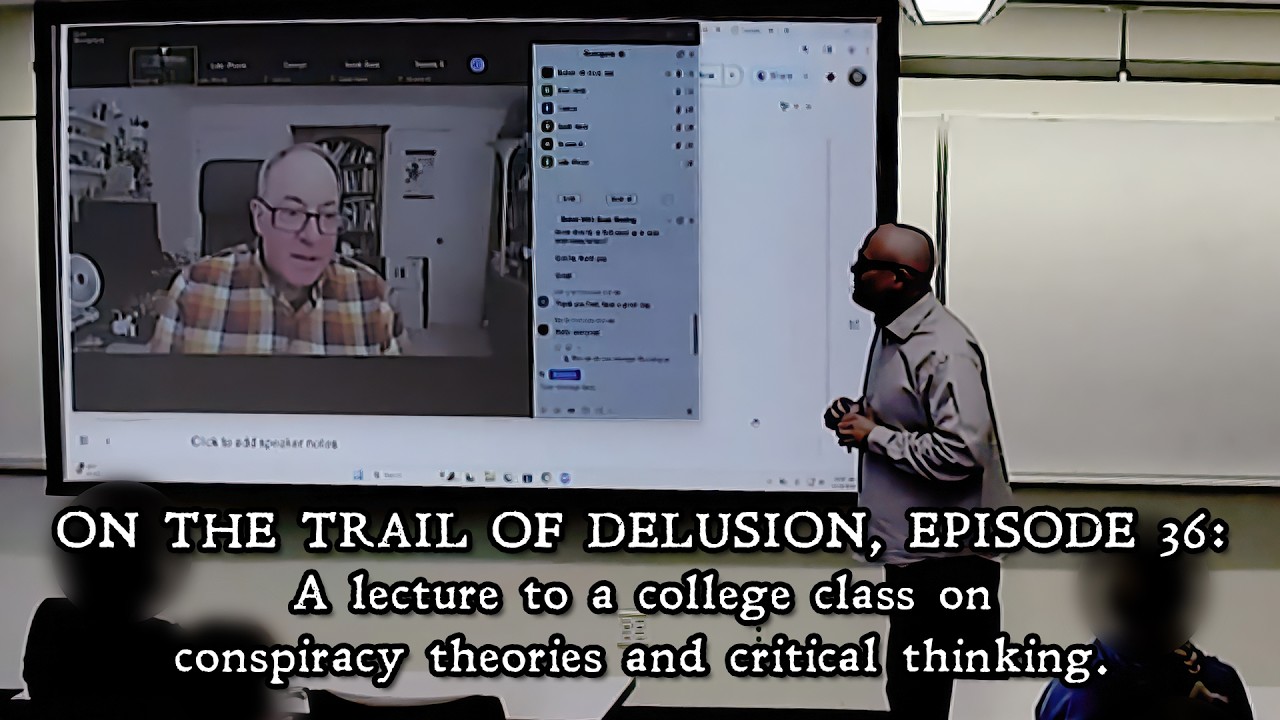
It was a ton of fun to present to Professor Robert Vitt's class at Long Beach City College. Professor Vitt was also a guest on Episode 30. Episode 30 Dr. Robert Vitt talks about conspiracy theories, the early JFK researchers, and how to evaluate evidence. Previous Episodes of On the Trail of Delusion: Episode 1 My first guest was Robert Reynolds who is an expert on the JFK assassination files. Episode 2 Robert A. Wagner discusses his new book, JFK Assassinated. Episode 3 Gerald Posner discusses the JFK assassination and conspiracy theories. Episode 4 Dr. Martin J. Kelly, Jr. discusses conspiracy theories and the medical evidence in the JFK assassination. Episode 5 Steve Roe discusses the life of General Edwin Walker and Oswald's attempt to kill him. Episode 6 Gus Russo discusses his participation in the PBS Frontline documentary on Lee Harvey Oswald. Episode 7 Dave Perry tells some great stories about debunking JFK conspiracy nonsense. Episode 8 Nick Nalli explains some of the science behind the assassination. Episode 9 Alecia Long discusses Jim Garrison and his non-existent case against Clay Shaw. Episode 10 Don Carpenter discusses the life of Clay Shaw. Episode 11 Bill Brown discusses the murder of Officer J. D. Tippit. Episode 12 Eric Dezenhall discusses the relationship between the mob and JFK. Episode 13 Nick Nalli discusses the acoustics evidence and the Zapruder Film. Episode 14 Scott Maudsley discusses Lee Harvey Oswald's antisocial personality disorder. Episode 15 Document expert Robert Reynolds discusses what to expect in the upcoming JFK assassination file releases. Episode 16 A panel discussion on the document releases with Fred Litwin, Gus Russo, Robert Reynolds, Larry Haapanen, Mark Allen, and Steve Roe. Episode 17 An interview with author Michel Gagné about conspiracy theories. Episode 18 An interview with Phil Tinline about his book, Ghosts of Iron Mountain. Episode 19 An interview with Janet Banister, grand-niece of Guy Banister. Episode 20 The Marina Oswald Tapes. Episode 21 Dr. Chad Zimmerman discusses JFK's autopsy X-rays and photographs. Episode 22 Tour guide Daniel Evans talks about his years of researching the JFK assassination. Episode 23 Adam Gorightly discusses Fred Crisman, Thomas Beckham, Raymond Broshears and Kerry Thornley. Episode 24 A fun interview with Larry Haapanen who discusses the Garrison investigation, and his involvement with Project Blue Book. Episode 25 Dale Myers discusses the Tippit shooting and shows us some nifty animation. Episode 26 Brian Roselle discusses the timing of the first shot. Episode 27 Dr. Martin J. Kelly, Jr. talks about the psychology of Lee Harvey Oswald and Jack Ruby. Episode 28 Gus Russo talks about what happened to Lee Harvey Oswald in Mexico City. Episode 29 John-Paul Pagano discusses conspiracy theories, conspiracism and antisemitism. Episode 30 Dr. Robert Vitt talks about conspiracy theories, the early JFK researchers, and how to evaluate evidence. Episode 31 Josh Sundloff discusses conspiracy theories and his TikTok channel. Episode 32 A panel discussion of the single-bullet theory with Dr. Martin Kelly, Dr. Nick Nalli, Fred James and Scott Maudsley. Episode 33 Ernest Kearney discusses conspiracy theories and how to evaluate evidence. Episode 34 Steve Barber discusses the acoustics evidence and his visits with Robert Groden. Episode 35 Assassination researcher John Corbett stops in to talk about the case.
- Paul Bleau Chokes, Part 5
Paul Bleau's first chokehold is that "the official record impeaches the Warren Commission." He believes that: (page 38 in the Kindle edition of his book Chokeholds) U.S. investigations into the assassination, statements made by investigation insiders and foreign government conclusions about the assassination prove that there is a strong consensus by the independent investigative authorities that there was a conspiracy in the murder of President John F. Kennedy. Bleau's chapter then lists out a variety of statements that seemingly prove conspiracy. Of course, Bleau doesn't tell readers the full truth about these viewpoints. U.S. House of Representatives Select Committee on Assassinations Bleau Assertion: Bleau includes a summary of the HSCA conclusions. He also makes the following points: Oswald and Ruby were not loners and "were involved in relationships that could have matured into a conspiracy." Oswald was connected to David Ferrie and Guy Banister, if not Clay Shaw. Jack Ruby was connected to the Mafia. Marina Oswald's "incriminating statements against her husband were found to be lacking in credibility." The HSCA believed Sylvia Odio. The Lopez Report "established that someone was impersonating Oswald." The Justice Department reinvestigation of the case only looked at the acoustical evidence, "which it rejected based on science, but that itself is also contested." What Bleau Doesn't Tell You: Bleau doesn't include this key finding of the HSCA: That's quite an omission, no? Here are some comments on his other assertions: I am not sure what Bleau is claiming when he says that Oswald and Ruby were "involved in relationships that could have matured into a conspiracy." That is probably true of most people, no? The HSCA found only that "there was at least a possibility that Oswald and Guy Banister were acquainted." Delphine Roberts, Banister's secretary, was the only witness who claimed that Oswald and Banister knew each other but the HSCA noted that "Because of such contradictions in Roberts' statements to the committee and lack of independent corroboration of many of her statements, the reliability of her statements could not be determined." Check out this blog post -- not one of Banister's employees ever saw Oswald. And David Ferrie was not connected with Oswald. The HSCA stated that "the evidence available to the committee indicated that Ruby was not a "member" of organized crime in Dallas or elsewhere." Bleau doesn't provide any specificity to his claims about Marina Oswald. For instance, the HSCA believed her testimony that Oswald told her about his attempt to kill General Walker. Even Vincent Bugliosi believed Sylvia Odio. So did Jean Davison who believed that Oswald was trying to infiltrate another anti-Castro group, perhaps to impress the Cubans in Mexico City. The Lopez report did not "establish" that Oswald was impersonated. The Lopez Report noted “While the majority of the evidence tends to indicate that [the individual who visited the Cuban consulate and Soviet embassy on the dates in question] was indeed Lee Harvey Oswald, the possibility that someone else used Lee Harvey Oswald’s name during this time in contacts with the Soviet and Cuban Consulates cannot be absolutely dismissed." Here is another view of the impersonation of Oswald. Bleau says that the rejection of the acoustical evidence "is also contested," but provides no details. The National Academy of Sciences' "Report of the Committee on Ballistics Acoustics" provided pretty clear evidence that the dictabelt tape did not capture the shots fired in Dealey Plaza. Here is a 1988 letter from the Department of Justice on the recommendations of the HSCA: Previous Relevant Blog Posts on Paul Bleau Paul Bleau Chokes, Part 4 Bleau leaves out some important details about a Warren Commission staffer. Paul Bleau Chokes, Part 3 Was Oswald a loner? Bleau says no, and then says yes. Paul Bleau Chokes, Part 2 Bleau leaves out some important details about Malcolm Kilduff. Paul Bleau Chokes An introduction to Paul Bleau's new book, Chokeholds. Paul Bleau on David Ferrie, the Pimp Was David Ferrie Clay Shaw's pimp? Paul Bleau and the IRS Man Did Lee Harvey Oswald have an escort? Paul Bleau and the Forger Edward Girnus was in prison for forgery, and he told a fanciful story about Clay Shaw and Lee Harvey Oswald. Paul Bleau and the Three Tramps Leander D'Avy told the HSCA he saw Oswald and Ferrie with the three tramps. Paul Bleau's Reign of Error Bleau's analysis of Garrison's files is full of errors. Paul Bleau's Plots Bleau believes there were seven plots against JFK before Dallas. Paul Bleau and the Supposed Chicago Plot Against JFK Bolden's allegation that there was a plot against JFK in Chicago has changed over the years. "JFK: Destiny Betrayed" Misleads on Supposed Tampa 'Patsy' There is no evidence that there was a plot against JFK in Tampa. "JFK Revisited" Misleads on the Supposed Chicago Plot There is no evidence that there was a plot against JFK in Chicago.